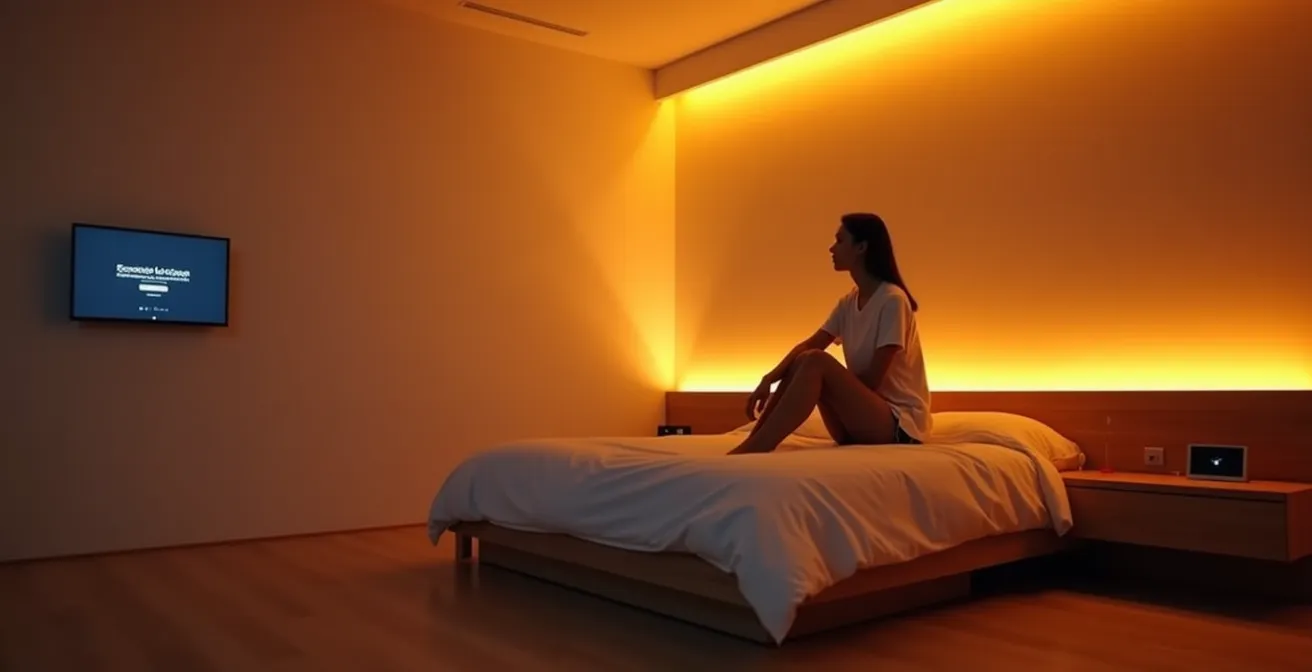
Your smart lights are likely making your sleep worse, not better, by disrupting your body’s natural hormonal signals.
- The key is to treat light as a biological signal, programming its color and intensity to match the sun’s natural 24-hour cycle.
- A resilient technical architecture—using dedicated networks and compatible device protocols—is non-negotiable for the system to work reliably.
Recommendation: Audit your home’s light sources and smart device protocols to build a true circadian lighting system, not just a collection of gadgets.
If you’re an insomniac or a biohacker, you’ve likely invested in smart technology with the promise of a better night’s sleep. You’ve set your lights to dim in the evening and turn off at bedtime. Yet, restful, deep sleep remains elusive. The common advice—use warm lights and avoid screens—scratches the surface but often fails because it ignores the fundamental nature of the problem. Your body doesn’t just see light; it interprets it as a powerful hormonal signal that governs your internal clock, the suprachiasmatic nucleus (SCN).
The issue isn’t just about brightness or a single color. It’s about a 24-hour “temporal light recipe” that either aligns with or fights against millions of years of biological programming. Most smart home setups are a chaotic mix of disconnected signals, sending confusing messages to your brain and sabotaging the very sleep you’re trying to optimize. The solution isn’t another gadget; it’s a paradigm shift. You must stop thinking like a consumer and start thinking like a biological engineer, designing a home environment where the technological architecture serves a precise biological purpose.
This guide moves beyond generic tips to provide a blueprint for this project. We will deconstruct the science of how light programs your hormones and then build, piece by piece, the robust technical framework required to deliver that light signal with flawless precision. From network protocols to sensor ecology, you will learn to orchestrate your home’s lighting not for simple convenience, but for profound biological impact.
This article provides a comprehensive roadmap for transforming your home into a high-performance sleep environment. The following sections will guide you through the biological principles, security applications, and critical technological choices needed to build an effective automated lighting system.
Summary: A Guide to Mastering Circadian Lighting
- Why Blue Light at Night Destroys Your Melatonin Production?
- How to Program Lights to Mimic Presence When You Are Away?
- Smart Bulbs or Smart Switches: Which Is Cheaper for Whole-Home Control?
- The Wi-Fi Mistake That Makes Smart Bulbs Unresponsive
- Problem and Solution: Placing Sensors to Trigger Lights Without Waving Your Arms
- Why Certain Color Palettes Sell Faster Than Others in Modern Art?
- How to Choose Projectors for Mapping Without Blowing the Budget?
- The Ecosystem Error: Buying Smart Technology That Doesn’t Talk to Your Hub
Why Blue Light at Night Destroys Your Melatonin Production?
To engineer your sleep, you must first understand the mechanism you’re targeting. Your sleep-wake cycle is governed by melatonin, a hormone produced by the pineal gland. Its release is controlled by your master internal clock, the suprachiasmatic nucleus (SCN), which takes its primary cue from light detected by your retinas. Specifically, photons of light—especially those in the blue spectrum—strike intrinsically photosensitive retinal ganglion cells (ipRGCs). These cells send a direct signal to the SCN, effectively saying, “It’s daytime; stay awake and suppress melatonin production.”
The problem with modern life is the constant, ill-timed exposure to this signal. The blue-enriched light from screens, LEDs, and standard smart bulbs sends a powerful “daytime” alert to your brain long after the sun has set. This artificially extends the “day” for your SCN, delaying and diminishing the crucial evening surge of melatonin needed to initiate sleep. In fact, compelling research has demonstrated that blue light exposure for 6.5 hours can suppress melatonin for about twice as long as green light, highlighting its potent biological effect. It’s a direct hormonal intervention, and your body responds accordingly by remaining in a state of alert wakefulness.
The solution is not just dimming the lights but curating the spectrum. A precisely programmed “light recipe” must transition from blue-enriched light in the morning to energize you, to neutral light in the afternoon, and finally to warm, amber, or red-toned light in the evening. This mimics the natural progression of sunlight and sends the correct temporal signals to your SCN, allowing melatonin to rise unimpeded. As a case study in a nursing home found, older adults exposed to such circadian-aligned lighting experienced significantly fewer sleep disturbances, proving the practical power of managing light as a biological signal.
| Light Type | Color Temperature | Melatonin Impact | Best Time of Use |
|---|---|---|---|
| Blue-enriched | 5000K-6500K | Maximum suppression | Morning/Noon |
| Neutral white | 3500K-4500K | Moderate suppression | Afternoon |
| Warm white | 2700K-3000K | Minimal suppression | Evening |
| Amber/Red | 1800K-2200K | No suppression | Night/Sleep |
Understanding this principle is the first step in reclaiming control over your internal clock from the chaotic inputs of modern lighting.
How to Program Lights to Mimic Presence When You Are Away?
Beyond biological optimization, automated lighting serves a crucial security function. However, the common “vacation mode” on many smart apps is often simplistic and predictable, turning lights on and off at the same time every day. This creates a pattern that is easy for a determined observer to spot. A truly effective system doesn’t just illuminate rooms; it creates a believable illusion of life by simulating the natural, slightly chaotic patterns of human habitation. This requires moving beyond simple timers to programmatic sequencing.
The goal is to script a story of occupancy. Your programming should reflect a typical evening: lights come on in the living room, later join in the kitchen for a brief period, then extinguish in the common areas as a bedroom light turns on. The key to realism lies in the details. Transitions should not be instantaneous; programming a 5-10 minute overlap as lights in one room fade while another brightens suggests movement. Most importantly, your system must incorporate randomized variations. By adding a random offset of ±15 to 30 minutes to each event, you break the predictable cycle that makes basic automation so transparent.
This automated choreography can be made even more convincing by integrating other devices. A smart plug can be programmed to turn on a radio or television at a low, muffled volume during the evening hours, adding an auditory layer to the visual illusion. Distinguishing between weekday and weekend patterns further enhances realism. This level of detail transforms a simple on/off schedule into a dynamic performance that presents a convincing portrait of an occupied, secure home.
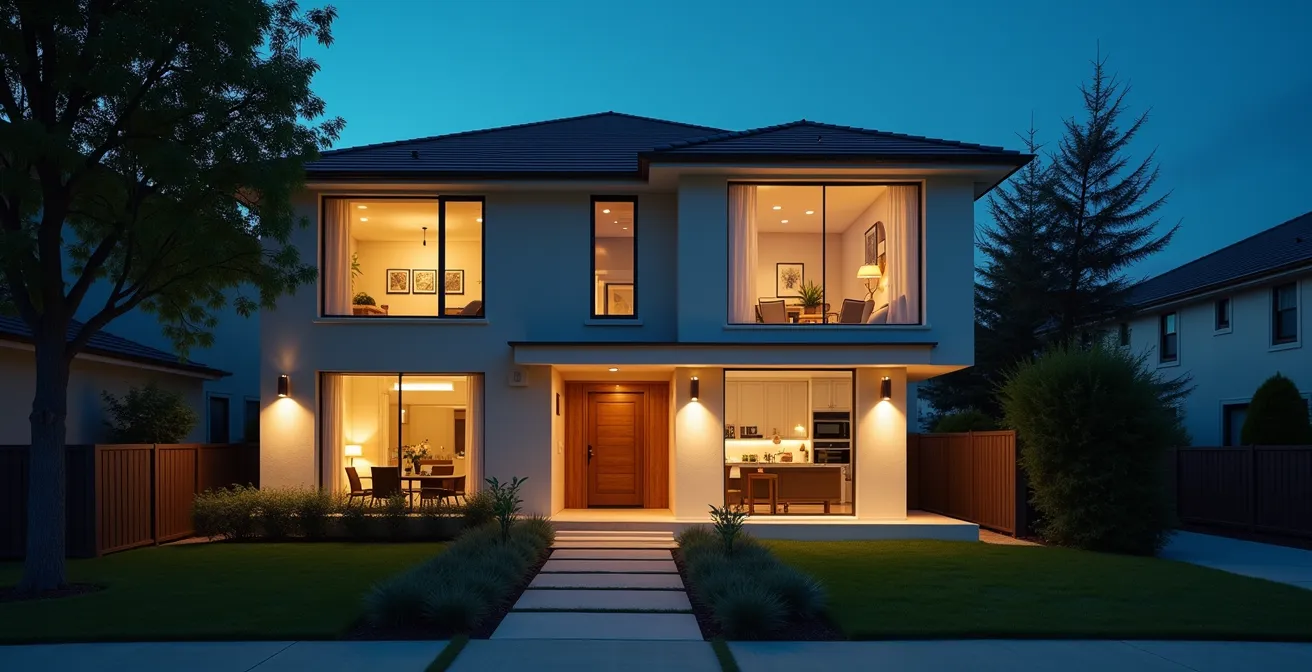
By treating your security lighting as a form of stagecraft, you create a far more robust deterrent than any simple timer could provide.
Smart Bulbs or Smart Switches: Which Is Cheaper for Whole-Home Control?
Building the physical layer of your lighting architecture presents a fundamental choice: control the light at the source (smart bulbs) or at the wall (smart switches). This isn’t just a matter of preference; it’s a strategic decision with long-term implications for cost, functionality, and reliability. For a biohacker focused on whole-home control, analyzing the total cost of ownership and system capabilities is critical.
Smart bulbs offer the lowest barrier to entry and the highest degree of flexibility. They are perfect for renters and for creating specific “scenes” with full color control, which is essential for a circadian light recipe. However, their primary weakness is the “switch problem”: if someone manually flips the wall switch off, the bulb loses power and becomes unresponsive. Furthermore, each bulb consumes a small amount of standby power, which can add up across dozens of devices in a home.
Smart switches, by contrast, are a more permanent and architecturally sound solution. They are generally more reliable as they are always powered and work like a normal switch even if your Wi-Fi is down. While they lack the individual color-changing ability of bulbs, they are ideal for controlling fixtures with multiple small bulbs (like chandeliers or track lighting), where replacing each one would be prohibitively expensive. Installation is more involved and may require an electrician, but the per-unit cost can be lower when controlling multiple lights. A hybrid approach often provides the best of both worlds: using smart switches for general room lighting and adding smart bulbs only in key areas where color control is paramount, such as bedside lamps or a home office.
The following table, based on data from consumer analysis, breaks down the trade-offs for a typical 10-room home setup. While a thorough analysis from a source like Consumer Reports provides deep insights, the choice ultimately depends on your specific architectural needs.
| Factor | Smart Bulbs | Smart Switches | Hybrid Approach |
|---|---|---|---|
| Initial Cost (10 rooms) | $130-550 | $200-400 | $150-350 |
| Standby Power/Year | $12-24 | $8-15 | $10-18 |
| Works Without Internet | No | Yes (manual) | Mixed |
| Color Control | Yes | No | Selected rooms |
| Installation | DIY instant | Electrician needed | Mixed |
| Best For | Renters, color scenes | Permanent homes | Maximum flexibility |
Ultimately, the most resilient and cost-effective system is rarely one-size-fits-all, but rather a carefully considered hybrid tailored to your home’s unique layout and your biological goals.
The Wi-Fi Mistake That Makes Smart Bulbs Unresponsive
You’ve programmed the perfect circadian light recipe, but it’s useless if your bulbs are frequently “unresponsive” in your app. This common frustration is rarely the fault of the bulb itself. Instead, it’s a symptom of a critical architectural error: treating your smart devices like any other computer on your network. Your home’s Wi-Fi network, particularly the crowded 2.4GHz band that most IoT devices use, is a shared resource. Laptops, phones, streaming devices, and dozens of smart bulbs are all competing for limited bandwidth and router attention.
This competition leads to packet loss and connection dropouts, causing the infamous unresponsiveness. The more Wi-Fi-based smart devices you add, the worse the problem becomes. You are not building a network; you are creating digital gridlock. For a system that needs to reliably deliver precise light signals at specific times, this is an unacceptable point of failure. The solution is to create a dedicated, isolated network specifically for your IoT devices, treating it like a separate utility.
An even more robust solution is to move away from Wi-Fi for lighting altogether and embrace a dedicated mesh protocol like Zigbee or Z-Wave. In these networks, each powered device (like a bulb or switch) acts as a repeater, strengthening the network with every device you add. Instead of competing for a central router’s attention, they create a resilient, self-healing web. As a case study from home automation enthusiasts shows, switching from Wi-Fi to a Zigbee mesh for a system with over 50 bulbs completely resolved chronic unresponsiveness issues. This is the difference between a collection of gadgets and a true smart home nervous system.
By building a resilient network, you ensure that your carefully crafted light recipe is delivered flawlessly, every single day, without fail.
Problem and Solution: Placing Sensors to Trigger Lights Without Waving Your Arms
True automation creates an environment that anticipates your needs, not one that forces you to perform for it. The classic frustration of waving your arms in a bathroom to keep the lights on is a clear sign of a poorly designed “sensory ecology.” This happens when automations rely solely on basic Passive Infrared (PIR) motion sensors. PIR sensors are effective for detecting large movements in transitional spaces like hallways, but they are blind to the micro-movements of a person sitting still, reading a book, or working at a desk.
To create a truly responsive home, you must graduate from motion detection to presence detection. This requires deploying more advanced sensor technology. Millimeter-wave (mmWave) sensors are a game-changer in this domain. They work like miniature radar systems, capable of detecting subtle movements like breathing or the turn of a page. By placing an mmWave sensor in a living room or office, you can create an automation that keeps the lights on as long as a person is physically present in the room, regardless of their activity level. This eliminates the need for frustrating arm-waving and creates a seamless experience.
The most sophisticated systems use a strategy of sensor fusion, combining multiple inputs for a more accurate picture of occupancy. For instance, an automation for entering a room might be triggered instantly by a door/contact sensor, kept active by an mmWave presence sensor, and finally turned off after a delay only when both the presence sensor and a PIR sensor at the exit detect no one. This multi-layered approach creates a zero-lag, highly reliable system that feels intuitive and intelligent. Choosing the right sensor for the right job is as crucial as choosing the right light bulb.
| Sensor Type | Detection Method | Range | Best Use Case | Limitations |
|---|---|---|---|---|
| PIR Motion | Heat movement | 5-7m | Hallways, entrances | Requires visible movement |
| mmWave Presence | Micro-movements | 8-10m | Offices, living rooms | Higher cost, complex setup |
| Door/Contact | Open/close trigger | 2cm gap | Instant entry lighting | Single trigger point |
| Combined Sensors | Multiple inputs | Varies | Zero-lag automation | Requires integration |
By building a rich and accurate sensory ecology, you create an environment that adapts to you, not the other way around.
Why Certain Color Palettes Sell Faster Than Others in Modern Art?
The biological principles of light that govern your sleep cycle have far-reaching implications, extending even into the realm of aesthetics and consumer psychology. The way our brains are programmed to respond to the color temperature of light for survival—alertness under the cool blue sky of midday, calm during the warm red of sunset—creates deep-seated preferences that influence our perception of value and beauty. This is subtly reflected in the art market, where the emotional resonance of a color palette can impact its commercial velocity.
Consider two abstract paintings. One is dominated by a palette of vibrant cyans, cool whites, and sharp, energetic lines. The other is suffused with deep ochres, warm ambers, and soft, blended forms. The former evokes feelings of energy, clarity, and daytime activity. It’s intellectually stimulating and resonates with our biological state of peak alertness. The latter taps into our programming for evening and rest, evoking feelings of comfort, intimacy, and calm. Neither is inherently “better,” but they appeal to different emotional and biological states.
Art that sells quickly often aligns its color palette with the desired emotional response of its target environment. A piece destined for a corporate lobby might succeed with a cool, energetic palette that promotes focus and dynamism. A piece for a residential living room or bedroom may find a broader audience with a warm, calming palette that aligns with our innate desire for a restful sanctuary. This isn’t about chasing trends, but about understanding that color is a form of non-verbal communication that speaks directly to the most ancient parts of our brain. The artist who intuits this—or the collector who feels it—is tapping into the same circadian mechanism you are engineering for your sleep.
The same light signals that can either disrupt or enhance our sleep can also make a piece of art feel either jarringly out of place or perfectly, inexplicably “right.”
How to Choose Projectors for Mapping Without Blowing the Budget?
For the ultimate biohacker or light architect, static bulbs and switches are merely the beginning. The next frontier in environmental control is to move from illuminating a space to literally “painting” it with light. This is where projection mapping comes in. Instead of a few fixed points of light, a projector can wash an entire wall with a dynamic, precisely controlled “lightscape.” Imagine a basement office without windows, where the main wall subtly transitions from a cool, bright 6500K morning light to a warm, 2200K amber sunset over the course of your workday. This is not just lighting; it is a full-scale environmental and biological intervention.
Historically, projection mapping has been the domain of artists and commercial installations with massive budgets. However, the decreasing cost and increasing brightness of consumer and prosumer projectors have made this technology accessible for ambitious home projects. The key to doing this on a budget is to prioritize the right specifications. You don’t need a 4K, cinema-grade projector. Instead, focus on three critical metrics: lumens (brightness), throw ratio, and connectivity.
For most indoor applications, a projector with 2,000-3,000 ANSI lumens is sufficient to create a powerful effect, even in a room with some ambient light. The throw ratio determines how large an image you can create from a certain distance; a “short-throw” projector is ideal for smaller rooms where you need a large image without placing the projector far away. Finally, ensure the projector has reliable connectivity options (like HDMI and network control) that can integrate with smart home automation platforms. By focusing on these core features and opting for a 1080p model from a reputable but not top-tier brand, you can acquire the tools for large-scale light painting for a fraction of the cost of professional systems.
With the right equipment, you can move beyond simple circadian lighting and begin designing a truly dynamic and responsive biological environment.
Key Takeaways
- Blue light is a powerful drug; its timing dictates your sleep quality by controlling melatonin.
- A reliable circadian lighting system depends more on a robust network architecture (protocols, dedicated networks) than on the brand of the bulb.
- True automation relies on presence, not motion. Use the right sensors to create a home that responds to you, not just your movements.
The Ecosystem Error: Buying Smart Technology That Doesn’t Talk to Your Hub
The single greatest mistake in building a smart home is the ecosystem error: purchasing devices from various brands that cannot communicate with each other. This creates a fragmented system of “digital islands” where your Philips bulbs can’t be triggered by your Wyze sensor, and your routine is managed across three different apps. This is the antithesis of the seamless, orchestrated environment required for a true circadian system. Your home’s nervous system is fractured, and the overall intelligence of the system is crippled.
The solution lies in a commitment to protocol-level thinking. Instead of focusing on brands, you must focus on the underlying communication standards that allow devices to interoperate. For years, this required choosing a single protocol like Zigbee or Z-Wave and sticking to it. However, a new universal standard is changing the game. As highlighted by integration experts, this new protocol is a critical development. As CEDIA Integration Specialists state in their guide, “Circadian Lighting & Wellness in The Smart Home”:
Matter is a game-changer for interoperability. Advise readers to prioritize buying Matter-certified devices to ensure long-term compatibility.
– CEDIA Integration Specialists, Circadian Lighting & Wellness in The Smart Home
For the biohacker who demands ultimate control and wants to integrate existing, non-compatible devices, a universal bridge is the answer. Open-source platforms like Home Assistant can act as a central hub, using inexpensive hardware to speak multiple protocols (Wi-Fi, Zigbee, Z-Wave) and unify them under a single control interface. A case study from the Home Assistant community shows a user successfully integrating Philips, IKEA, and generic Tuya bulbs into one seamless circadian system. This approach requires more technical setup but provides unparalleled power and frees you from being locked into any single corporate ecosystem.
Your Action Plan: Auditing Your Smart Home for Ecosystem Cohesion
- Contact Points: Make a complete list of all your smart devices, including bulbs, switches, plugs, sensors, and hubs.
- Protocol Inventory: For each device, identify its primary communication protocol (e.g., Wi-Fi, Zigbee, Z-Wave, Bluetooth, Matter) by checking its specifications.
- Cohesion Check: Draw a map showing which devices can communicate directly with your central hub. Identify any “communication islands” that require a separate app.
- Reliability vs. Simplicity: Evaluate the performance of your Wi-Fi devices versus any mesh network devices (Zigbee/Z-Wave). Note any devices that are frequently unresponsive.
- Integration Roadmap: Prioritize replacing or bridging isolated devices. For all future purchases, make compatibility with your central hub or the Matter protocol a non-negotiable requirement.
Building a cohesive ecosystem is the final and most critical step. It ensures that your entire environmental architecture works as a single, intelligent organism programmed to support your biology.