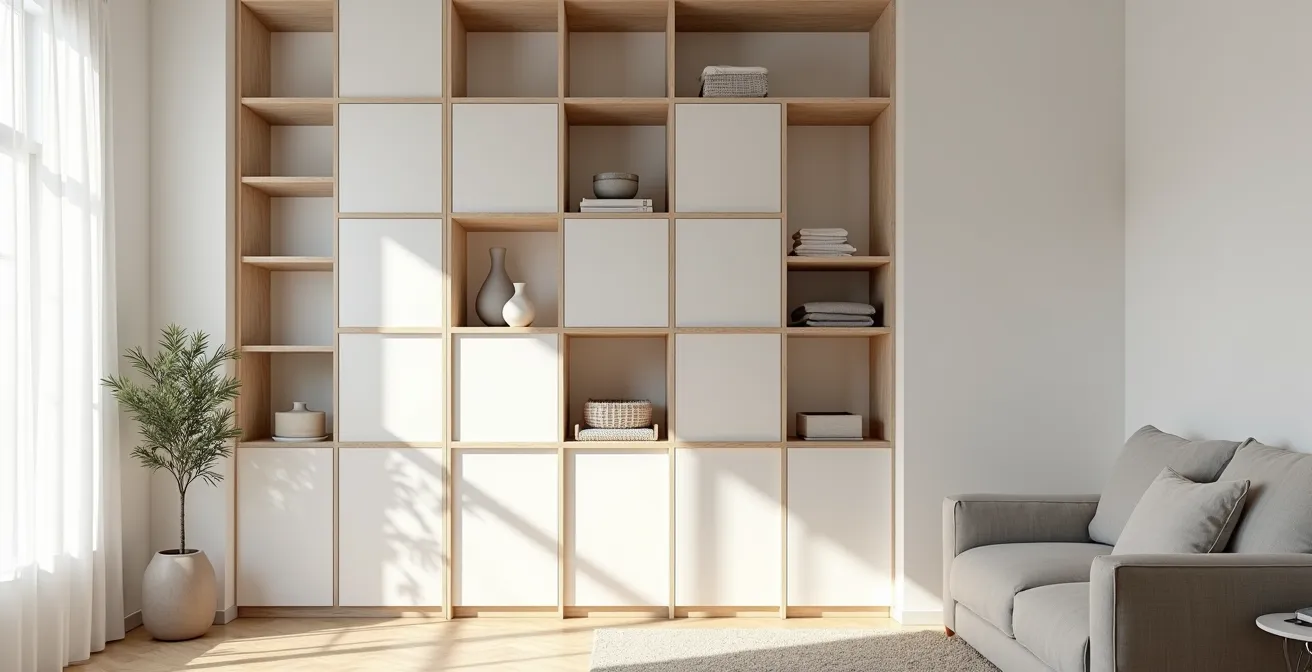
In summary:
- Solve storage shortages by utilizing vertical space instead of consuming valuable floor area.
- Treat storage as a flexible, adaptable system that can be reconfigured as your needs change or when you move.
- Use the physical limits of modular containers to guide decluttering decisions and prevent future accumulation.
- Combine different modular types to conquer awkward spaces and create multi-functional rooms.
Living in a small apartment presents a universal challenge: the constant battle for space. For renters, this is compounded by the inability to make permanent changes. The default solution often involves a reactive scramble for more bins or shoving items into already overflowing closets. This approach only masks the problem, leading to a home that feels more like a storage locker than a sanctuary. We’re often told to “declutter” or “buy organizers,” but this advice rarely addresses the root issue.
The real problem isn’t just the amount of stuff we own; it’s the absence of a coherent storage philosophy. We treat storage as an afterthought, a collection of disparate containers, rather than what it should be: an intentional, integrated system. This system shouldn’t just hold your belongings; it should liberate your living area, be flexible enough to move with you, and adapt to your evolving life.
What if the key wasn’t just adding more shelves, but rethinking the very geometry of your space? The solution lies in adopting a modular mindset. It’s about designing a storage system that works with you, not against you, by treating every cubic inch as a strategic asset. This guide will walk you through the principles of modular storage, transforming your approach from chaotic accumulation to orderly, spatial freedom.
This article provides a complete roadmap for renters to reclaim their space. We will explore why vertical thinking is superior, how to master tricky corners, choose the right materials, and avoid common organizational pitfalls. By the end, you will have a clear strategy to double your effective storage and create a home that feels spacious and serene.
Summary: A Renter’s Guide to Modular Storage Systems
- Why You Should Build Up, Not Out, in Small Rooms?
- How to Configure Cube Storage for Weirdly Shaped Corners?
- Wire Shelving or Solid Wood: Which Holds Heavy Items Best?
- The “Open Shelving” Mistake That Makes Rooms Look Messy
- When to Purge Items Before Buying New Storage Containers?
- Problem and Solution: Removing Trunk Clutter to Gain Mileage
- Problem and Solution: Migrating from No-Code to Custom Code at Scale
- How to Design a Transforming Space That Functions as Both Office and Guest Room?
Why You Should Build Up, Not Out, in Small Rooms?
In any small living space, the most valuable commodity is the floor. Every square foot taken up by a wide, low piece of furniture is a square foot lost for living. The fundamental shift in thinking is to stop seeing your room as a two-dimensional floor plan and start seeing it as a three-dimensional volume. Building “out” consumes your living area, making a room feel cramped and difficult to navigate. Building “up” leverages the often-ignored vertical plane, drawing the eye upward and creating an illusion of height and openness.
This isn’t just a design trick; it’s a strategic response to a widespread issue. The sheer demand for space is evidenced by data showing that over 11% of U.S. households rent off-site storage units, effectively paying a premium for space they lack at home. By embracing verticality with tall, narrow modular units, you reclaim that value within your own walls. These units have a minimal physical footprint but offer a massive increase in storage capacity, turning an empty wall into a highly functional spatial asset.

As you can see, floor-to-ceiling shelving not only provides immense storage but also forces the eye to travel upward, enhancing the perceived height of the room. This psychological effect is key to making a small space feel liberating rather than restrictive. A tall, slender unit feels less imposing than a bulky, wide credenza, even if it holds twice as much. For renters, this strategy is perfect as it requires no permanent installation and maximizes the potential of the existing architecture.
How to Configure Cube Storage for Weirdly Shaped Corners?
Every apartment has them: the awkward corner, the small nook next to a doorway, the space under a slanted ceiling. These areas often become “dead zones” because standard, one-size-fits-all furniture simply doesn’t work. This is where the true power of a modular DNA shines. Instead of searching for a single perfect piece, you can build one by combining smaller, standardized units to fit an irregular space precisely.
Cube storage is the quintessential tool for this task. Systems like IKEA’s EKET demonstrate this perfectly; by combining cubes of different dimensions, users can create L-shaped or stepped configurations that hug the contours of a corner. This transforms an unusable void into a high-capacity storage hub. For renters, the advantage is twofold: it solves a unique spatial problem without custom carpentry and the entire system can be disassembled and reconfigured in a new home.
When selecting a system, it’s crucial to consider not just size, but adaptability and material. Some systems offer specific corner connectors, while others rely on simple stacking. The following table provides a starting point for comparing popular options suitable for renters.
| System | Price Range | Corner Adaptability | Material |
|---|---|---|---|
| IKEA LIXHULT | $170 combo | Outside corner cabinet option | Metal/Particle board |
| Muuto Stacked | $300-500/module | Angular clips for stability | MDF/Oak veneer |
| West Elm Industrial | $200-400/unit | Metal frames, flexible layout | Metal/Wood |
| Container Store Cubes | $50-150/cube | Stackable, various sizes | Wire/Laminate |
As this comparative analysis for corner solutions suggests, the market offers a range of choices in both price and style. The key is to measure your awkward space first, then design a configuration on paper before purchasing. This ensures you buy only the modules you need to create a bespoke fit.
Wire Shelving or Solid Wood: Which Holds Heavy Items Best?
Once you’ve decided on a modular approach, the next critical decision is material. This choice directly impacts what you can store and where. For renters planning to store heavy items like books, kitchen appliances, or record collections, understanding the load-bearing capabilities of wire versus wood is essential. It’s a trade-off between airflow, aesthetics, and pure structural strength.
Solid wood is the undisputed champion for heavy loads. With proper wall mounting into studs, a solid wood shelf can often handle 100 pounds or more per linear foot. Its rigid structure distributes weight evenly, preventing the sagging that plagues weaker materials. Wire shelving, while excellent for visibility and preventing dust accumulation in closets or pantries, has inherent weak points at its welds. Its capacity is typically lower, often around 50 pounds per linear foot, and weight must be distributed carefully to avoid bending the mesh.

This close-up view reveals the fundamental difference: wood provides continuous support, while wire creates concentrated stress points. For a renter’s flexible system, a hybrid approach is often best. Use robust wooden modular units for your “library” or media center, and employ wire systems inside closets or for lighter goods. To ensure safety and longevity, always follow these material-specific guidelines:
- For particleboard shelving, a common budget-friendly option, prevent sagging by adding vertical supports every 30 inches.
- If using wire shelving for medium-weight items, inspect the weld points monthly for any signs of stress or bending.
- When mounting any heavy-duty shelving, always use a stud finder to locate secure anchoring points in the wall.
- In cases where studs are not available, use toggle bolts rated for at least 75 pounds to secure shelves safely in drywall.
The “Open Shelving” Mistake That Makes Rooms Look Messy
Open shelving is a popular feature in modern apartments, celebrated for its airy, accessible feel. However, it can quickly become the epicenter of visual chaos. The most common mistake is treating open shelves as a dumping ground for anything and everything, failing to distinguish between functional storage and aesthetic display. Without a clear organizational strategy, these shelves amplify clutter, making an entire room feel messy and stressful. This is a problem of what we can call visual volume—the perceived space an object or collection of objects occupies.
The solution is to curate your open shelves with the same intentionality as an art gallery. It’s not about hiding everything, but about creating a balanced composition of function, decoration, and empty space. An effective guideline is the 60/30/10 principle, which provides a clear framework for shelf styling.
A balanced shelf should be composed of 60% functional storage, 30% key decorative items, and 10% negative space.
– Interior Design Principle, IKEA Storage Ideas for Small Spaces
This rule transforms a cluttered shelf into a structured display. The “functional storage” component is key: by grouping smaller, less attractive necessities into identical, opaque boxes, you turn visual noise into clean, geometric blocks. The “decorative items” are your chance to inject personality, while the “negative space”—the empty gaps—is crucial for allowing the composition to breathe. It prevents the overwhelming feeling of a wall-to-wall clutter.
Your Action Plan: Auditing Open Shelving for Visual Calm
- Points of Contact: Identify all open shelving units in the room. These are your primary sources of visual noise.
- Collect: Inventory every item currently on the shelves. Group them into categories: books, decor, practical items, and pure clutter.
- Coherence: Confront the collection with a defined aesthetic. Choose a strict three-color palette for all visible items and identify objects that clash.
- Memorability & Emotion: Apply the 60/30/10 rule. Designate your most meaningful objects as the 30% decorative focus. Everything else is either functional (60%) or must be removed.
- Plan for Integration: Create a plan to acquire uniform boxes for functional items, rearrange decor to create visual breathing room (the 10% negative space), and re-home clashing or unnecessary objects.
When to Purge Items Before Buying New Storage Containers?
The conventional wisdom on organizing is clear: declutter first, then buy storage to fit what remains. While logical, this approach has a hidden flaw. Without a physical container to provide limits, the decluttering process can be abstract and endless. We tend to overestimate how much we need to keep. This often results in buying too much—or the wrong kind of—storage after the fact. A more effective, if counter-intuitive, strategy is to reverse the process.
This is the “container-first” method. It involves purchasing a modular storage unit with a fixed volume *before* you begin the final purge. This unit becomes your set of intentional boundaries. The rule is simple: if an item is worth keeping, it must earn its place within the new system. If it doesn’t fit, it goes. This physical limitation transforms an emotional decision (“Do I love this enough?”) into a practical one (“Is this more important than something else that could fit here?”). It forces ruthless prioritization.
Case Study: The Container-First Decluttering Method
NYC apartment dweller Laura Peruchi, struggling with limited space, implemented this reverse approach by first acquiring a buffet cabinet with a defined capacity. As documented on her blog, having the physical container present made sorting far more decisive. Items were evaluated based on whether they fit the designated space, which streamlined the removal process. This tactic prevented the common error of misjudging storage needs. The result was a reported 30% greater reduction in retained items compared to her previous attempts with traditional declutter-first methods.
This method turns storage from a passive receptacle into an active tool for curation. For a renter, this is incredibly empowering. You define the physical footprint of your belongings, ensuring your possessions serve your lifestyle, not the other way around. It’s the ultimate way to ensure your storage system creates freedom, not just more places to hide things.
Problem and Solution: Removing Trunk Clutter to Gain Mileage
While the phrase might evoke a car, the principle of “trunk clutter” applies powerfully within our homes. In this context, the “trunk” is any large, single-purpose storage piece: a hope chest, a deep ottoman, or an oversized cabinet. These items promise vast storage but often become chaotic catch-alls—deep, dark voids where items get lost and forgotten. The problem is a lack of internal organization and accessibility. You only see the top layer, and everything beneath is effectively gone.
The solution is to trade this inefficient volume for accessible, modular components. The “mileage” you gain is not in fuel, but in spatial efficiency and usability. Imagine emptying a large storage trunk. You could likely replace its entire contents into a vertical stack of clear, labeled, pull-out modular drawers that occupy half the physical footprint. You’ve not only saved floor space but also made every single item visible and instantly accessible.
Breaking down the “trunk” into a storage as a system of smaller, dedicated modules solves several problems at once:
- Visibility: You can see what you own, preventing you from buying duplicates.
- Accessibility: You don’t have to dig through layers of items to find what you need.
- Categorization: Each module can be assigned a specific category (e.g., “winter accessories,” “craft supplies”), enforcing order.
This approach is ideal for renters. Instead of moving one massive, heavy trunk, you move a collection of light, manageable modules that can be reconfigured to fit a new space. You’re replacing a single point of failure with a resilient, adaptable system.
Problem and Solution: Migrating from No-Code to Custom Code at Scale
In the world of technology, individuals and businesses often start with simple, “no-code” tools—easy, off-the-shelf solutions that get the job done. As their needs grow more complex (“at scale”), they migrate to “custom code” for more power and flexibility. We can apply this exact same logic to our home storage strategy. Many of us start with a “no-code” approach: an assortment of unrelated plastic bins and random baskets bought on impulse. This system works for a while, but it’s inefficient and doesn’t adapt as our lives change.
The “custom code” of storage is a true modular system. It’s not about being a DIY expert; it’s about making a conscious decision to adopt a single, coherent system (like IKEA’s KALLAX, Elfa’s shelving, or The Container Store’s Avera) and designing a personalized layout. This is your “source code”—a flexible framework you can add to, subtract from, and reconfigure over time. This migration is about moving from a reactive to a proactive mindset.
Migrating “at scale” for a renter means planning for change. When you move from a studio to a one-bedroom, or when a hobby requires more space, your storage should scale with you. A “no-code” collection of mismatched bins becomes a moving-day nightmare. A “custom code” modular system, however, can be easily disassembled and re-deployed in a new configuration in your next home. You’re not just buying containers; you’re investing in an infrastructure for your belongings. This system provides a stable, predictable framework for your life, regardless of the apartment you inhabit.
Key takeaways
- Think Vertically: Always prioritize height over width to preserve precious floor space and create a sense of openness.
- Embrace Systemic Thinking: View your storage not as individual containers, but as an interconnected and adaptable system that can evolve with your life.
- Let Containers Define Boundaries: Use the fixed volume of your chosen storage to make decisive decluttering choices and maintain long-term order.
How to Design a Transforming Space That Functions as Both Office and Guest Room?
The ultimate test of a modular storage system is its ability to create a multi-functional space. For renters in small apartments, the dream of having a separate home office and a guest room is often out of reach. However, by combining smart furniture with a flexible storage strategy, you can design a single room that effortlessly transforms to serve both functions. This is where all the principles we’ve discussed—verticality, modularity, and accessibility—converge.
The key is to choose anchor furniture that transforms. A Murphy bed that folds up to reveal a desk is a classic example. Modern solutions documented by storage experts show that such setups can result in a massive 70% space saving compared to traditional furniture, with transformation taking less than two minutes. The storage around this central piece must be equally adaptable. Open shelving can hold office supplies during the day and be quickly styled with guest amenities (a water carafe, a small plant) when visitors arrive.
Mobile modular units on casters are invaluable here. A set of drawers that holds work files can be rolled into a closet, while a cart with guest towels and toiletries can be rolled out. The goal is to make the transition between “office mode” and “guest mode” as frictionless as possible. The following table compares options for achieving this flexibility.
| Solution Type | Transformation Time | Storage Capacity | Best For |
|---|---|---|---|
| Modular cubes on casters | 30 seconds | Medium | Daily transitions |
| Platform bed with storage | No transformation | High | Permanent guest setup |
| 5×5 KALLAX divider | 5 minutes to style | Very High | Zone separation |
| Murphy desk/bed combo | 2 minutes | Low-Medium | True dual-purpose |
By designing a transforming space, you are not just doubling your storage; you are doubling the functionality of your square footage. It is the ultimate expression of living large in a small space, proving that thoughtful design, not size, is what truly defines a home.
Now that you have the complete framework for a modular storage system, the next logical step is to begin planning. Start by measuring your spaces, auditing your belongings, and designing the system that will liberate your home.
Frequently Asked Questions about Problem and Solution: Doubling Storage in Small Apartments Using Modular Units
Should I measure before buying modular storage?
Yes, absolutely. Measure your space, but also measure your existing items. You should allocate storage based on categories. As a rule of thumb from experts at leading storage solution providers, if you cannot assign a specific purpose to at least 75% of the new storage space immediately, you should reconsider the purchase.
What’s the ideal storage-to-belongings ratio?
Aim for a storage system that comfortably accommodates about 80% of your current belongings. This leaves a crucial 20% of free space. This “breathing room” is not wasted; it’s essential for preventing clutter and allowing for seasonal rotation or future acquisitions without creating stress.
How do I avoid buying unnecessary storage?
Conduct a pre-purchase audit. Before you buy a single module, mentally assign specific categories of items to each shelf or compartment. If you find yourself buying storage for vague “someday” items, you are not solving a problem—you are enabling future clutter.