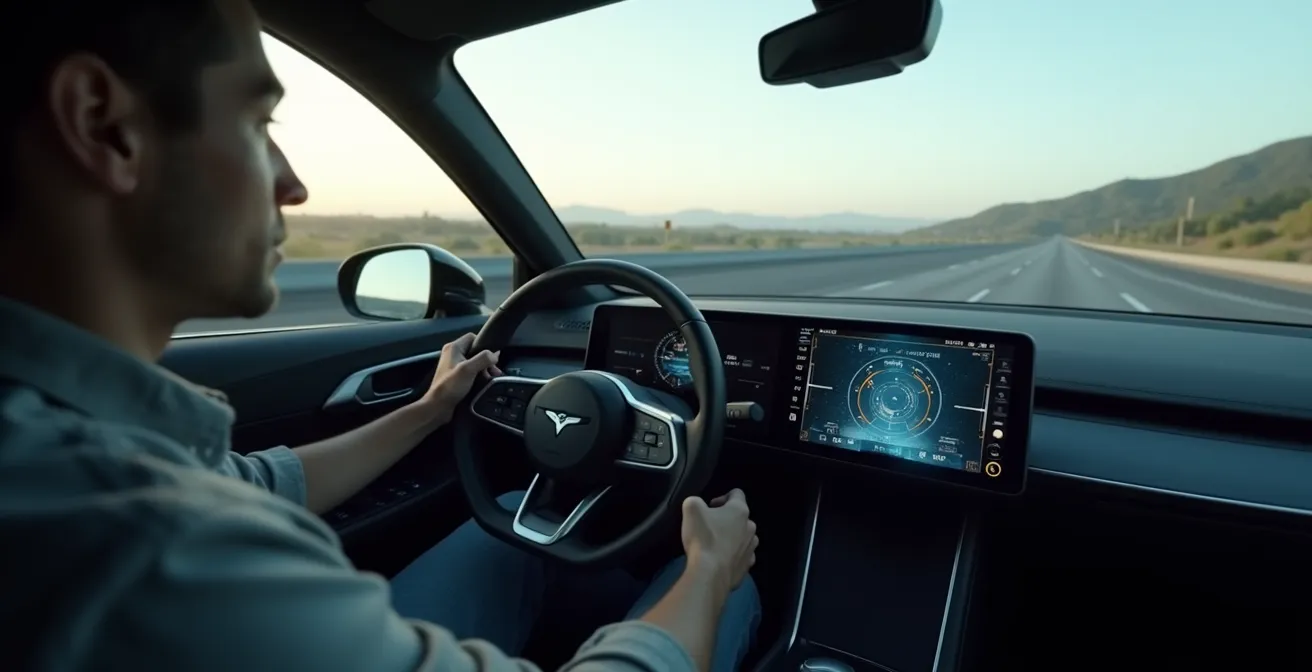
Contrary to the belief that ADAS makes driving inherently safer, these systems introduce subtle psychological traps like ‘vigilance decrement’ and ‘alert fatigue’. This guide moves beyond generic advice, focusing instead on the cognitive skills required to manage these systems. The key isn’t just to ‘pay attention,’ but to actively counter the system’s flaws by acting as a ‘human firewall,’ constantly vetting its decisions to maintain true situational awareness.
The feeling is familiar to any driver of a modern vehicle. On a long, monotonous stretch of highway, you engage the adaptive cruise control and lane-keeping assist. The car takes over the subtle adjustments of speed and steering, and a sense of relief washes over you. Your cognitive load decreases, your body relaxes. This is the promise of Advanced Driver-Assistance Systems (ADAS): a safer, less stressful driving experience. The common wisdom tells us to simply “stay alert” and remember that these are “assistants, not autopilots.”
But this advice fails to address the central paradox of these systems. By their very design, they encourage the mind to wander, creating a state known as vigilance decrement—a natural decline in attention during a passive monitoring task. The real danger is not just that the system might fail, but that the driver’s mind will be too far removed from the task to effectively re-engage during a critical “handoff crisis.” True mastery of ADAS is not about passively trusting the technology; it’s a demanding psychological skill.
This article moves beyond the owner’s manual. We will deconstruct the inherent limitations of these systems, from weather-related failures to algorithmic biases. We will analyze the specific attention errors that lead to accidents and, most importantly, provide a new mental framework for interacting with your vehicle. The goal is to transform you from a passive supervisor into an active, vigilant co-pilot who understands and compensates for the technology’s flaws.
The following sections break down the critical components of this new, safer approach to semi-autonomous driving, providing the insights needed to balance automated assistance with unwavering human attention.
Summary: Navigating the Complexities of ADAS and Driver Attention
- Why Radar and Cameras Fail in Heavy Rain or Snow?
- How to Ensure Safety Sensors Are Recalibrated After a Windshield Replacement?
- Blind Spot Monitor or Lane Centering: Which Feature Prevents More Accidents?
- The Attention Error That Leads to Accidents in Semi-Autonomous Cars
- Problem and Solution: Customizing Annoying Safety Beeps to Reduce Driver Fatigue
- The Algorithmic Bias Error That Skews Medical Research Results
- The Email Mistake Remote Employees Make That Breaches the Network
- Voice Control or Touchscreen: Which Intelligent Assistance Is Safer While Driving?
Why Radar and Cameras Fail in Heavy Rain or Snow?
The perceived invincibility of ADAS often shatters at the first sign of severe weather. While these systems perform reliably in clear conditions, their effectiveness plummets when visibility is compromised. This isn’t a rare occurrence; research from the American Automobile Association (AAA) showed a staggering 69% failure rate for lane keeping systems in simulated poor weather tests. The underlying reasons are rooted in the physics of how the sensors perceive the world.
Cameras, the “eyes” of the system, rely on clear contrast to identify lane markings, road edges, and other vehicles. Heavy rain, snow, or fog drastically reduces this contrast, effectively blinding the camera. Snow can completely obscure lane lines, while heavy downpours create reflections and spray that can be misinterpreted as solid objects. Radar, which is generally more robust, is also not immune. It works by bouncing radio waves off objects, but dense precipitation can absorb and scatter these waves, reducing the system’s detection range and accuracy. A layer of snow or ice directly on the sensor can render it completely inoperative.
This sensor degradation means the driver must shift their mental model from “supervising” to “actively driving with potential support.” Believing the system will work as normal in a blizzard is a critical, and common, mistake. Preparing for this reality is a non-negotiable part of safe ADAS use.
Action Plan: Preparing Your ADAS for Inclement Weather
- Pre-drive Inspection: Before your journey, physically clean all camera lenses and radar sensor areas of any snow, ice, mud, or debris.
- Increase Following Distance: Manually override your Adaptive Cruise Control (ACC) to set a much longer following distance than the default, accounting for longer braking distances on slick roads.
- Mental Rehearsal: As you start your drive, consciously think through the steps for manual takeover. Remind yourself where the disengage buttons are and be prepared to use them instantly.
- Software Updates: Ensure your vehicle’s software is current. Manufacturers often release updates that improve sensor processing and performance in marginal conditions.
- Monitor and Override: Pay close attention to system behavior. If the lane keeping feels hesitant or the ACC reacts erratically, immediately disengage and take full manual control.
How to Ensure Safety Sensors Are Recalibrated After a Windshield Replacement?
A chipped or cracked windshield is no longer a simple piece of glass to be replaced; in a modern car, it’s a critical structural and technological component. The forward-facing cameras that control essential ADAS features like Automatic Emergency Braking (AEB), Lane Departure Warning (LDW), and Traffic Sign Recognition are mounted directly onto the windshield. Even a millimeter of deviation in a new windshield’s placement or the camera’s angle can cause the system to misinterpret the road, with potentially catastrophic consequences.
This is why post-replacement sensor recalibration is not an optional upsell—it is a mandatory safety procedure. The process involves precisely aligning the camera’s field of view with the vehicle’s centerline to ensure it accurately perceives distances and positions. Without this, the system might fail to detect a stopped car ahead or may steer the vehicle out of its lane.
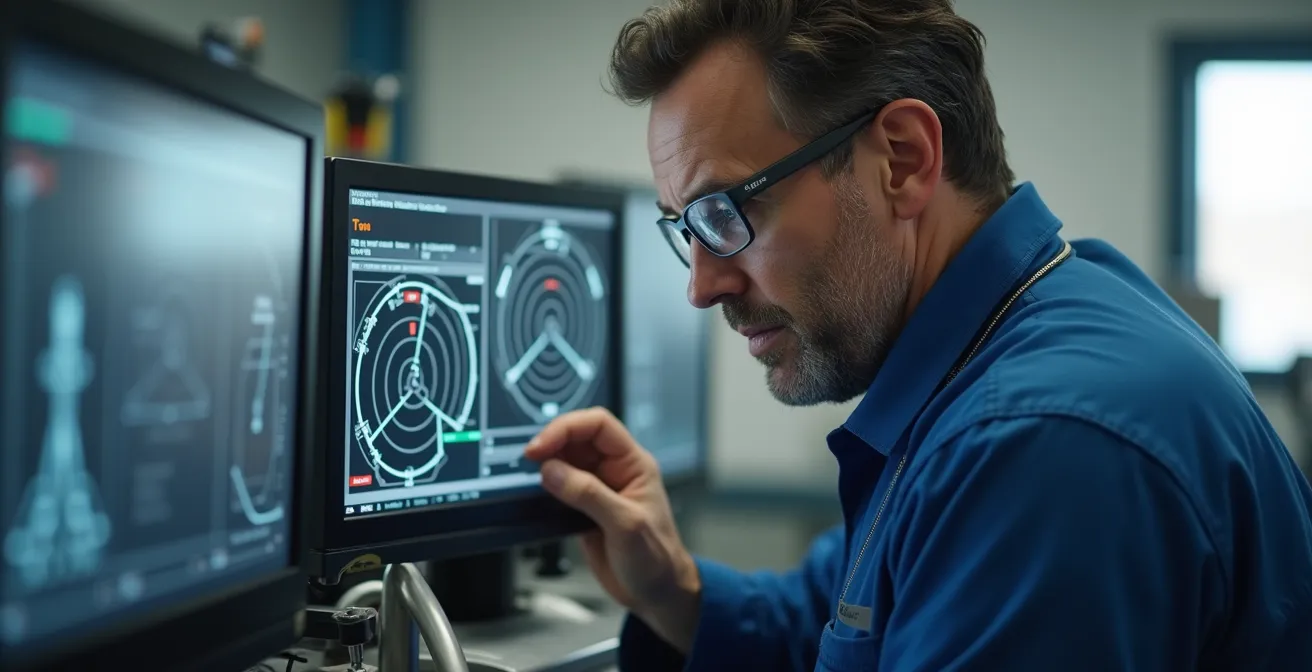
As the image above illustrates, this is a highly technical job requiring specialized equipment and a controlled environment. The technician uses specific targets and patterns to teach the camera its exact position and orientation relative to the vehicle’s thrust line. This process ensures the digital “eyes” of the car are looking exactly where they should be.
Case Study: The Two Types of Calibration
According to technicians at major glass repair companies like Safelite, there are two primary methods of recalibration, and the required type is dictated by the vehicle manufacturer. Static calibration is performed in the workshop, where the car is stationary and aimed at a series of specific targets. Dynamic calibration requires a technician to drive the vehicle on well-marked roads at specific speeds to allow the system to self-calibrate. Some vehicles, particularly from luxury brands, require a combination of both methods. Neglecting the correct procedure means the safety features you rely on may not function when you need them most.
Blind Spot Monitor or Lane Centering: Which Feature Prevents More Accidents?
When evaluating ADAS features, it’s crucial to distinguish between systems that prevent momentary mistakes and those that manage continuous tasks. Both Blind Spot Monitoring (BSM) and Lane Centering (or Lane Keeping Assist) are designed to enhance safety, and broad research confirms their effectiveness. In fact, IIHS and HLDI research demonstrated that major ADAS technologies are associated with significant reductions in crash rates. However, they address different types of driver error and have vastly different impacts on the driver’s cognitive state.
BSM acts as a discrete warning system. It monitors an area the driver cannot easily see and provides an alert during a specific, high-risk maneuver: the lane change. Lane Centering, conversely, takes over a continuous control task: keeping the vehicle in the middle of the lane. This fundamental difference is key to understanding their relative impact on safety and driver attention.
| Feature | Urban/Dense Traffic | Highway/Monotonous Driving | Driver State Impact |
|---|---|---|---|
| Blind Spot Monitor | Critical – frequent lane changes | Moderate – less merging | Augments awareness without encouraging complacency |
| Lane Centering | Limited – stop-and-go reduces effectiveness | Highly effective – combats attention fatigue | Can encourage over-reliance and reduced vigilance |
The table highlights a critical trade-off. Lane Centering is highly effective on long, monotonous highways where attention naturally wanes, but it’s precisely this offloading of the driving task that can lead to complacency and over-reliance. The driver’s role shifts from active controller to passive monitor, a state for which the human brain is poorly suited. BSM, on the other hand, does not encourage this mental disengagement. It acts as a digital “shoulder check,” augmenting the driver’s awareness at a critical moment without taking over control. It supports, rather than replaces, driver vigilance. Therefore, while both reduce accidents, BSM can be considered a ‘safer’ intervention as it carries a lower risk of inducing the dangerous state of cognitive detachment.
The Attention Error That Leads to Accidents in Semi-Autonomous Cars
The most insidious danger of semi-autonomous driving is not a sudden system failure, but a slow, creeping decline in driver alertness. This psychological phenomenon, known as vigilance decrement, describes the human brain’s inability to maintain focus while passively monitoring a stable environment. When a car handles steering and speed for extended periods, the driver’s brain naturally reallocates its cognitive resources elsewhere. The driver is technically “watching the road” but has lost true situational awareness—the deep understanding of the evolving traffic pattern, potential threats, and vehicle dynamics.
This cognitive detachment creates the perfect storm for what researchers call the “Handoff Crisis.” This is the moment the ADAS unexpectedly disengages or encounters a situation it cannot handle, requiring the driver to instantly take back full control. The core of the problem lies in this transition.

The most critical error is not the initial lack of attention, but the driver’s inability to regain full situational awareness in the 2-5 seconds during a takeover request.
– ADAS Safety Research, Analysis of Semi-Autonomous Vehicle Handoff Crisis
To combat this, a driver must engage in active monitoring drills, transforming the passive task into an active one. Safety experts recommend strategies like verbally narrating the driving situation every 30 seconds (“The system is braking for the red car; in five seconds, it should resume speed”). Another technique is to periodically make tiny, manual steering or speed adjustments to stay physically and mentally connected to the task. These exercises force the brain to remain engaged, drastically reducing the time needed to regain control during a handoff crisis and bridging the gap between passive supervision and active readiness.
Problem and Solution: Customizing Annoying Safety Beeps to Reduce Driver Fatigue
A car that constantly beeps and chimes for non-existent threats is not a safe car. This phenomenon, often caused by overly sensitive Forward Collision Warnings or Lane Departure systems, leads to a serious psychological issue known as “alert fatigue.” When a driver is bombarded with false alarms—a collision warning for a car turning far ahead or a lane alert on a wide, curving exit ramp—they quickly learn to distrust and ignore the system. The beeps become an annoying background noise rather than an urgent call to action. When a real threat finally does occur, the conditioned response is to ignore it, defeating the entire purpose of the safety feature.
The solution is not to simply turn the systems off, but to tune them to be a more intelligent and less “chatty” co-pilot. Most modern vehicles allow for a significant degree of customization of ADAS alerts, enabling the driver to match the system’s sensitivity to the specific driving environment. By reducing false positives, the driver can rebuild trust in the system, ensuring that when an alert does sound, it is treated with the seriousness it deserves. This transforms the system from a source of fatigue and annoyance into a valued safety partner.
Creating customized profiles can dramatically improve the human-machine interface:
- Highway Profile: Reduce the sensitivity of the forward collision warning to prevent phantom braking alerts from cars in other lanes, while keeping lane departure sensitivity high.
- City Profile: Increase the sensitivity of Rear Cross-Traffic Alert for navigating busy parking lots and set the collision warning to its most sensitive setting for unpredictable urban traffic.
- Haptic-First Approach: For drivers who find audio alerts distracting, configure the system to use steering wheel vibrations or seat rumbles as the primary warning for lane departures.
- Weather Profile: In heavy rain or snow, temporarily disable features that are known to be overly sensitive or unreliable, such as Traffic Sign Recognition, to prevent a cascade of error messages.
The Algorithmic Bias Error That Skews Medical Research Results
The title of this section draws an analogy: just as biased data can lead to flawed conclusions in medical research, biased training data fed into an ADAS algorithm creates dangerous, real-world blind spots. A driver who implicitly trusts their car’s “vision” is unknowingly relying on a system whose worldview is shaped by the limited data it was trained on. This is not a hypothetical problem; it is a documented flaw known as algorithmic bias, and it creates tangible safety risks that the driver must actively compensate for.
These systems learn to identify pedestrians, cyclists, and other vehicles by analyzing millions of miles of driving data and images. If that training data is not sufficiently diverse, the system’s ability to recognize subjects outside its learned norms is compromised. The driver, therefore, cannot assume the car sees the world as they do. They must instead operate with the knowledge that their co-pilot has inherent prejudices and blind spots.
Case Study: ADAS Bias in Pedestrian and Vehicle Detection
Independent research has uncovered alarming examples of ADAS algorithmic bias. For instance, some systems that were trained extensively in sunny, dry climates have shown reduced effectiveness at identifying lane markings covered by snow or faded by sun. More concerningly, multiple studies have found that certain systems exhibit reduced effectiveness at detecting pedestrians with darker skin tones, particularly in low-light conditions, because the training data was not sufficiently representative. Similarly, unconventional vehicles like recumbent bicycles or unique regional transport may be completely invisible to an algorithm that has never encountered them before. The system is not “seeing” a person or a bike; it is matching patterns, and if the pattern is new, it may be ignored.
This reality fundamentally changes the driver’s role. You are not just monitoring the road; you are also monitoring the system for its inherent biases, ready to intervene when it fails to recognize a reality outside its programming.
The Email Mistake Remote Employees Make That Breaches the Network
In the world of cybersecurity, it is understood that the most advanced technical defenses can be defeated by a single moment of human error—an employee clicking on a malicious link in a phishing email. In a modern vehicle equipped with ADAS, the driver’s role is strikingly similar. You are the final, and most important, line of defense against system limitations. You are the human firewall.
The driver is the human firewall – a moment of inattention is the ‘human error’ that breaches the ADAS safety net.
– Automotive Cybersecurity Expert, Human-in-the-Loop Safety Systems Analysis
This mindset shift, from passive passenger to active firewall, is being formalized in professional driving circles. It requires abandoning the idea of implicit trust in the system and adopting a new mental model of constant, low-level skepticism. Every action the car takes must be treated as a potentially flawed suggestion that requires human verification before it can be trusted.
Case Study: The “Zero Complacency” Driving Strategy
Progressive fleet safety managers are implementing “Zero Complacency” training programs, a concept adapted directly from cybersecurity’s “Zero Trust” architecture. In a Zero Trust network, no user or device is trusted by default; everything must be verified. Similarly, drivers are trained to treat every moment of automated driving as requiring potential intervention. They are taught to constantly question the system: “Why is it braking now? Does it see the car ahead that I see? Is it correctly interpreting that construction zone?” This approach, especially when paired with AI dash cams for driver monitoring and real-time coaching, has shown measurable reductions in ADAS-related incidents in commercial fleets.
For the everyday driver, adopting this strategy means you never fully disengage. You are constantly running a mental audit, treating the ADAS not as a pilot, but as an unvetted source of information that requires your final approval.
Key Takeaways
- ADAS reliability plummets in adverse weather conditions like rain and snow; manual preparation and a willingness to disengage the system are non-negotiable.
- The most dangerous ADAS-related error is the “Handoff Crisis”—the driver’s inability to regain full situational awareness in the critical seconds after a system disengages.
- Drivers must act as a “human firewall,” actively compensating for system limitations and algorithmic biases by treating ADAS as an unreliable co-pilot, not a trusted autopilot.
Voice Control or Touchscreen: Which Intelligent Assistance Is Safer While Driving?
As cars become more complex, interacting with their systems presents its own safety challenge. The debate between using voice commands and a touchscreen centers on one key factor: cognitive load. Every interaction, whether spoken or touched, demands a portion of the driver’s limited attentional resources. A safe interaction is one that minimizes the total load across three domains: visual (eyes off road), manual (hands off wheel), and cognitive (mind off driving).
At first glance, voice control appears to be the clear winner, as it requires minimal visual or manual input. However, this overlooks the often-significant cognitive load it can impose when it fails to understand a command. Repeatedly trying to phrase a navigation request or correct a misunderstood contact name can be intensely frustrating and mentally distracting. Touchscreens, while demanding both visual and manual attention, can become second nature for simple, repetitive tasks like adjusting the temperature, relying on muscle memory rather than conscious thought.
| Distraction Type | Voice Control Impact | Touchscreen Impact | Winner |
|---|---|---|---|
| Visual (eyes off road) | Low – No visual requirement | High – Must look at screen | Voice |
| Manual (hands off wheel) | None – Hands stay on wheel | High – Hand leaves wheel | Voice |
| Cognitive (mind off driving) | Variable – High if system fails or command is complex | Low – Often quick muscle memory taps for simple tasks | Context Dependent |
Ultimately, there is no single “safer” method; the optimal choice is task-dependent and driver-specific. For complex, multi-step tasks like finding a new destination mid-route, a well-functioning voice system is likely safer. For simple, frequent adjustments, a well-placed physical button or a quick tap on a familiar touchscreen icon may impose a lower total cognitive load than a voice command. The safest driver is one who understands this trade-off and chooses the right tool for the job. You can determine your own optimal method with a simple self-assessment.
- In a safe, parked location, choose a complex task, such as “Navigate to the nearest coffee shop, adding a stop at a gas station along the way.”
- Attempt the task once using only voice commands, and then again using only the touchscreen.
- Honestly self-assess: During which attempt did you feel more frustrated or lose track of your imaginary surroundings?
- Note which method required more steps or correction attempts to achieve the goal.
- The method with the lowest total frustration and distraction time is the safer choice for you for that type of task.
The next step is to consciously apply these mental models during your next drive. Start by actively narrating the system’s behavior and identifying its limitations—transforming passive supervision into active, life-saving vigilance.