Scaling global restoration is a complex logistical challenge of ecosystem engineering, not a simple tree-planting exercise.
- Prioritizing functional biodiversity over monoculture planting delivers higher, more resilient carbon yields and economic co-benefits.
- Natural regeneration and rewilding frequently outperform active afforestation in terms of biodiversity and long-term carbon storage, often at a lower cost.
- Strategic timing, site preparation, and avoiding the “Green Desert” error are critical failure points that determine a project’s success and environmental ROI.
Recommendation: Shift focus from counting trees to engineering high-yield, self-sustaining carbon systems by adopting a portfolio of restoration strategies tailored to local ecological conditions.
The global ambition to combat climate change often crystallizes into a single, tangible goal: planting trees. Trillions of them. While commendable, this singular focus on mass afforestation overlooks a more critical, underlying challenge. We are not just trying to put trees in the ground; we are attempting to restart complex, living systems capable of sequestering carbon on a planetary scale. This is not a gardening project; it is an immense logistical and engineering operation, and treating it as anything less is a recipe for catastrophic failure and wasted investment.
Most discussions gravitate toward two familiar themes: the need for more funding and the sheer number of saplings to be planted. Yet, these conversations often ignore the harsh realities learned from decades of projects. What if the key to success isn’t simply securing a bigger budget or planting faster, but fundamentally shifting our approach? What if the true leverage lies not in the quantity of our efforts, but in the quality of our strategy—in understanding the systemic failure points and maximizing the long-term carbon yield of every restored hectare?
This guide moves beyond the platitudes of tree planting. It presents a strategic framework for climate policy advisors and sustainability officers tasked with delivering measurable environmental ROI. We will dissect the operational logistics of scaling restoration, from valuing biodiversity as an economic asset to transitioning entire supply chains. By focusing on ecosystem engineering principles, we will explore how to avoid costly errors and build resilient, self-sustaining carbon sinks that deliver on their climate promises. This is a playbook for ambitious, result-oriented leaders ready to tackle the real complexities of global restoration.
To navigate this complex but crucial subject, this article breaks down the core strategic pillars for effective, large-scale ecosystem restoration. The following sections provide a detailed roadmap, from the economic imperatives of biodiversity to the logistical nuances of implementation and the transition towards a truly circular bioeconomy.
Summary: How to Scale Global Ecosystem Restoration Projects for Maximum Carbon Capture?
- Why the Loss of Biodiversity Hotspots Costs the Global Economy Trillions?
- Why Rewilding Agricultural Land Increases Long-Term Soil Value?
- How to Apply Permaculture Principles to Restore Degraded Landscapes?
- Active Reforestation or Natural Regeneration: Which Yields Better Biodiversity?
- The “Green Desert” Error: Why Planting Trillions of Trees Can Fail
- When to Start Restoration Planting to Ensure 90% Survival Rates?
- The Flexibility Error That Makes Bio-Robots Fail in Real Terrain
- How to Transition Supply Chains to Circular Bioeconomies Without Disrupting Output?
Why the Loss of Biodiversity Hotspots Costs the Global Economy Trillions?
The conversation around ecosystem restoration is often dominated by carbon, but its economic foundation is built on biodiversity. A functioning, diverse ecosystem is not a decorative bonus; it is the core engine of carbon sequestration and the provider of irreplaceable “ecosystem services” like water purification, pollination, and soil stability. The loss of these hotspots is a direct and quantifiable hit to the global economy, far exceeding the immediate costs of restoration. When key species disappear, entire systems can flip from being valuable carbon sinks to net carbon sources, triggering cascading financial and environmental losses.
This economic value is becoming increasingly monetized. As corporations and nations seek to offset their emissions, the voluntary carbon market is expected to reach $10-40 billion by 2030. Projects that can demonstrate robust biodiversity co-benefits command premium prices because they represent a more holistic and resilient form of carbon removal. Investing in a monoculture plantation is a short-term bet; investing in a biodiverse ecosystem is a long-term, appreciating asset.

The link between a single species and ecosystem-wide carbon balance is not theoretical. Consider the case of the Serengeti, where the recovery of the wildebeest population had a profound economic and environmental impact. After their numbers rebounded, their grazing patterns and the massive input of dung into the soil helped transform the entire ecosystem. According to a WFA report, this biodiversity restoration flipped the Serengeti from a carbon source, which regularly released carbon through wildfires, into a powerful and stable carbon sink, demonstrating a direct, positive ROI from wildlife conservation.
Why Rewilding Agricultural Land Increases Long-Term Soil Value?
Conventional agriculture often treats soil as a mere substrate, a medium to hold plants upright while being fed with external inputs. This approach depletes soil organic matter, reduces water retention, and ultimately diminishes the land’s intrinsic value. Rewilding, in contrast, is a strategy for reinvesting in this natural capital. By reintroducing natural processes and keystone species to abandoned or marginal farmland, rewilding kickstarts the ecological engine that builds rich, carbon-dense topsoil. This process transforms a depreciating asset into a high-value, self-sustaining system for carbon sequestration and ecological resilience.
The mechanism is a virtuous cycle. The return of diverse vegetation with deep root systems begins to break up compacted earth and deposit organic matter. The arrival of grazing animals accelerates this process. Their hoof action aerates the soil, their grazing prevents single species from dominating, and their manure provides a potent, slow-release fertilizer that feeds the complex web of soil microorganisms responsible for locking carbon away. This is not just restoring nature; it is actively building long-term soil value.
Case Study: European Bison and Carbon Sequestration in Romania
The reintroduction of European bison to Romania’s Țarcu mountains provides a powerful, quantified example. A Yale School of the Environment study analyzed the impact of just 170 bison on the landscape. It estimated that their grazing activities across 20 square miles of grassland led to the drawdown of an additional 54,000 tons of carbon annually. This is a staggering carbon yield, equivalent to taking 43,000 cars off the road, achieved simply by restoring a key natural process.
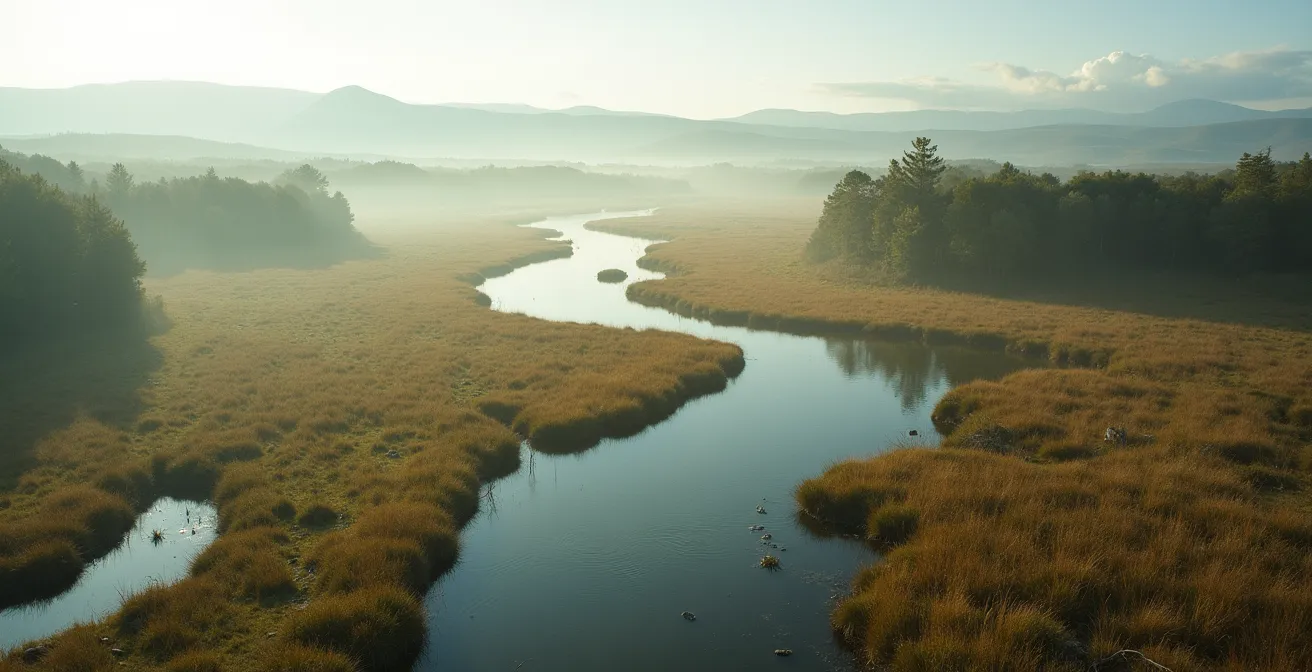
As the illustration above suggests, a rewilded landscape is a mosaic of habitats—grasslands, scrub, and emerging woodland—each contributing differently to soil health and carbon capture. This structural complexity, driven by natural disturbances, creates a far more resilient and productive system than a uniform field or even a monoculture forest. For policymakers and investors, this means rewilding should be viewed as a strategic land-use decision that generates appreciating returns in soil fertility, water security, and, most critically, measurable carbon sequestration.
How to Apply Permaculture Principles to Restore Degraded Landscapes?
While rewilding focuses on letting natural processes take the lead, permaculture offers a design-intensive framework for actively accelerating the restoration of heavily degraded landscapes. It is a form of ecosystem engineering that works with nature, not against it, to create productive and self-sustaining systems. Instead of imposing a rigid plan, permaculture applies a set of principles derived from observing natural ecosystems to design human-managed landscapes that are diverse, stable, and resilient. The core objective is to create closed-loop systems where waste becomes a resource and every element serves multiple functions.
In the context of large-scale restoration, this means moving beyond planting trees in rows and instead designing complex “polyculture guilds.” These are synergistic groupings of plants, fungi, and even animals that support each other. For example, nitrogen-fixing trees are planted alongside fruit-bearing trees, with groundcover plants that suppress weeds and retain soil moisture, and deep-rooted vegetables that break up compacted soil. This multi-layered approach maximizes the use of sunlight, water, and nutrients, dramatically increasing both biodiversity and the rate of carbon sequestration. Indeed, a BCG report notes that advanced soil carbon methods can sequester 3 to 4 tons of CO2 per acre, a goal to which permaculture directly contributes.
The implementation of permaculture on a large scale also involves macro-level design, such as creating water-harvesting earthworks (swales and ponds) on contour lines to stop erosion, passively irrigate the landscape, and recharge groundwater. This turns a major problem in degraded lands—water runoff—into a key asset for regeneration. By focusing on whole-system health, permaculture provides a powerful toolkit for turning barren land back into a thriving, carbon-storing ecosystem.
Action Plan: Auditing Your Regenerative Practices
- System Design: Inventory existing and planned systems. Are you combining trees with crops (agroforestry) and creating polyculture guilds that mimic nature, or are you relying on monocultures?
- Soil Health Inputs: List all soil amendments. Are you using cover crops with legumes for natural nitrogen fixation and applying compost to feed soil biology, or are you dependent on chemical fertilizers?
- Nutrient Cycling: Assess how nutrients are managed. Is managed grazing integrated to cycle nutrients and build organic matter, or are resources being extracted without replenishment?
- Water Management: Map water flows on your site. Have you designed and implemented water harvesting earthworks (swales, ponds) to prevent erosion and maximize water infiltration?
- Biodiversity Integration: Audit the functional diversity of your project. Does each element (plant, animal, structure) serve multiple purposes, contributing to the overall resilience and carbon capture capacity of the system?
Active Reforestation or Natural Regeneration: Which Yields Better Biodiversity?
The default image of restoration is active reforestation: teams of people planting saplings in neat rows. While this approach can be effective for specific goals like timber production, it often falls short when the objective is to maximize biodiversity and create a resilient, long-term carbon sink. An alternative, often more powerful strategy is natural regeneration—also known as passive rewilding—where the focus is on removing the barriers (like grazing pressure or invasive species) and allowing the forest to reclaim the land on its own terms.
The results can be striking. Natural regeneration typically leads to a more diverse, complex, and resilient ecosystem. Seeds arrive naturally via wind and wildlife, ensuring a mix of species perfectly adapted to the local conditions. This creates a multi-layered forest structure with a rich understory, providing habitat for a much wider range of fauna. In contrast, plantations are often dense monocultures that support very little life and can be highly vulnerable to disease, pests, and fire. The carbon sequestration potential of natural regrowth has also been historically undervalued. Research from the World Resources Institute highlights that IPCC defaults underestimate carbon sequestration rates by as much as 50% for tropical forests that are allowed to regrow naturally.
This does not mean active planting has no role. An “assisted regeneration” approach, which combines the best of both worlds, can be highly effective. This involves letting the area regenerate naturally while strategically introducing key species that are missing from the local seed bank to accelerate the process and increase diversity. The choice between these strategies is not a binary one; it is a critical logistical decision that depends on site conditions, budget, and long-term goals.
As researchers from npj Biodiversity succinctly put it, the holistic benefits of a natural approach are clear:
Recovering natural ecosystems through rewilding should eventually maximise their overall carbon sequestration and storage capacity through both above- and below-ground woody biomass and soils. Moreover, rewilded areas are of much greater value to biodiversity and more resilient to increasing climate extremes than forest plantations.
– npj Biodiversity researchers, Rewilding abandoned farmland has greater sustainability benefits than afforestation
The “Green Desert” Error: Why Planting Trillions of Trees Can Fail
The seductive simplicity of “planting a trillion trees” hides a critical strategic flaw: focusing on the number of trees planted rather than the health of the ecosystem created. When executed poorly, mass afforestation projects can result in what ecologists call a “green desert”—a dense, uniform monoculture plantation that, while green from a distance, is a biological wasteland. These plantations often have low survival rates, support minimal biodiversity, and can even have negative impacts on local water cycles and soil health.
This error stems from a failure to match the right tree to the right place and a focus on short-term planting metrics over long-term ecosystem function. Planting non-native, fast-growing species like eucalyptus or pine in an area that was historically grassland or a mixed-hardwood forest is a common mistake. These trees may grow quickly, but they can acidify the soil, deplete water resources, and fail to provide food or habitat for local wildlife. Ultimately, these green deserts are brittle systems, highly susceptible to collapse from drought, disease, or fire, releasing the very carbon they were meant to store.
The global potential for restoration is significant, but it is not infinite, and we cannot afford to waste it on failed projects. While optimistic figures circulate, a sobering 2025 study in Nature estimates that even under the most ambitious scenarios, maximum ecosystem restoration can sequester only 96.9 Gt of carbon by 2100. This highlights the critical need for every project to be as effective as possible. We must shift our success metric from “trees in the ground” to “functional, resilient ecosystems established.”
Case Study: The Failure of Afforestation in Spain
The pitfalls of the “green desert” approach are well-documented. For example, large-scale, subsidized afforestation projects on abandoned vineyards in Spain have been heavily criticized. As reported in an npj Biodiversity study, these projects, often using inappropriate tree species, resulted in significant adverse impacts on local biodiversity and failed to restore the ecosystem services that the original landscape provided. It served as a stark lesson in how well-intentioned planting can go wrong.
When to Start Restoration Planting to Ensure 90% Survival Rates?
For any restoration project involving active planting, success is not determined on planting day but in the 12 months that precede it. Achieving high survival rates—the crucial metric for environmental ROI—is a matter of meticulous logistical planning and timing. Simply putting saplings in the ground during a designated “planting season” without adequate preparation is a primary cause of project failure. The question is not just “when to plant,” but “when to start preparing to plant.”
The preparation timeline is a multi-stage process. It begins a year out with a thorough site assessment and soil analysis to establish a carbon baseline and understand the land’s specific needs. This is followed by a critical phase of invasive species removal and soil preparation, such as aeration or the addition of organic matter, which can take several months. Roughly six months before planting, infrastructure for water harvesting and erosion control must be in place. This ensures that when the rains do come, the water is captured and held in the landscape, providing a vital lifeline for new plants.
Sourcing the right genetic material is another long-lead item. Identifying and collecting appropriate native seeds, followed by their nursery production, must begin months in advance to ensure healthy, well-acclimatized saplings are ready at the optimal moment. The final planting window itself is not a fixed date on a calendar but a flexible period determined by hyperlocal weather. The team must be ready to mobilize rapidly during the first optimal 2-week period of sustained soil moisture. Once established, these planted forests achieve removal rates of 4.5 to 40.7 t CO2 per hectare per year, but only if they survive that critical first year.
This rigorous, timeline-driven approach transforms planting from a game of chance into a strategic operation. It requires a project management mindset focused on risk mitigation and operational readiness, ensuring that the significant investment in planting yields a resilient and thriving new ecosystem rather than a field of dead saplings.
The Flexibility Error That Makes Bio-Robots Fail in Real Terrain
In the quest for scalability, there is a dangerous temptation to adopt rigid, one-size-fits-all restoration models. These approaches treat ecosystems like factories and planting efforts like an assembly line, deploying “bio-robots”—a metaphor for inflexible methodologies and technologies—across diverse and unpredictable landscapes. This “flexibility error” is a primary reason why promising lab-tested techniques or drone-based planting systems often fail spectacularly in real-world terrain. Nature is not a uniform substrate; it is a complex, dynamic, and often chaotic system that punishes rigidity.
A successful restoration strategy must be inherently adaptive. It must be able to respond to the immense variability of soil types, microclimates, and existing vegetation found across even a single project site. A method that works in a valley bottom may fail on a windswept slope. A species that thrives in one soil type may die in another just meters away. An inflexible approach that deploys a single solution everywhere is doomed to inefficiency and high failure rates. This is especially critical given the scale of the opportunity: projections suggest that European agricultural land abandonment will reach 10-29 million hectares by 2030, a vast and varied canvas that demands flexible solutions.
The alternative is a portfolio approach. Instead of searching for a single “best” method, a smart strategist deploys a range of techniques—from passive rewilding to assisted regeneration and intensive permaculture-style planting—tailored to different zones within the project area. This requires on-the-ground intelligence, continuous monitoring, and the empowerment of local teams to make adaptive decisions. The goal is not to impose a predetermined design but to catalyze and guide the land’s own regenerative potential.
The following table, based on data from a Nature study, starkly illustrates the trade-offs between different restoration methods, highlighting why a flexible, portfolio-based strategy is superior to a rigid, one-size-fits-all approach.
| Restoration Method | Carbon Sequestration Rate | Biodiversity Impact | Implementation Cost |
|---|---|---|---|
| Natural Rewilding | 5.2 tCO2e/ha/yr | Very High | Low |
| Active Afforestation | 4.5-40.7 tCO2/ha/yr | Low-Medium | High |
| Assisted Regeneration | 3-8 tCO2e/ha/yr | High | Medium |
Key Takeaways
- Restoration ROI is maximized by engineering self-sustaining ecosystems, not by simply counting planted trees. Focus on carbon yield and biodiversity.
- Natural regeneration and rewilding are often more cost-effective and deliver superior biodiversity and carbon outcomes compared to monoculture afforestation.
- Logistical planning is paramount: success depends on a year of preparation, site-specific strategies, and precise timing, turning restoration into a strategic operation.
How to Transition Supply Chains to Circular Bioeconomies Without Disrupting Output?
True long-term success in global restoration cannot be siloed from the broader economy. The ultimate goal is to transition from an extractive model to a circular bioeconomy, where restored landscapes become a source of sustainable resources and economic value, thus creating a powerful incentive for their own preservation and expansion. This involves reimagining supply chains to integrate the outputs of regenerated ecosystems—from sustainably harvested timber and non-timber forest products to bio-based materials and even ecotourism—without disrupting industrial output.
This transition is not a simple substitution of materials; it is a fundamental redesign of industrial processes. It requires significant investment in R&D to develop new bio-materials and processing technologies. It also demands close collaboration between restoration project managers, local communities, and industrial partners to create reliable, high-quality supply streams. The challenge is to build this new economic engine in parallel with the old one, ensuring a smooth transition that does not compromise productivity or create market shocks. The prize, however, is immense: an economy that is not only carbon-neutral but actively carbon-negative, powered by the landscapes it helps to restore.
The permanence of the carbon captured in these new systems adds a critical layer of value. For instance, innovative approaches like enhanced rock weathering or ocean alkalinity enhancement, which are part of a broader bio-economic toolkit, promise exceptionally durable carbon storage. Research from Yale has shown that carbon captured through alkalinity enhancement is stored for over 1,000+ years, offering a form of sequestration that is far more secure than terrestrial biomass alone.
The scale of the opportunity is truly planetary. As researchers highlighted in a landmark 2023 Nature Climate Change study, the potential is nothing short of revolutionary:
Rewilding efforts focused on restoring populations of nine key wildlife species could capture an extra 6.4 gigatons of carbon dioxide annually. This is equivalent to over 15% of current global annual emissions, matching or surpassing each of the IPCC’s top five options for mitigating climate change.
– Nature Climate Change researchers, 2023 Nature Climate Change study
This transition represents the final frontier of sustainability. For climate advisors and corporate officers, the next logical step is to move from understanding these principles to actively designing and investing in the pilot projects that will build the bio-economies of the future. Begin today by evaluating how these restoration strategies can be integrated into your organization’s long-term sustainability and supply chain planning.