The secret to overcoming range anxiety isn’t a bigger battery or more charging stations; it’s building personal charging resilience by mastering your vehicle and your planning.
- Modern EVs are more robust against fast-charging damage than most people believe, thanks to advanced battery management systems.
- Proactive planning that accounts for real-world variables like weather and charger reliability is more critical than simply mapping a route.
Recommendation: Shift your focus from finding the next charge to optimizing your energy usage through techniques like one-pedal driving and smart preconditioning.
The feeling is familiar to anyone who has driven a car with a gas-powered engine: the needle dips into the red, and a low-grade panic sets in. For prospective electric vehicle (EV) owners, this fear is amplified into “range anxiety”—the persistent worry that your battery will die, leaving you stranded far from a charger. Many articles will tell you to simply plan your trips with an app or point out that charging infrastructure is growing. While true, these points miss the fundamental issue. They treat range anxiety as a logistical problem to be solved with technology alone.
But what if the anxiety isn’t just about the car’s physical range? What if it’s about a lack of confidence and a feeling of lost control? The transition from the familiar “fill-up-in-five-minutes” gas station model to the “plan-and-wait” EV charging model requires a significant mental shift. It’s not just about learning where chargers are; it’s about learning how your car consumes energy and how to manage that energy proactively. The real solution isn’t just about finding chargers; it’s about building your own charging resilience.
This guide moves beyond the generic advice. We will dismantle the common fears one by one, providing practical, experience-based strategies to help you move from a state of anxiety to one of empowerment. We will explore how to manage your battery for long-term health, navigate the realities of home and public charging, and master the systems within your car that put you back in the driver’s seat of your energy consumption. You will learn to think not like a worried driver, but like a skilled energy manager.
To help you navigate this new landscape with confidence, this article breaks down the essential skills and mindset shifts needed. From understanding the nuances of charging to mastering your vehicle’s efficiency features, each section is designed to build your competence and, in turn, eliminate your anxiety.
Summary: How to Overcome Range Anxiety When Switching to a Zero-Emission Vehicle?
- Why Fast Charging Every Day Is Bad for Long-Term Battery Health?
- How to Install a Level 2 Charger Without Upgrading Your Electrical Panel?
- Full Electric or Plug-In Hybrid: Which Fits Rural Driving Better?
- The Planning Error That Leaves EV Drivers Stranded on Road Trips
- Problem and Solution: Regaining Range When Temperatures Drop Below Freezing
- Algae Fuel or Waste-to-Energy: Which Biomass Solution Scales Best?
- Why Rewilding Agricultural Land Increases Long-Term Soil Value?
- How to Master One-Pedal Driving with Regenerative Braking Systems?
Why Fast Charging Every Day Is Bad for Long-Term Battery Health?
One of the most persistent fears surrounding EV ownership is that using DC fast chargers—the kind you find along highways that can add hundreds of miles of range in under an hour—will rapidly degrade your battery. The conventional wisdom is to use them sparingly, like a guilty pleasure. This advice stems from early battery chemistry, where high heat and high voltage were indeed a recipe for accelerated wear. However, the narrative is more nuanced with today’s advanced battery management systems (BMS).
The primary concern with fast charging is heat generation. Consistently subjecting your battery to high temperatures can, over time, reduce its ability to hold a full charge. This is why your EV’s BMS is so critical; it actively manages temperature with liquid cooling and heating systems to keep the battery in its optimal operating range during a fast-charge session. It also controls the charging speed, often slowing it down as the battery approaches 80% to protect it.
Interestingly, the real-world impact may be less dramatic than feared. A landmark 2024 study by Recurrent analyzed over 13,000 Tesla vehicles and found a surprising result: there was no statistically significant difference in range degradation between cars that fast-charged more than 70% of the time versus those that fast-charged less than 30%. This suggests that for many modern EVs, the BMS is doing an excellent job of mitigating damage. The key isn’t to avoid fast charging entirely, but to practice smart charging habits: primarily using slower Level 2 charging at home for daily needs and relying on fast chargers for what they’re designed for—long-distance travel.
How to Install a Level 2 Charger Without Upgrading Your Electrical Panel?
The foundation of a stress-free EV experience is reliable home charging. A Level 2 (240-volt) charger is the gold standard, capable of fully replenishing your battery overnight. However, many potential owners hit a major roadblock: their home’s electrical panel doesn’t have the capacity for another dedicated 40- or 50-amp circuit. The prospect of a multi-thousand-dollar panel upgrade can be enough to halt an EV purchase in its tracks. In fact, market analysis suggests nearly 50% of US households may face this exact issue.
Fortunately, upgrading your entire panel is no longer the only option. The solution lies in smart load management technology. These systems are designed to monitor your home’s total electricity usage in real-time. When they detect that your home is approaching its maximum capacity—for instance, when the air conditioning, electric oven, and clothes dryer are all running—they automatically and temporarily reduce the power going to the EV charger. Once the overall demand drops, the system restores full power to the charger. This ensures your car gets charged without ever overloading your panel or tripping the main breaker.
This approach transforms a major barrier into a manageable one. Instead of a costly and invasive electrical overhaul, you can install a smart charger or a separate load management device that works with your existing setup. These solutions intelligently share the available power, making home charging accessible and safe for millions more households.
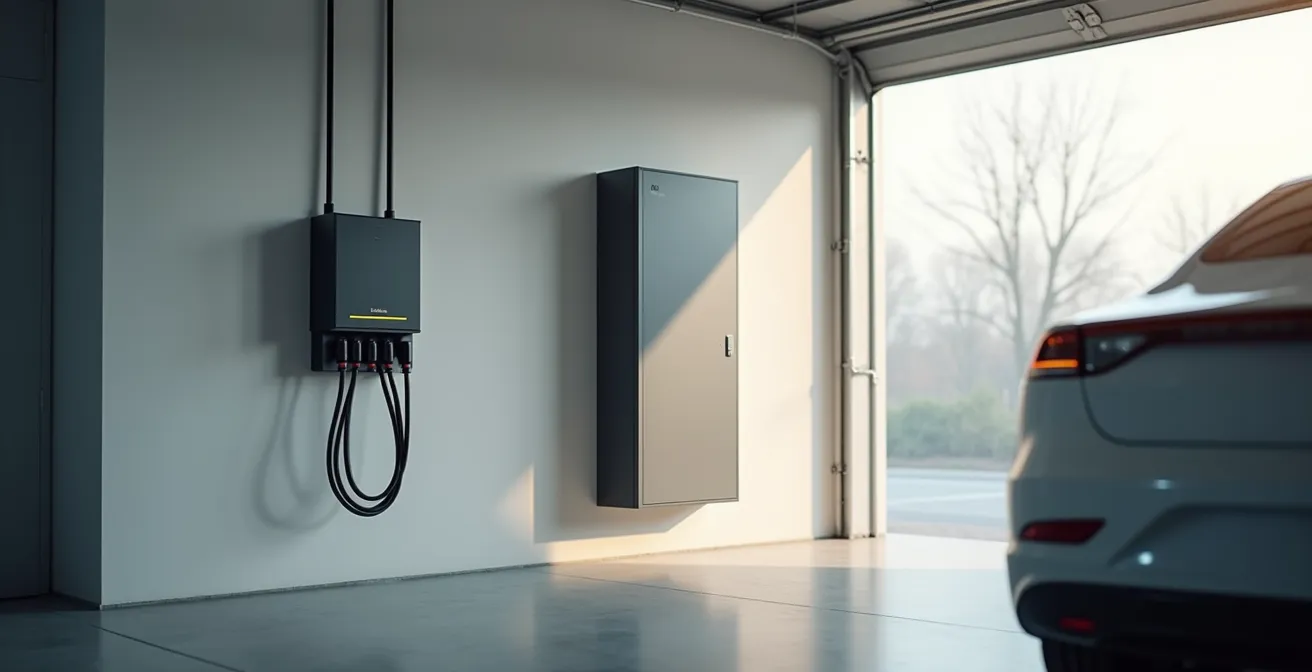
As the image illustrates, these modern systems integrate cleanly into a home’s existing electrical infrastructure. They act as a traffic cop for your electricity, prioritizing household needs while ensuring your vehicle is still charged efficiently. The table below compares some of the common solutions available.
| Solution Type | Cost Range | Installation Complexity | Power Sharing Capability |
|---|---|---|---|
| Smart Load Management (PowerSmart) | $399-$599 | Moderate | Up to 4 chargers per circuit |
| Load Controller Devices | $200-$400 | Simple | 2 chargers per circuit |
| Smart Panel Upgrade | $2,000-$4,000 | Complex | Unlimited with full control |
Full Electric or Plug-In Hybrid: Which Fits Rural Driving Better?
For city dwellers, going fully electric (BEV) is an increasingly easy decision. With shorter commutes and denser charging networks, range is rarely a daily concern. But for those living in rural areas, the calculation is different. Distances are greater, and public chargers can be few and far between. This is where the choice between a BEV and a Plug-in Hybrid (PHEV) becomes a critical component of building charging resilience.
A PHEV offers a “best of both worlds” approach: a smaller battery for 20-50 miles of pure electric driving, and a gasoline engine that kicks in for longer trips. This completely eliminates range anxiety for road trips, as you can always fall back on the ubiquitous gas station network. Given that the average American’s daily drive is only around 31 miles per day, a PHEV allows many rural drivers to handle all their daily errands on electricity alone, saving the gas engine for those long hauls into the next town or cross-country journeys.
On the other hand, modern BEVs are more capable than ever. With ranges now commonly exceeding 250-300 miles, a full EV can handle a week’s worth of rural commuting on a single home charge. The decision hinges on a realistic assessment of your personal driving patterns. It requires moving beyond the *idea* of a cross-country road trip and looking at the *reality* of your 99% use case. A BEV offers a simpler, lower-maintenance, and ultimately cheaper-to-run vehicle, but demands more forethought for those occasional long trips. A PHEV offers ultimate flexibility but comes with the complexity and maintenance of two separate powertrains. The right choice is the one that aligns with your actual lifestyle, not your imagined one.
Your Rural EV Readiness Checklist: A Practical Audit
- Route Mapping: Use apps like PlugShare or A Better Routeplanner to map your most frequent long-distance routes and identify available chargers.
- Daily Mileage Audit: Track your actual daily mileage for a full month to get a real-world average, not just a guess.
- Home Charging Feasibility: Get a quote from an electrician to understand the cost and complexity of installing a Level 2 charger at your home.
- Backup Options: Identify potential “opportunity charging” spots near you, like local businesses, libraries, or workplaces that might have a charger.
- Real-World Test Drive: Test drive both a BEV and a PHEV on your typical routes, including a longer stretch of highway, to see how they feel and perform in your environment.
The Planning Error That Leaves EV Drivers Stranded on Road Trips
The most common mental picture of range anxiety is an EV sputtering to a halt on a desolate highway. While this can happen, it’s rarely because the car’s range was miscalculated. The more frequent and frustrating reality is arriving at a planned charging stop only to find it’s broken, occupied by another EV for the next hour, or blocked by a non-electric vehicle. This is the shift from “range anxiety” to “charge anxiety,” and it’s where most planning goes wrong.
The critical error is relying solely on static maps. Old-school planning involved looking at a map and drawing a line. Modern EV planning involves looking at a dynamic, real-time system. Apps like PlugShare, Electrify America, and others are indispensable because they provide user-generated, real-time data on a charger’s status. They tell you if a station is operational, how fast it’s charging, and often, whether it’s currently in use. Ignoring this layer of data is like navigating with a 10-year-old paper map—you know where the road *should* be, but you have no idea if it’s closed for construction.
This is reinforced by real-world analysis. A report from National Grid highlights that the primary pain points for EV drivers on the road are no longer just the distance between chargers, but long queues, broken equipment, and occupied spots. True road trip resilience comes from a multi-layered plan. It means not just planning your next stop, but also identifying one or two backup chargers within range of that stop. It means checking the real-time status of your target charger 30-60 minutes before you arrive. It means building a buffer into your plan, aiming to arrive at a charger with 20% battery, not a nail-biting 5%.

Effective planning is an active, not a passive, process. It’s about using modern tools to make informed, real-time decisions. By anticipating potential points of failure—like a broken charger on a holiday weekend—you can build a flexible itinerary that ensures you always have a viable option. This mindset shift, from rigid planning to adaptive strategy, is the ultimate cure for road trip anxiety.
Problem and Solution: Regaining Range When Temperatures Drop Below Freezing
Every EV driver’s first winter comes with a shock: the estimated range on the dashboard plummets. Cold weather is the nemesis of battery performance. The chemical reactions inside the battery slow down, reducing its ability to discharge energy efficiently. Furthermore, a significant portion of that energy is diverted to heating the battery and the cabin. This one-two punch can lead to a significant drop in real-world range, a factor that must be managed to maintain confidence.
The impact is not trivial. Fleet data analysis from Geotab shows that cold temperatures can cause an up to 30% range reduction during winter months. For a car with a 250-mile estimated range, that’s a loss of 75 miles. If you haven’t accounted for this, a comfortable journey can quickly become a stressful one. The key to mitigating this is understanding the two main energy draws—battery conditioning and cabin heating—and addressing them proactively.
The most effective strategy is preconditioning. This means using energy from the grid, while your car is still plugged in, to warm up the battery and the cabin to your desired temperature *before* you unplug. By doing this, you start your journey with a warm, efficient battery and a toasty interior, without having used a single electron of your stored range. Many EVs allow you to schedule this via their app, so your car is ready to go when you are. Once on the road, be frugal with cabin heat. Using heated seats and a heated steering wheel is far more energy-efficient than trying to heat the entire air volume of the car. These simple behavioral changes can reclaim a significant portion of the range lost to the cold, turning a major source of winter anxiety into a manageable variable.
Emergency Cold Weather Range Recovery Protocol
If you find yourself with less range than expected in freezing temperatures, don’t panic. Take immediate action: first, reduce your speed to 55 mph (90 km/h) or less, as aerodynamic drag is a massive energy consumer. Second, turn off the main cabin heat and rely solely on your seat and steering wheel heaters. Engage your vehicle’s “Eco” or “Efficiency” mode, which will dull accelerator response and limit power output. These steps can dramatically slow your energy consumption and give you the crucial extra miles needed to reach your destination or the next charger safely.
Algae Fuel or Waste-to-Energy: Which Biomass Solution Scales Best?
While topics like algae fuel might seem distant from your daily drive, the bigger picture of energy production is directly tied to the confidence of EV drivers. A common underlying fear is the stability and resilience of the electrical grid itself. “What happens if the grid goes down?” is a question that fuels anxiety. The answer lies in diversification, and the growing ecosystem of energy sources is making the grid more robust than ever before.
The electricity that charges your car comes from an increasingly diverse portfolio of sources: solar, wind, hydro, natural gas, and yes, emerging biomass technologies. This diversity is a strength. A cloudy, windless day might reduce renewable output, but other sources are there to pick up the slack. This built-in redundancy is fundamental to a reliable grid. As this energy mix becomes cleaner and more distributed, the grid becomes less vulnerable to single points of failure.
More importantly, EVs themselves are poised to become a key part of the solution. The concept of Vehicle-to-Grid (V2G) technology is rapidly becoming a reality. In a V2G ecosystem, the millions of EVs connected to the grid don’t just draw power; they can also act as a massive, distributed battery, feeding power back to the grid during times of peak demand. This transforms EVs from simple consumers into active participants in grid stability.
The grid is becoming more resilient through diverse energy sources, and EVs will play a crucial role as mobile energy storage units in the future Vehicle-to-Grid ecosystem.
– National Grid, National Grid EV Infrastructure Report 2024
Understanding this context helps build long-term confidence. You are not just adopting a new type of car; you are plugging into an evolving, strengthening, and increasingly intelligent energy ecosystem. Your EV is not just a potential strain on the grid; it is a future asset for its resilience.
Why Rewilding Agricultural Land Increases Long-Term Soil Value?
The concept of rewilding—allowing land to return to its natural, unmanaged state—offers a powerful metaphor for overcoming range anxiety. A rewilded ecosystem becomes strong and resilient not through a single, perfect species, but through a diverse and interconnected web of plants, animals, and microorganisms. In the same way, an EV driver builds resilience not by relying on a single app or one perfect charging habit, but by cultivating a diverse personal driving ecosystem.
This ecosystem consists of multiple layers. It’s having several charging network apps on your phone, not just one. It’s knowing your primary, secondary, and tertiary charging options on a familiar route. It’s developing an intuitive feel for how your car’s range changes with speed, temperature, and topography. Just as a rewilded forest can withstand drought or disease better than a monoculture crop, a resilient driver can handle a broken charger or an unexpected detour without panic.
This approach emphasizes adaptation and knowledge over rigid rules. It’s about building a web of solutions that make you robust against any single point of failure. The long-term value of this approach is immense, much like the increased ecological and financial value of rewilded land over time. An analysis by the Green Energy Consumers Alliance shows that with proper battery management—a core part of this resilient mindset—EVs can last over 20 years, saving owners thousands in fuel and maintenance. This long-term thinking is the antidote to short-term anxiety.
Just as a rewilded ecosystem becomes more resilient through diversity, EV drivers build resilience through multiple charging options, efficient driving styles, and adaptation to varying conditions.
– Environmental Transport Association, Sustainable Transport Quarterly 2024
Building this personal ecosystem takes time and practice. It starts with small steps: trying a different charging network, testing your car’s eco mode on your commute, or deliberately taking a scenic route to see how it affects your consumption. Each action adds another layer of knowledge and another thread to your web of resilience.
Key Takeaways
- Range anxiety is more about a lack of confidence and control than a real-world limitation of the vehicle.
- Building “charging resilience” through knowledge, planning, and skill is the most effective solution.
- Modern EVs and the electrical grid are more robust and adaptable than many new owners assume.
How to Master One-Pedal Driving with Regenerative Braking Systems?
If there is one skill that transforms an EV driver from a passive operator into a master of their own range, it is mastering one-pedal driving. This feature, powered by the car’s regenerative braking system, is perhaps the most significant departure from driving a traditional car, and it’s your most powerful tool for fighting range anxiety. Instead of using two pedals for two distinct actions (go and stop), you primarily use one: the accelerator.
Here’s how it works: when you press the accelerator, the car moves forward. When you lift your foot, instead of coasting freely, the electric motor reverses its function. It becomes a generator, using the car’s momentum to create electricity and send it back to the battery. This process creates drag, which slows the car down smoothly and effectively, often to a complete stop, without you ever touching the brake pedal. You are literally recapturing energy that would otherwise be wasted as heat through traditional friction brakes.
Mastering this takes practice. It requires you to look much further ahead, anticipating traffic lights and stop signs so you can ease off the accelerator at just the right moment for a smooth, graceful stop. It’s a more engaged and fluid way of driving. But the payoff is enormous. According to fleet data, drivers who become proficient with one-pedal techniques can improve their vehicle’s efficiency by 15-20%, especially in stop-and-go city traffic. That’s a direct and tangible increase in your available range, gained simply through skill.
This is the ultimate form of charging resilience. You are no longer just a consumer of energy; you are an active manager and recapturer of it. Every time you slow down, you are topping up your battery. This fundamental shift in control—from relying on external chargers to generating your own power on the move—is what truly dissolves range anxiety. You are no longer at the mercy of your battery gauge; you have a direct hand in influencing it.
Ultimately, overcoming range anxiety is a journey of empowerment. It’s about replacing fear of the unknown with the confidence that comes from knowledge and skill. By understanding your vehicle’s systems, planning intelligently for real-world conditions, and mastering techniques like one-pedal driving, you shift from being a passenger to your car’s battery to being its pilot. This is the path to truly enjoying the quiet, powerful, and liberating experience of driving electric.