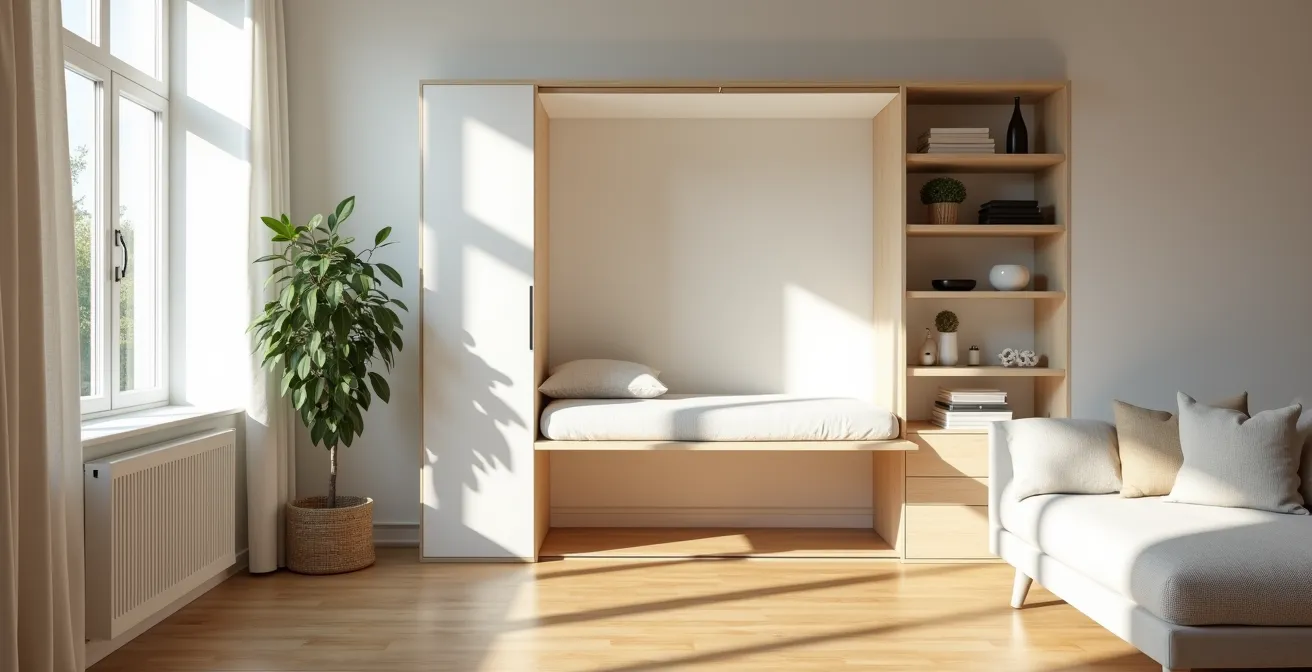
A truly transformative dual-function room is not defined by its furniture, but by its choreography—a system of spatial, sensory, and mechanical elements working in harmony.
- Success lies in managing light and sightlines with visual dividers, not solid walls.
- The choice between a daybed and a sofa bed hinges on prioritizing guest sleep quality over seating convention.
- Instant ambiance change from “work” to “relax” is achieved through sensory cues like light and texture.
Recommendation: Begin by auditing your space not for what you can add, but for what single-use items you can replace to reclaim valuable, flexible floor space.
For apartment dwellers, the dream of a dedicated home office and a welcoming guest room often collides with the reality of limited square footage. The common advice is predictable: buy a Murphy bed, get a sofa bed, or use “smart” storage. While these elements are part of the equation, they are merely props on a stage. Focusing on them alone often leads to a space that feels like a compromised office and an uncomfortable bedroom, excelling at neither.
The real challenge isn’t about cramming more functions into a room; it’s about designing a seamless transformation. The key isn’t in the objects themselves, but in the spatial choreography that dictates how the room changes. What if the secret to a successful dual-purpose space was less about multi-functional furniture and more about mastering the art of the transition? This involves a deeper understanding of visual perception, mechanical empathy, and the power of sensory cues to redefine a room’s purpose in an instant.
This guide moves beyond the catalog of convertible furniture. We will deconstruct the architectural principles that make these spaces work, exploring how to manage sightlines, select the right transformative pieces for sleep quality, avoid critical storage mistakes, and master the “transformative rituals” that shift a room’s energy from productivity to hospitality. We will even analyze the hidden costs of inefficient space and draw lessons from extreme organizational challenges to prepare you for any scenario.
By the end of this article, you will have a strategic framework for creating a space that doesn’t just switch functions but truly transforms its character, maximizing every valuable inch of your home. The following sections break down this approach into actionable strategies.
Summary: A Strategic Blueprint for Your Dual-Function Space
- Why Visual Dividers Work Better Than Walls in Small Apartments?
- How to Install a Wall Bed Safely Without Professional Help?
- Sofa Bed or Daybed: Which Offers Better Sleep Quality for Guests?
- The Storage Error That Makes Transforming Rooms Feel Cramped
- Problem and Solution: Changing Ambiance from “Work” to “Relax” Instantly
- Problem and Solution: Organizing a Small Studio for Large Sculpture Work
- Why Your Parked Car Is Costing You $500/Month in Invisible Fees?
- Problem and Solution: Doubling Storage in Small Apartments Using Modular Units
Why Visual Dividers Work Better Than Walls in Small Apartments?
In a small apartment, the most valuable commodity is not square footage, but the perception of it. A solid wall, while offering absolute privacy, is a space-killer. It halts light, stops the eye, and creates two smaller, often claustrophobic, zones. Visual dividers, by contrast, practice a form of spatial negotiation. They suggest separation without demanding it, allowing light and sightlines to travel, which makes the entire area feel larger and more interconnected. This approach is a core principle of spatial choreography, where you guide the experience of a space rather than rigidly defining it.
The effectiveness of this strategy is reflected in a growing market; the global room divider market demonstrates strong growth, signaling a definitive shift in how we approach flexible interiors. The key is permeability. Materials like slatted wood, perforated metal, or fluted glass create a psychological boundary while maintaining a physical connection. They define a “work zone” from a “living zone” without sacrificing the flow of natural light, which is crucial for well-being and the illusion of spaciousness.

As this image demonstrates, the interplay of light through different materials is not just functional but also aesthetic. The patterns of light and shadow add texture and dynamism to the room. This technique allows you to delineate your office area during the day, giving you the mental separation needed for focus, while allowing the room to feel whole and integrated once the workday is over. You achieve functional separation without the permanent, shrinking effect of a solid wall.
Ultimately, choosing a visual divider is choosing a dynamic boundary over a static one. It’s an architectural sleight of hand that gives you the best of both worlds: the definition you need with the openness you crave.
How to Install a Wall Bed Safely Without Professional Help?
The Murphy bed, or wall bed, is the heavyweight champion of transforming furniture. Its ability to reclaim an entire room’s worth of floor space is unmatched. However, its significant weight and mechanical complexity can be intimidating, leading many to assume professional installation is mandatory. With careful planning and an understanding of “mechanical empathy”—respecting the physics of the device—a DIY installation is not only possible but can be a rewarding project that deepens your connection to the space.
The absolute, non-negotiable key to a safe installation is anchoring the bed cabinet securely to the wall studs. This is not a task for drywall anchors alone. The pulling force exerted when opening and closing the bed is immense, and failure to secure it to the structural frame of your building can lead to catastrophic failure. You must use a high-quality stud finder to locate at least two, preferably three, studs and use the heavy-duty hardware specified by the manufacturer.
Case Study: A Successful DIY Murphy Bed Transformation
Jenny Giller, a homeowner in Arizona, provides a powerful example of DIY success. She installed a queen-sized Murphy bed in her home office with the help of a partner, relying on the manufacturer’s instructional videos and guides. Her story, detailed in a project by More Space Place, highlights her critical advice: anchor the bed securely to wall studs and take the time to understand the pivot mechanism before assembly. This foresight helped her avoid common alignment mistakes and ensured a safe, functional, and professionally finished result without the professional cost.
Before you even unbox the components, conduct a pre-installation audit. Verify your ceiling clearance, ensuring you have enough space for the bed to pivot open without hitting light fixtures. Test the piston or spring mechanism to understand how it functions and check its alignment. This “mechanical empathy” prevents you from forcing parts and ensures a smooth, silent operation for years to come. A wall bed is a long-term investment in your home’s flexibility; treating its installation with precision and respect is paramount.
By prioritizing safety and methodical assembly over speed, you can confidently install a wall bed yourself, creating a truly transformative element that forms the centerpiece of your room’s choreography.
Sofa Bed or Daybed: Which Offers Better Sleep Quality for Guests?
When a wall bed isn’t an option, the choice often falls between a sofa bed and a daybed. The conventional choice is the sofa bed, as it presents as a standard living room couch. However, from a spatial architect’s perspective focused on genuine hospitality, the primary question should be: which provides a better night’s sleep? In almost every case, the answer is the daybed. The reason lies in its fundamental construction.
A sofa bed is a compromise by design. Its primary function is sitting, so its mattress must be thin and foldable to fit within the frame, leading to the infamous “bar in the back” problem. A daybed, conversely, is a bed by design. It is built to hold a standard twin mattress, typically 6-8 inches thick, supported by a proper slat or platform system. This means your guests are sleeping on a real bed, not a temporary contraption. While it maintains a bed-like footprint, its function as a couch or chaise during the day is achieved through styling with bolsters and pillows, not mechanical compromise.
The following table, based on common specifications seen in home organization guides, breaks down the key differences that impact guest comfort.
| Factor | Sofa Bed | Daybed |
|---|---|---|
| Mattress Thickness | 3-4 inches typical | 6-8 inches typical |
| Support System | Springs/metal frame | Slats or platform |
| Daily Wear Impact | High – used for sitting daily | Low – occasional use |
| Setup Time | 30-60 seconds | 2-3 minutes |
| Guest Comfort Rating | Fair to Good | Good to Excellent |
| Space When Closed | Standard sofa footprint | Twin bed footprint |
As the data suggests, a daybed consistently offers a superior sleep experience. The setup may take a minute longer as you arrange bedding, but this is a small price for ensuring your guests wake up refreshed. To elevate the experience further, investing in a high-quality 8-inch mattress and a memory foam topper can make a daybed indistinguishable from a permanent guest bed, a fact supported by countless positive guest experiences in multi-use spaces.

Ultimately, the decision reflects your priority. If the room must function as a formal living room 99% of the time, a high-end sofa bed might be necessary. But if your goal is to offer genuine, restorative sleep to your guests, the daybed is the architecturally sound and more comfortable choice.
Choosing a daybed is an investment in hospitality, signaling to your guest that their comfort was a primary consideration in your design, not an afterthought.
The Storage Error That Makes Transforming Rooms Feel Cramped
The most common storage mistake in a dual-function room isn’t a lack of storage, but a lack of storage hierarchy. Many people opt for uniform, monolithic storage units—like identical floor-to-ceiling bookcases or a wall of closed cabinets. While this hides clutter, it creates a visually heavy, oppressive block that makes the room feel smaller and static. It works against the very idea of a transforming space by presenting a solid, unchanging facade. The room feels permanently like a storage unit, not a flexible living area.
A successful approach involves creating strategic zones based on frequency of use and visual weight. This is a key part of the room’s choreography. You must mix open and closed storage, and high and low storage, to create a sense of rhythm and lightness. For example, office supplies used daily (“active storage”) should be in easily accessible drawers at desk height. Guest linens and seasonal items (“deep storage”) belong in closed cabinets up high, out of the daily line of sight. Decorative items and books can live on open shelving at eye level to add personality and a sense of openness.
This visual hierarchy breaks up the wall, drawing the eye to different depths and preventing the “wall of stuff” effect. It treats your storage not as a single block, but as a layered system. Before implementing any new storage, it is crucial to audit your existing setup and identify where this hierarchy is failing.
Your 5-Step Audit for a Dual-Function Space
- Identify Transformation Points: List every item that must move, fold, or be hidden when switching from “office” to “guest room” mode (e.g., laptop, work chair, files).
- Inventory by Function: Collect and group all items into two piles: “daily work” and “occasional guest.” This visualizes the volume you need to manage for each function.
- Assess Storage Coherence: Compare your inventory to your existing storage. Are guest linens taking up prime desk-side real estate? Are daily-use work files stored on a top shelf? Identify these mismatches.
- Evaluate Visual Weight: Look at your room. Where are the heavy, solid blocks of storage? Identify at least one area where you could swap a closed cabinet for open shelving to create visual relief.
- Draft a Relocation Plan: Create a simple plan to move items based on the hierarchy: active work items at arm’s reach, deep guest items stored away, and decorative items at eye level to balance the space.
By moving from monolithic storage to a layered, hierarchical system, you not only organize your belongings more efficiently but also make the room feel lighter, larger, and truly capable of transformation.
Problem and Solution: Changing Ambiance from “Work” to “Relax” Instantly
The biggest challenge in a dual-function room is often psychological. Even after the laptop is closed and the bed is pulled down, the lingering “energy” of the office can make it difficult for both you and your guests to relax. The solution is not just to change the room’s function, but to orchestrate a rapid change in its ambiance. This is achieved by creating a transformative ritual that engages multiple senses.
This ritual is a series of small, deliberate actions that signal to the brain that the purpose of the space has shifted. It goes beyond simply tidying up; it’s about actively curating a new sensory environment. The most powerful tools for this are light, texture, and scent. A workspace thrives on bright, cool-toned light (around 4000K-5000K) that promotes alertness. A relaxing guest space, however, calls for dim, warm-toned light (around 2700K) that signals rest and comfort. This single change is the most effective way to alter a room’s mood instantly.
Next, consider texture. The smooth, hard surfaces of an office (a leather chair, a laminate desk) can be softened in seconds. Swapping a task chair’s cushion for a plush throw or rolling out a small, high-pile rug over the hardwood floor introduces tactile comfort. Finally, scent has a powerful, subconscious effect on mood. An essential oil diffuser can switch from an energizing citrus or peppermint scent during the workday to calming lavender or sandalwood in the evening. These small actions, when combined into a routine, create a powerful sensory shift.
Here are some practical techniques to build your transformative ritual:
- Program smart bulbs with “Work” and “Relax” scenes, controllable by voice or a single button.
- Keep a “transformation basket” with a soft throw, a decorative pillow, and a small plush rug ready to deploy.
- Use a folding screen with calming artwork to physically hide the desk and computer, instantly removing the visual trigger of work.
- Create a “closing ritual” playlist—a short set of calming music that plays as you transition the space, reinforcing the mental shift.
- Utilize different scents for each mode using an essential oil diffuser to create a powerful subconscious cue.
By choreographing these sensory cues, you can guide the room’s—and its occupants’—mindset from productive focus to restful sanctuary in a matter of minutes.
Problem and Solution: Organizing a Small Studio for Large Sculpture Work
While most of us aren’t storing large sculptures in our home offices, this extreme example provides a powerful lesson in storage strategy: if a system can handle a bulky, awkward, and demanding item, it can certainly handle your printer and files. This is the “large sculpture” test. It forces us to think vertically and to adopt a ruthless storage hierarchy. It’s a masterclass in distinguishing between active, passive, and deep storage.
Imagine you must accommodate a six-foot-tall sculpture in your 400-square-foot studio/office. You can’t leave it in the middle of the floor. The solution is to think like a museum curator or an industrial designer. The “sculpture” (your most cumbersome, least-frequently-used item, be it guest bedding, seasonal clothing, or large project materials) goes into deep storage. This means utilizing the vertical space that is often ignored: the area above 6 feet (1.8 meters). High-mounted, closed cabinets or a lofted storage platform are perfect for these items. They are out of sight and out of the way, freeing up precious floor and eye-level space.
Your everyday work items—laptop, notebook, pens—are your “active” items. They must live within arm’s reach, in the zone between your waist and your shoulders. This is your prime real estate. Everything else, from reference books to a rarely used printer, is “passive” storage. These items can be placed just outside the active zone, perhaps on a lower shelf or in a rolling cart that can be moved aside. By categorizing every single item into one of these three tiers, you create an incredibly efficient system.
You may not have a sculpture, but you likely have a “sculpture”—an item or category of items that clogs up your space. By applying this rigorous, three-tiered logic, you can conquer even the most challenging storage problem and create a space that feels organized and effortlessly functional.
Why Your Parked Car Is Costing You $500/Month in Invisible Fees?
This question seems out of place until you stop thinking about a literal car and start thinking about your furniture. In a small apartment, any large, single-use item is a “parked car”—it’s an object occupying valuable real estate, 24/7, while only being used for a fraction of that time. A traditional queen bed, for example, “parks” in about 35 square feet of your apartment. If your rent is $2500 for a 500-square-foot studio, you are effectively paying $175 per month in “invisible rent” just for that bed to exist. This is the real cost of inflexible furniture.
This concept is what I call Negative Space Value. Empty, usable floor space is not a void; it is a luxury asset. It represents potential, flexibility, and a feeling of calm. When you fill it with a static, single-purpose object like a conventional bed or a bulky, dedicated desk that can’t be moved or transformed, you are sacrificing that value. The “invisible fee” is the opportunity cost—the home gym you can’t have, the larger dinner party you can’t host, the clear floor space your mind needs to de-stress.
The goal of a transformative room is to minimize these “parked cars.” This is why wall beds, modular furniture, and drop-leaf tables are so powerful. They allow you to “un-park” your furniture and reclaim that negative space on demand. A wall bed gives you back 35 square feet of living space during the day. A modular desk that breaks down into storable cubes gives you back 15 square feet of floor space in the evening. This isn’t just about tidying up; it’s a fundamental financial and spatial calculation.
Start seeing your furniture not as static objects, but as investments of space. Ask yourself of every piece: is its utility worth the “rent” I’m paying for it? If the answer is no, it’s time to trade in that “parked car” for a more dynamic, transformative model.
Key Takeaways
- A room’s transformation is a psychological and sensory experience, not just a physical one.
- Prioritize guest sleep quality by choosing furniture designed as a bed first (daybed) over a sofa first (sofa bed).
- Adopt a three-tiered storage hierarchy (active, passive, deep) to conquer clutter and free up prime space.
Problem and Solution: Doubling Storage in Small Apartments Using Modular Units
The final piece of the spatial choreography puzzle is modularity. If transformative furniture like wall beds are the stars of the show, modular units are the versatile and hard-working supporting cast. Their power lies in their inherent flexibility—the ability to be reconfigured, stacked, and even mobilized to meet the changing demands of a dual-function space. This approach fundamentally rejects the idea of static, built-in storage and embraces a more fluid, adaptable system.
The rise of this trend is a direct response to the needs of modern urban living, with the modular furniture market experiencing rapid expansion as more people seek out intelligent, non-permanent solutions for their homes. Instead of a single large bookcase, imagine a system of cube units. They can be stacked vertically to form a storage wall during work hours, then reconfigured into two lower benches for guest seating, or even rolled apart to create a temporary room divider for privacy.
Case Study: A Dynamic Modular Transformation
One compelling case study involves a resident in a 500-square-foot Wilmington apartment who used mobile modular cubes on casters to create a highly dynamic environment. The system was layered into a “workstation” level near the floor with office supplies, a “personal” display level at eye-level, and an “archival” level on top for guest linens. Crucially, the mobile units could be rolled apart to create a private nook for the guest bed, then reconfigured back into a compact office setup in minutes. This strategy effectively doubled their usable storage and functional flexibility without a single permanent installation.
This is where mechanical empathy comes into play once more. When selecting modular units, pay close attention to the quality of the connectors and, if applicable, the casters. Smooth-rolling wheels and secure, easy-to-use locking mechanisms are what make the system a joy to use rather than a chore. This mobility is what truly unlocks the potential to “double” your space, allowing one set of objects to serve multiple layouts and functions, effectively creating two rooms in one footprint.
By embracing modularity, you are no longer a resident in a static floor plan but a choreographer of your own space, with the power to direct and redirect its flow and function at a moment’s notice. To put these principles into practice, your next step is to conduct a thorough audit of your own space to identify opportunities for transformation.