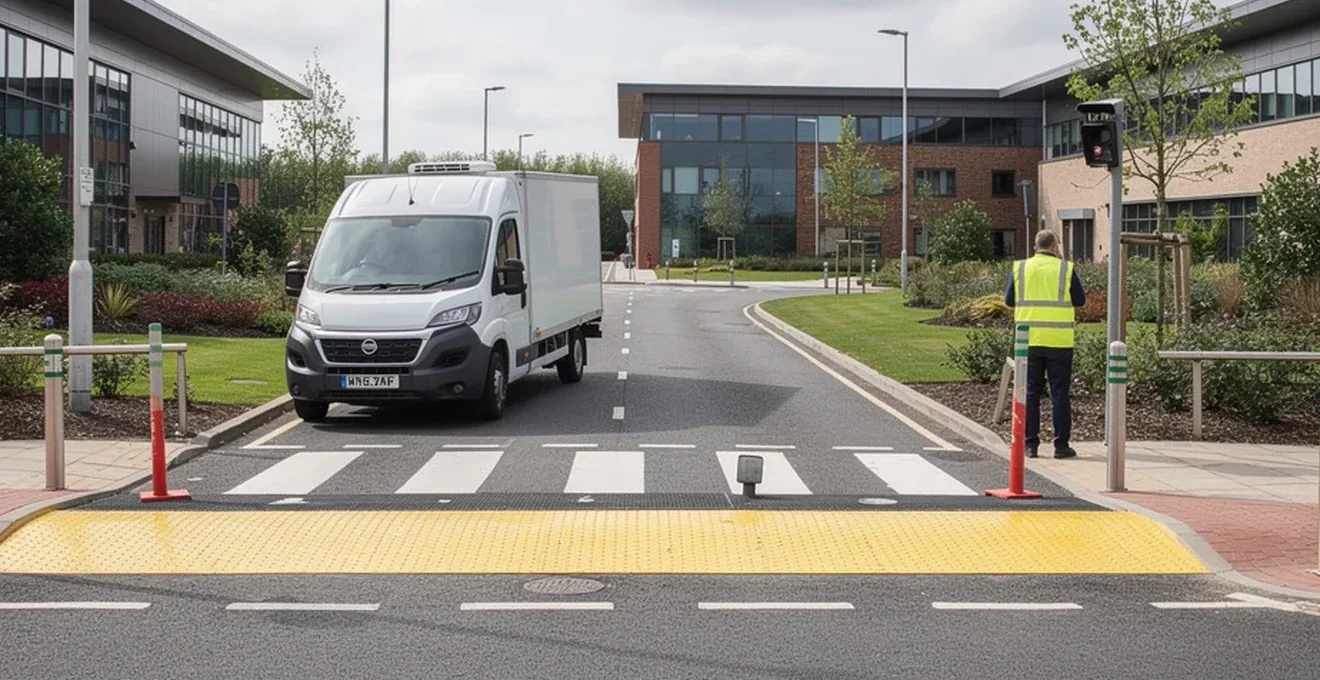
Managing vehicle movement on business premises is about far more than compliance paperwork. Vehicle-related incidents remain a persistent workplace hazard in the UK, and while comprehensive figures are difficult to pin down (many injuries, such as falls from moving vehicles, get recorded under general slips, trips and falls statistics) the fact that 20 people died after being struck by vehicles on business premises in 2019/20 is stark evidence that the risk is real. Incidents also occur during reversing, slow-speed manoeuvres, loading and unloading, coupling and uncoupling, and maintenance work. This guide sets out practical, evidence-based approaches to traffic calming on commercial sites, from physical infrastructure and signage through to technology-driven monitoring, helping you protect people, reduce liability and keep operations running smoothly.
Understanding traffic calming requirements for commercial premises
Every business site has a unique traffic profile, shaped by the types of vehicles it receives, the number of pedestrians on foot, and the layout of roads, yards and parking areas. Before specifying any traffic calming measure, it’s essential to understand where risk actually occurs, rather than applying a generic solution. Commercial driver training can only go so far in preventing accidents; physical and environmental controls are needed to manage risk consistently, regardless of individual driver behaviour.
Assessing vehicle speed and pedestrian conflict points
The starting point for any traffic calming strategy is understanding where vehicles and pedestrians are likely to interact, and at what speeds. Areas where delivery vehicles cross pedestrian walkways, where staff exit buildings onto vehicle routes, or where visibility is limited by parked vehicles or structures all represent conflict points that deserve close attention. Recording actual vehicle speeds, rather than assuming compliance with posted limits, gives a much clearer picture of where intervention is needed.
Identifying High-Risk zones: car parks, loading bays and access roads
Not all areas of a site carry equal risk. Car parks often see a mix of pedestrians, cyclists and manoeuvring vehicles in a confined space. Loading bays involve reversing HGVs, coupling and uncoupling activity, and workers on foot in close proximity to large vehicles. Access roads, particularly where they connect to public highways, are where vehicles are most likely to be travelling at higher speeds before slowing for site conditions. A site-wide risk assessment should map out these zones individually, since each may require a different calming solution.
Regulatory standards and local authority compliance in the UK
If traffic calming measures are planned on roads leading to or around your premises that connect with the public highway, they must comply with the Highways Regulations (Road Humps) 1999. This means road humps can only be installed on roads with a speed limit of 30mph or less, and their location must be clearly indicated. For measures that sit entirely within private land, landowner permission is the key requirement, but it remains vital to work with a reputable supplier to ensure structures are reliable, durable and effective. Cheap or dubious products can create new hazards rather than resolving existing ones.
Physical traffic calming measures for business environments
Physical measures remain the most reliable way to control vehicle speed because they don’t rely on driver discretion. Where a sign might be ignored, a raised surface or narrowed carriageway physically enforces slower, more careful driving.
Speed humps, speed cushions and speed tables
Speed humps are rounded mounds placed across the full width of the carriageway, forcing every vehicle to slow down. Speed cushions are raised areas installed in pairs or groups with gaps between them, allowing wider-wheelbase vehicles such as buses or emergency vehicles to pass with less disruption while still slowing cars and vans. Speed tables are flat-topped raised platforms, often used at crossings or junctions, offering a smoother, more accessible profile for pedestrians while maintaining a speed-reducing effect on traffic.
Research shows that vertical speed bumps can reduce accident rates by as much as 44%, and where accidents do still occur, the lower speeds involved tend to result in less serious injuries. Their presence is proven to encourage drivers to cross at no more than 15mph, while a series of traffic calming systems across a route can bring average speeds down to around 20mph. For most commercial sites, the practical choice comes down to either 50mm-high domestic speed bumps or 75mm-high commercial speed bumps, both typically available in kit form and in a range of lengths, making them straightforward to install on concrete or tarmac surfaces.
Chicanes and road narrowing techniques
Chicanes use alternating kerb extensions or barriers to create a bending path of travel, requiring drivers to slow down and steer carefully around the obstruction. Similarly, build-outs narrow the lane at specific points along a road, naturally reducing speed without altering the road’s height. These horizontal deflection measures are particularly useful in areas where raised surfaces may not be practical, such as routes used heavily by forklifts or where ground-level clearance is a concern.
Rumble strips and textured surfacing
Textured surfacing and rumble strips create a tactile and audible warning for drivers, alerting them to an upcoming change in road conditions or the approach to a lower-speed zone. While less forceful than a full speed hump, they’re a useful complementary measure, particularly on approach roads or at transitions between public highway and private site access.
Raised pedestrian crossings and refuge islands
Raised crossings combine the speed-reducing benefit of a vertical deflection with a clear, accessible crossing point for pedestrians. Refuge islands, meanwhile, give pedestrians a safe halfway point when crossing wider roads or yards, reducing the distance they need to cover in a single movement and giving them a place to pause if traffic conditions change mid-crossing.
Bollards and physical barriers for vehicle restriction
Bollards and other physical barriers are often used alongside road-based speed reduction systems to control where vehicles can and cannot go. They’re particularly effective for protecting pedestrian walkways, building entrances and vulnerable infrastructure from vehicle incursion, and for clearly defining the boundary between vehicle and pedestrian zones. In warehouse environments, speed bumps and wheel stops are frequently used in combination to manage both moving traffic and parked vehicle positioning.
Signage and road marking strategies to reduce vehicle speed
Physical measures work best when paired with clear visual communication. Drivers need to understand what’s expected of them well before they reach a calming feature, and signage plays a critical role in that.
Mandatory and advisory speed limit signage
Clearly displayed speed limits, whether mandatory or advisory, set the baseline expectation for drivers entering a site. These should be positioned at key entry points and repeated at intervals along longer site roads, particularly where speed limits change between zones.
Vehicle-activated signs (VAS) and their effectiveness
Vehicle-activated signs, which display a warning or the driver’s actual speed when triggered by an approaching vehicle, offer a more direct behavioural nudge than static signage. Because they respond in real time, they tend to capture driver attention more effectively than a fixed sign that becomes part of the background over repeated journeys.
Road marking systems: SLOW legends, Give-Way lines and zebra crossings
Painted road markings, including SLOW legends, give-way lines and zebra crossings, reinforce the message carried by physical infrastructure and signage. Coloured surfacing can also be used to highlight pedestrian routes or crossing points, drawing driver attention to areas of higher foot traffic. These markings are especially valuable in areas where physical interventions aren’t feasible due to budget or site constraints, offering a lower-cost way to influence driver behaviour through visual cues alone.
Site-specific applications: retail parks, warehouses and industrial estates
The right combination of traffic calming measures depends heavily on the type of site and how it’s used day to day.
Managing HGV movements on logistics and distribution sites
Sites with frequent HGV and LGV traffic need to consider the height, spread and fixing method of any speed bump or raised feature carefully. A structure that gets easily damaged or displaced by heavy vehicles creates a new safety hazard rather than resolving one. Specification should be based on the height-to-speed-goal ratio: a stronger speed reduction target, such as bringing vehicles down to 5mph in a loading area, generally requires a larger or more pronounced hump. Working with an experienced traffic safety supplier helps ensure the chosen solution slows vehicles effectively without damaging them or blocking access for emergency vehicles.
Segregating pedestrian and vehicle routes in retail car parks
Retail car parks combine high pedestrian footfall with constant vehicle manoeuvring, making clear segregation essential. Raised walkways, bollard-protected paths and clearly marked crossing points all help keep pedestrians away from vehicle routes, while speed cushions or humps at car park entrances slow traffic before it reaches busier pedestrian areas.
Traffic calming for school runs and nursery access points
Sites with nurseries, schools, or similar high-vulnerability pedestrian groups nearby benefit from a layered approach: raised tables at crossing points, clear signage indicating the presence of children, and coloured surfacing to mark pedestrian priority areas. These measures work together to create an unmistakable visual and physical cue that drivers are entering a zone where extra caution is required.
Technology-driven solutions for modern traffic management
Alongside physical infrastructure, technology offers additional tools for monitoring and managing vehicle behaviour on site.
ANPR systems and automated speed monitoring
Automatic Number Plate Recognition (ANPR) systems can be used to monitor vehicle movements, track compliance with site speed limits, and identify repeat offenders for follow-up. This data can also inform ongoing risk assessments, helping identify whether existing calming measures are having the desired effect or whether further intervention is needed.
Smart sensors and Real-Time pedestrian detection
Sensor-based systems that detect pedestrian presence and alert approaching vehicle drivers add a further layer of protection, particularly at blind corners or busy crossing points where visibility is limited. These technologies complement, rather than replace, physical traffic calming measures, adding real-time awareness to a site where sightlines or layout present ongoing challenges.
Implementation planning and return on investment for businesses
Introducing or upgrading traffic calming measures is an investment, but one that pays off through reduced accident risk, lower liability exposure and smoother day-to-day operations.
Conducting a site traffic risk assessment
A thorough risk assessment should map every vehicle route, pedestrian path and conflict point across the site, identifying arterial roads, secondary access routes, car parks, and areas where fleets and visiting lorries tend to cluster. This assessment forms the basis for deciding where bollards, signage and road-based speed reduction systems should be positioned for maximum effect, and it should include consideration of visibility: hi-vis markings and clear signage are essential to ensure calming measures are seen, and therefore safe, rather than becoming a hazard in themselves.
Cost analysis: installation, maintenance and insurance implications
Traffic calming measures involve upfront installation costs, but these should be weighed against the potential cost of accidents, including injury claims, litigation, reputational damage and operational disruption. Materials, weather resistance and drainage compatibility all affect long-term maintenance costs, so it’s worth considering total cost of ownership rather than just initial price. Modular, kit-based solutions can also help spread investment over time, supporting phased roll-outs or trial installations before committing to a full-scale scheme.
Case studies: traffic calming success at UK business parks
Across UK business sites, the consistent lesson is that effective traffic calming comes from combining measures rather than relying on a single solution. Speed bumps paired with wheel stops in warehouse yards, raised tables combined with clear signage near pedestrian crossings, and vehicle-activated signs used alongside physical narrowing all demonstrate how layered approaches deliver more reliable results than any single measure alone. Sites that treat traffic calming as an ongoing process, reviewing effectiveness and adjusting measures as vehicle patterns change, tend to see the most sustained improvements in safety.