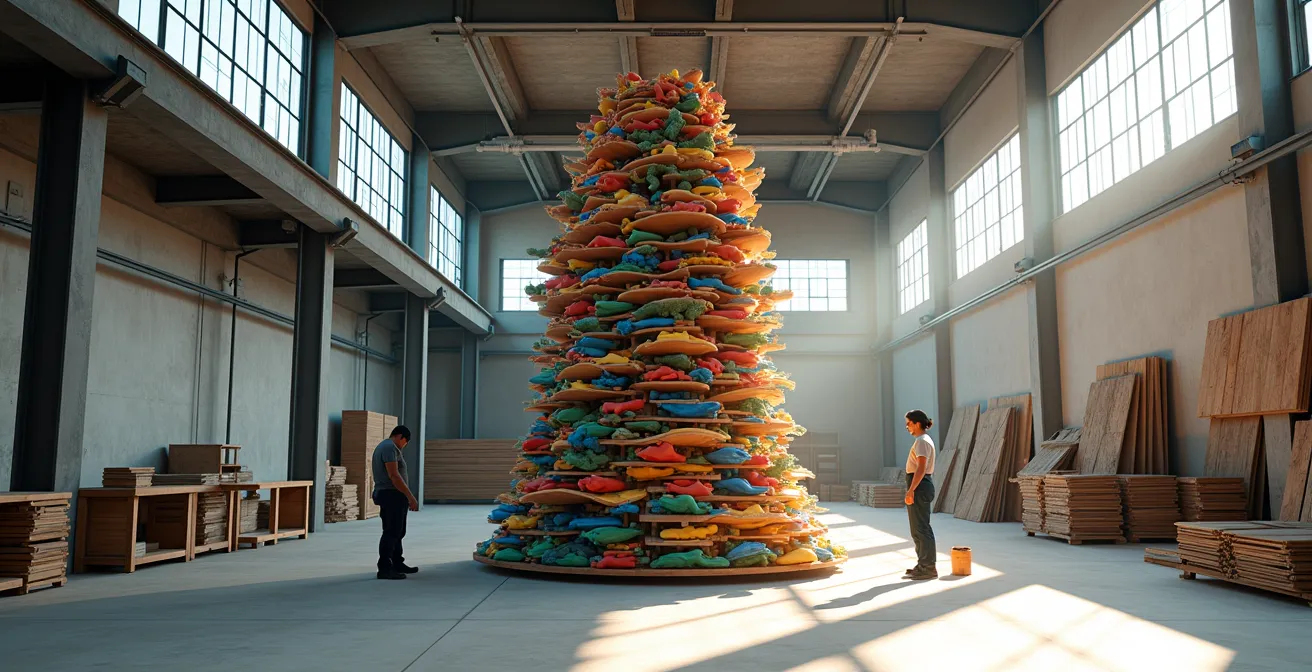
Contrary to common belief, creating significant sustainable sculpture is not about choosing eco-friendly materials; it’s about mastering the engineering of their entire lifecycle.
- Structural integrity, not just aesthetics, must dictate the use of unconventional materials like recycled polymers or bio-composites.
- Advanced analysis, such as Finite Element Analysis (FEA), is crucial for predicting long-term stability and ensuring public safety.
Recommendation: Shift your focus from material sourcing to a holistic framework of ‘Lifecycle Engineering’—planning for a sculpture’s stability, maintenance, and eventual deconstruction from day one.
The mandate for public art is evolving. Where once the discourse was dominated by form and placement, a new, more profound imperative has emerged: sustainability. For sculptors and public art installers, this shift presents a challenge that transcends mere material substitution. The prevailing wisdom urges the use of recycled plastics, reclaimed wood, and salvaged metal. While noble, this advice often overlooks the monumental engineering questions that arise when these materials are scaled for the public realm, where they must withstand environmental forces and the test of time.
The true task is not simply to build sustainably, but to build with structural intelligence and foresight. This involves grappling with the unique material properties of recycled composites, understanding their degradation rates, and designing anchoring systems that are both robust and reversible. The conversation must move beyond the conceptual message of sustainability to the practical, structural execution that gives it lasting form and credibility. The risk of failure—not just artistic, but physical—is immense if we treat sustainable materials as simple drop-in replacements for bronze or stone.
This guide reframes the challenge. Instead of asking *what* materials to use, we will explore *how* to integrate them within a majestic, innovative, and structurally sound framework. We will delve into a new paradigm of ‘Lifecycle Engineering’ for art, where the sculpture’s long-term behavior, its connection to its environment, and even its economic impact are considered integral parts of the creative act. It is a call for a new monumentality, one founded not on permanence alone, but on intelligent and responsible creation.
This article provides a structural framework for artists and commissioners, covering everything from the foundational physics of asymmetrical forms to the economic ecosystems that cultural institutions can foster. The following sections will guide you through the critical considerations for commissioning and creating large-scale sustainable sculpture that is both visionary and viable.
Summary: A Commissioner’s Framework for Sustainable Monumental Art
- Why Recycled Plastic Sculptures Are Gaining Value in Public Spaces?
- How to Calculate the Center of Gravity for Asymmetrical Sculptures?
- Bronze Casting or Stone Carving: Which Method Suits Your Artistic Temperament?
- The Anchoring Mistake That Can Topple Outdoor Sculptures
- Problem and Solution: Organizing a Small Studio for Large Sculpture Work
- Chemical Glues or Gecko Adhesives: Which Is the Future of Assembly?
- How to Re-point Historic Brickwork Without Trapping Moisture?
- How Can Cultural Institutions Drive Economic Revitalization in Post-Industrial Cities?
Why Recycled Plastic Sculptures Are Gaining Value in Public Spaces?
The ascent of recycled plastic in monumental sculpture marks a critical shift from a material of convenience to one of conceptual and economic significance. Initially valued for its low cost and availability, its role in public art is now being redefined. The new value proposition is not just that it is “green,” but that it offers a unique aesthetic language and a powerful narrative tool. In an era of heightened environmental awareness, using post-consumer waste is a political and social statement embedded directly into the artwork’s DNA.
This transition is driven by a deeper appreciation for Material Provenance—the story behind the material itself. A sculpture made from thousands of plastic bottles collected from a local riverfront carries a narrative weight that virgin materials cannot replicate. This practice transforms waste into a medium that critiques consumer culture and documents a community’s environmental footprint. As a result, commissioning bodies now see these works as more than just objects; they are catalysts for public dialogue and educational programming.
Case Study: El Anatsui’s Large-Scale Installations
The renowned Ghanaian artist El Anatsui creates majestic, tapestry-like installations from discarded aluminum bottle caps and metal scraps. By weaving together over 1,000 caps in a single piece, he transforms consumer waste into breathtaking art that comments on global trade, colonialism, and environmental impact. His work demonstrates how the immense scale and inherent history of recycled materials can produce works of profound beauty and cultural critique.
From a commissioner’s standpoint, this also has a practical dimension. Creating art from recycled plastics often reduces the demand for virgin materials, conserving natural resources and the energy-intensive processes required for their production. This alignment with municipal sustainability goals can unlock new funding streams and public-private partnerships, further increasing the value and viability of such projects. The sculpture becomes a tangible symbol of a city’s commitment to the circular economy.
Ultimately, the growing value of recycled plastic sculptures lies in their unique ability to merge aesthetic innovation with a potent, site-specific story, making them a majestic and highly relevant choice for contemporary public art.
How to Calculate the Center of Gravity for Asymmetrical Sculptures?
For any large-scale sculpture, stability is non-negotiable. With monumental works crafted from unconventional or asymmetrical sustainable materials, calculating the center of gravity ceases to be a simple physics problem and becomes a complex engineering challenge. Traditional methods fall short when dealing with materials like compressed textiles or non-uniform recycled polymers, which lack homogenous density. An error in this calculation can lead to structural instability and, in the worst-case scenario, catastrophic failure.
The modern, innovative solution lies in the use of digital tools, specifically Finite Element Analysis (FEA). FEA software allows artists and engineers to create a “digital twin” of the sculpture. This virtual model can be composed of multiple materials, each assigned specific properties like density, elasticity, and potential degradation rates. By simulating gravitational forces and external loads (like wind or snow) on this digital twin, it is possible to precisely locate the center of gravity for even the most complex, asymmetrical form. This predictive analysis is the cornerstone of responsible engineering in modern sculpture.

As this visualization demonstrates, the digital twin allows for a granular understanding of stress distribution throughout the structure. The glowing orb at the core represents the calculated center of gravity, but the colored gradients reveal how forces flow through the form. This insight is crucial for optimizing the internal armature and anchoring points, ensuring that the physical sculpture can safely support its own weight. This process moves beyond intuition and provides empirical data to guarantee long-term structural integrity.
By embracing such advanced analytical methods, creators of large-scale sustainable works can push artistic boundaries with confidence. They can design majestic, gravity-defying forms, secure in the knowledge that their vision is underpinned by rigorous scientific validation, ensuring the work’s safety and permanence in the public realm.
Bronze Casting or Stone Carving: Which Method Suits Your Artistic Temperament?
The question of bronze casting versus stone carving has traditionally been framed around an artist’s temperament: the additive, fluid process of modeling and casting versus the subtractive, confrontational act of carving. However, in the context of sustainability, this choice takes on a new dimension. The modern artistic temperament is increasingly defined not by a mastery of a single traditional material, but by an innovative aptitude for working with found, recycled, and unconventional materials. The choice is no longer just between bronze and stone, but between established processes and a new methodology of sustainable creation.
An artist’s temperament may now be expressed through their approach to material sourcing and assembly. As the Art Sustainability Journal notes, the process itself becomes part of the art:
Take, for example, an artist who repurposes old wood and scrap metal to create breathtaking sculptures. Or another who experiments with plant-based paints that are free from harmful chemicals. Some are even exploring biodegradable materials or using sustainable 3D printing technologies to bring their visions to life. The beauty of these practices? They show that art doesn’t need to rely on new or “perfect” materials to be valuable or impactful.
– Art Sustainability Journal, Sustainability in Art: Using Eco-Friendly Materials
This perspective reframes the question. An artist with a temperament for meticulous curation and storytelling might find their voice in assembling discarded objects, each with its own history. This is exemplified in the work of Song Dong, whose sculptures composed of old wooden windows, mirror panels, and other quotidian objects explore memory and transience, defining sustainability in a deeply personal and modern way. This approach requires a temperament comfortable with imperfection, narrative, and systemic thinking.
Therefore, choosing a method is less about the binary of casting versus carving and more about where an artist finds meaning. Is it in the timeless authority of stone, or in the urgent, layered narratives of repurposed materials? The truly contemporary artistic temperament is one that can see the monumental potential in the discarded and possesses the innovative spirit to give it a new, sustainable form.
The Anchoring Mistake That Can Topple Outdoor Sculptures
A sculpture’s connection to the ground is its most critical structural interface. For monumental works, especially those using sustainable materials with variable properties, a failure in anchoring is not just a mistake—it is a catastrophic risk to public safety. The most common error is treating the anchor as a static, inert component, ignoring the dynamic relationship between the sculpture, its foundation, and the environment over time. This is a failure of Lifecycle Engineering, where the long-term behavior of materials is not adequately planned for.
Sustainable materials introduce unique challenges. Recycled plastics can exhibit “creep,” a slow deformation under sustained load. Bio-composites or rammed earth can degrade or change properties when exposed to moisture. Using a standard concrete footing with a breathable material can trap moisture, accelerating decay. The anchoring system must be designed in structural symbiosis with the sculpture, anticipating these changes rather than ignoring them. This requires a shift from brute-force anchoring to intelligent, adaptable systems.
This is where predictive analysis becomes indispensable. According to engineering experts, using FEA can significantly reduce the number of physical prototypes needed, allowing for virtual testing of different anchoring strategies. This not only saves resources but also enables the optimization of the anchoring system for long-term resilience.

The most innovative approaches even integrate living systems. As seen in this conceptual design, a foundation can incorporate deep-rooted plants, creating a “living anchor” where the root system interweaves with mechanical fixtures. This bio-integrated approach creates a foundation that strengthens over time, offering a truly sustainable and majestic solution that works in harmony with its ecosystem. To avoid critical errors, a systematic audit of the anchoring plan is essential.
Action Plan: Critical Anchoring Considerations for Sustainable Materials
- Analyze material-specific degradation rates: Factor in creep for recycled plastics and biodegradation timelines for organic materials in your structural calculations.
- Design reversible mechanical anchoring systems: Use bolts and modular plates instead of poured concrete to facilitate maintenance, relocation, or end-of-life deconstruction, aligning with circular economy principles.
- Ensure material compatibility: Avoid pairing non-porous modern anchors (like stainless steel in concrete) with breathable, historic, or natural materials (like rammed earth or soft stone) to prevent moisture trapping and material failure.
- Integrate living anchor systems: For land-based installations, explore using deep-rooted, non-invasive plants to create a bio-integrated foundation that strengthens over time.
- Apply dynamic boundary conditions in FEA: Ensure your digital analysis accounts for how material properties (like elasticity or weight) will change over the sculpture’s lifespan due to environmental exposure.
Ultimately, the anchor is not the end of the sculpture, but the beginning of its dialogue with the earth. Designing it with foresight and innovation is the ultimate expression of structural responsibility.
Problem and Solution: Organizing a Small Studio for Large Sculpture Work
The problem is a classic paradox for sculptors: creating monumental art within the finite confines of a small studio. This challenge is magnified when working with sustainable materials, which often arrive in non-uniform shapes and require distinct processing environments. A haphazard workshop layout leads to inefficiency, cross-contamination, and safety hazards. The solution is not a larger space, but a more intelligent one: a modular, zoned system designed specifically for the workflow of sustainable art production.
This approach involves dividing the studio into distinct zones based on material and process. A “Clean Zone” is essential for sensitive work like cultivating mycelium or mixing bio-resins, requiring sterile surfaces and controlled air quality. A separate “Processing Zone” with robust ventilation and heat-resistant surfaces is needed for handling recycled plastics or cutting reclaimed metal. This systematic separation prevents, for example, sawdust from contaminating a resin pour or plastic off-gassing from affecting an organic material.
Organizing these zones effectively requires a strategic approach to storage and assembly. Vertical racking and a “just-in-time” inventory system for salvaged materials like old barn wood or industrial scrap prevent the studio from being overrun. Mobile work surfaces and tool carts allow the central “Assembly Zone” to be reconfigured on-demand, adapting to the shifting scale and needs of the project as it grows. The following table outlines a foundational zoning strategy for a sustainable materials workshop.
| Zone Type | Materials Handled | Key Requirements |
|---|---|---|
| Clean Zone | Mycelium cultivation, bio-resins | HEPA filtration, sterile surfaces, controlled humidity |
| Processing Zone | Recycled plastics, reclaimed metals | Ventilation for off-gassing, heat-resistant surfaces |
| Storage Zone | Reclaimed wood, salvaged materials | Vertical racking, moisture control, just-in-time inventory |
| Assembly Zone | All materials for final construction | Modular work surfaces, mobile tool storage |
By implementing a structured, zoned methodology, an artist transforms their small studio from a place of chaotic storage into a highly efficient, professional production facility. This organizational discipline is not just administrative; it is a foundational element of creating ambitious, large-scale sustainable sculpture safely and effectively.
Chemical Glues or Gecko Adhesives: Which Is the Future of Assembly?
The assembly of a large-scale sculpture is a moment of truth, where disparate parts become a unified whole. For decades, this has been the domain of powerful chemical glues and epoxies—effective, but often toxic and permanent, creating composite materials that are impossible to recycle. The future of sustainable assembly, however, is moving towards a more nuanced and intelligent approach, inspired by nature and designed for disassembly. This involves a choice between the brute force of chemical bonds and the innovative elegance of bio-adhesives and mechanical joinery.
The development of project-specific bio-adhesives represents a major leap forward. These are glues derived from natural, often locally sourced, binding agents like casein from milk proteins or starches from plants. As the “Sustainable Artwork Guide” suggests, even simple, traditional binders can be effective; one can “Bind them with vegan-friendly options like gum arabic or linseed oil.” The key is to match the adhesive’s properties to the base materials and the sculpture’s intended lifespan. For ephemeral works, it’s even possible to design joints with a calculated biodegradation timeline, embracing a concept of Engineered Ephemerality.
However, the most forward-thinking approach often minimizes adhesives altogether. Re-embracing traditional woodworking techniques like mortise-and-tenon joints, or designing modern systems of mechanical fasteners, allows a sculpture to be assembled and, crucially, disassembled at the end of its life. This commitment to a circular design ensures that materials can be recovered, repurposed, or returned to the earth. This is the philosophy behind gecko-inspired adhesives, which rely on physical forces (van der Waals forces) rather than chemical reactions, allowing for strong but reversible bonds.
Ultimately, the choice is not merely between two types of glue. It is a strategic decision that reflects the sculpture’s core philosophy. Does it aim for monolithic permanence at any environmental cost, or does it embody a majestic, intelligent design that accounts for its entire lifecycle, from creation to deconstruction?
How to Re-point Historic Brickwork Without Trapping Moisture?
The technical challenge of re-pointing historic brickwork—replacing deteriorating mortar with a new compound that breathes—offers a powerful and majestic metaphor for the stewardship of all monumental structures, including modern sustainable sculptures. The cardinal rule is to use a mortar that is softer and more porous than the bricks themselves. This ensures that moisture can escape through the mortar joints, which act as a “sacrificial” element, protecting the bricks from spalling and freeze-thaw damage. Using a hard, modern cement mortar traps moisture within the brick, leading to its eventual destruction from the inside out.
This principle of a sacrificial, breathable skin has profound implications for the maintenance of large-scale sculptures made from natural or earthen materials. Just as with historic brick, these works are not static. They breathe, absorb moisture, and shift with thermal changes. To protect them, we can develop sacrificial renders—thin, breathable coatings made from lime-wash or clay-slips that match the core material’s properties. These renders are designed to weather and erode slowly, protecting the structural layers beneath. Their reapplication becomes a planned ritual of maintenance, a documented part of the sculpture’s evolving history.
This concept extends even further, to the idea of Engineered Ephemerality. Some of the most innovative environmental art is designed to have a finite lifespan, gracefully returning to nature. This philosophy is perfectly embodied by the work of artists Martin Hill and Philippa Jones.
Case Study: The Ephemeral Sculptures of Martin Hill and Philippa Jones
Using only materials found in the natural environment—ice, stones, twigs, leaves—these artists create stunning, temporary sculptures. Once complete, the works are left to be reclaimed by nature, “thereby mimicking natural systems that operate without creating waste.” This approach creates a closed-loop design consistent with a circular pattern of sustainability, where nothing is wasted. The sculpture’s decay is not a failure, but the completion of its lifecycle.
Whether designing for centuries of managed care or for a few seasons of beautiful decay, the lesson from historic preservation is clear: we must work with the nature of our materials, not against them. A truly sustainable structure is one that is designed to age gracefully, whether its lifespan is measured in decades or in days.
Key Takeaways
- Sustainable sculpture is a discipline of engineering, not just material choice, requiring a ‘Lifecycle Engineering’ approach.
- Digital tools like Finite Element Analysis (FEA) are essential for ensuring the structural safety and integrity of works made from unconventional materials.
- The most innovative and responsible designs plan for a sculpture’s full lifecycle, including maintenance, graceful aging, and eventual disassembly or biodegradation.
How Can Cultural Institutions Drive Economic Revitalization in Post-Industrial Cities?
Cultural institutions, from museums to public art commissions, hold a unique power to act as engines of economic revitalization, particularly in post-industrial cities. By strategically commissioning and championing large-scale sustainable art, they can catalyze a new form of Economic Ecology. This goes far beyond simply erecting a sculpture. It involves creating a closed-loop system where art becomes a driver for local job creation, new skill development, and even environmental remediation. The movement towards eco-friendly art is no longer a fringe interest; as industry analysis shows, Sustainability has become a successful art niche, with artists gaining fame for these practices.
This is exemplified by artists like Aurora Robson, who is known for her intricate and majestic sculptures made from discarded plastic debris. Her work not only raises awareness about plastic pollution but also creates a demand for the systems to collect, sort, and process such waste, hinting at a new supply chain. When a cultural institution commissions such a work, it can stipulate the use of hyperlocal materials—sourcing plastic waste from local waterways or industrial scrap from defunct factories. This immediately creates a micro-economy around the collection and preparation of these materials.
The impact can be scaled through more ambitious initiatives. A city can establish a “Sustainable Materials Art Lab” in partnership with a university, creating a hub for R&D in eco-materials and training a local workforce in new green-tech skills. An annual “Circular Art Festival” can become a major tourism draw, generating recurring revenue while mandating that all installations are created from remediated land or local waste streams and are fully recycled at the festival’s end. This transforms the art program from a municipal expense into a regenerative economic and environmental asset.
The following model, based on an analysis of circular economic strategies, illustrates how targeted cultural initiatives can generate profound value:
| Initiative Type | Economic Impact | Sustainability Benefit |
|---|---|---|
| Hyperlocal Materials Commissioning | Creates local supply chains and jobs | Reduces waste from post-industrial sites |
| Sustainable Materials Art Lab | Develops new technical skills and R&D jobs | Advances eco-material innovation |
| Remediating Art Projects | Attracts environmental funding and tourism | Actively cleans contaminated land |
| Annual Circular Art Festival | Generates recurring tourism revenue | Zero-waste through complete material reuse |
By acting as visionary commissioners, cultural institutions can do more than beautify a city. They can actively participate in its economic and environmental rebirth, proving that monumental art can build not just cultural landmarks, but a more sustainable and prosperous future.