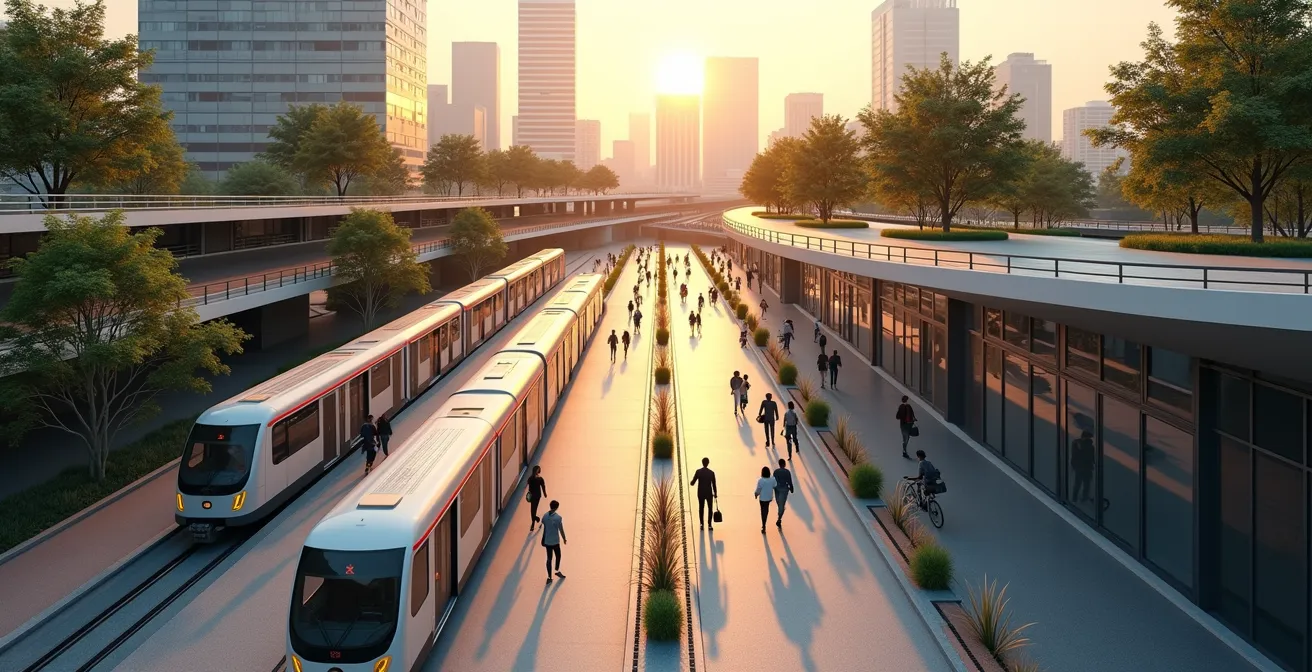
The debate over selling your car isn’t about saving a few dollars; it’s about opting out of an inefficient, depreciating system.
- Your privately owned car is a massively underutilized asset, costing you far more in hidden fees and lost time than you realize.
- Mobility as a Service (MaaS) acts as a city’s “Urban Operating System,” optimizing all transport modes for maximum efficiency, not just convenience.
Recommendation: Shift your mindset from “owning a vehicle” to “accessing mobility” to unlock faster, cheaper, and less stressful commutes.
For most urban dwellers, the daily commute is a ritual of frustration. You sit in traffic, burning fuel and time, in a vehicle that spends over 95% of its life parked and depreciating. The conventional wisdom suggests that moving away from private cars is about saving a little money on gas or reducing your carbon footprint. These are valid points, but they miss the larger, more fundamental transformation taking place in our cities.
The conversation is no longer just about choosing a greener or cheaper option. We are on the cusp of a complete paradigm shift in how we perceive and consume transportation. The real issue with car ownership isn’t the sticker price; it’s the profound inefficiency of the model itself. It’s a system built around a single, inflexible, and dramatically underutilized asset.
But what if the true solution wasn’t finding a better car, but replacing the entire concept of ownership with something more dynamic? This is the promise of Mobility as a Service (MaaS). This article reframes the debate, presenting MaaS not as a collection of apps, but as the integrated “Urban Operating System” designed to manage a city’s resources with ruthless efficiency. We will analyze the hidden burdens of car ownership and demonstrate how a service-based approach is the logical evolution for modern urban life.
For those who prefer a visual summary, the following video offers a glimpse into how Mobility as a Service is already reshaping a major city like London, illustrating the concepts we will explore in detail.
To fully grasp this transition, this guide is structured to deconstruct the old model of car ownership and build up the new logic of MaaS. We will explore the hidden costs, the efficiency gains of multimodal travel, and how this new system solves long-standing problems from commute stress to range anxiety.
Summary: The End of Car Ownership: How MaaS Is Becoming the New Urban Operating System
- Why Your Parked Car Is Costing You $500/Month in Invisible Fees?
- How to Combine Bikes, Trains, and Rideshare for Faster Commutes?
- Car Subscription or Lease: Which Offers More Flexibility?
- The Commuting Error That Adds 20 Minutes to Your Trip
- Problem and Solution: Reducing Commute Stress Using Real-Time Data Apps
- Why a 3-Day Festival Generates Year-Round Income for Locals?
- How to Reduce Fuel Drag by 5% Using Shark Skin Textures?
- How to Overcome Range Anxiety When Switching to a Zero-Emission Vehicle?
Why Your Parked Car Is Costing You $500/Month in Invisible Fees?
The most significant flaw in the private car ownership model is the concept of asset underutilization. A car is often the second-largest purchase a person makes, yet it sits idle for the vast majority of its life. This isn’t just a missed opportunity; it’s a constant financial drain that goes far beyond your monthly loan payment. When you factor in insurance, depreciation, maintenance, parking, and taxes, the true cost of ownership becomes staggering.
Most car owners dramatically underestimate these “invisible” expenses. They are not line items you pay every day, but they steadily erode your finances. A comprehensive 2025 Bankrate study reveals that these hidden costs can amount to an average of $575 per month. For new vehicles, the picture is even starker. According to AAA’s 2025 Your Driving Costs analysis, the total cost of owning and operating a new car averages $11,577 annually, or roughly $965 per month. This isn’t the cost of mobility; it’s the cost of keeping a large piece of machinery on standby.
From an urban planning perspective, this represents a massive misallocation of both personal and public resources. Your parked car occupies valuable urban real estate, contributes to the demand for costly parking infrastructure, and represents locked-up capital that could be used more productively. MaaS challenges this by converting the fixed, high cost of ownership into a variable, pay-per-use model. You pay only for the mobility you consume, eliminating the financial burden of the 95% of the time your vehicle is not in use.
How to Combine Bikes, Trains, and Rideshare for Faster Commutes?
The power of Mobility as a Service lies in its ability to function as a city’s “Urban Operating System.” It doesn’t just offer different transport options; it intelligently integrates them into a single, seamless journey. The goal is to achieve frictionless transition, allowing a commuter to switch from a train to a scooter to a ride-hail vehicle without juggling multiple apps, tickets, or payment methods. This integration is what unlocks true efficiency and often leads to faster travel times than relying on a private car, which is subject to the single point of failure: traffic.
Imagine this scenario: your MaaS app analyzes real-time traffic and transit data. It determines that driving your car to work will take 45 minutes due to an accident on the highway. Instead, it proposes a 35-minute alternative: a 5-minute e-bike ride to the nearest train station, a 20-minute express train journey, and a final 10-minute walk or e-scooter ride to your office. The system handles all ticketing and payments in the background. This is multimodal optimization in action.

As the image above suggests, this process empowers the user, providing a single interface to orchestrate a complex journey with confidence. A MaaS platform can calculate the optimal combination of speed, cost, and personal preference, offering a level of flexibility impossible with a private vehicle. The system’s ability to dynamically re-route and suggest alternatives based on live conditions transforms the commute from a rigid, stressful chore into an agile, responsive process. This is the core function of the Urban OS: managing all mobility assets to deliver the most efficient outcome for the end-user.
Car Subscription or Lease: Which Offers More Flexibility?
As urban dwellers begin to question the rigid model of car ownership, intermediate solutions like leasing and car subscriptions have emerged. They represent steps away from long-term commitment, but they are still fundamentally tied to a single vehicle. A traditional lease locks you into one car for 2-4 years with heavy penalties for early termination. A car subscription offers more flexibility, allowing you to switch vehicles or cancel with a month’s notice, but you are still managing a dedicated car. MaaS represents the final evolution in this journey toward flexibility.
The following table, inspired by analyses from organizations like the MaaS Alliance, compares these models, clearly showing the progression towards the on-demand freedom that a true MaaS system provides.
| Feature | Traditional Lease | Car Subscription | MaaS Integration |
|---|---|---|---|
| Contract Length | 24-48 months fixed | 1-12 months flexible | Daily/Monthly/Pay-per-use |
| Vehicle Switching | Not possible | Monthly changes allowed | Per-trip selection |
| Insurance Included | Separate purchase | Bundled in price | Fully integrated |
| Maintenance | Owner responsibility | Included in service | No maintenance needed |
| Early Termination | Heavy penalties | 30-day notice | No commitment |
While subscriptions are an improvement, they don’t solve the core problem of choosing the right tool for the job. You might have a subscription for an SUV, but for a quick trip downtown, an e-bike is faster and cheaper. A true MaaS platform makes the entire mobility ecosystem your garage. You choose the perfect mode for each specific trip, whether it’s a cargo van for a trip to the hardware store or a train for a long-distance commute.
Case Study: Berlin’s Jelbi Platform
A prime example of this ultimate flexibility is Berlin’s Jelbi app. Developed in partnership with the city’s public transport authority, it integrates every form of public and shared mobility—from trains and buses to scooters, bikes, and car-sharing services. Berliners can plan multimodal journeys, purchase all necessary tickets, and pay for every leg of the trip within a single application. This is the MaaS vision made real: a system where access to a diverse fleet of options completely replaces the need for a single, privately-owned vehicle.
The Commuting Error That Adds 20 Minutes to Your Trip
The single biggest commuting error urbanites make is a cognitive one: defaulting to the private car for every journey. This reliance on a single, inflexible mode of transport is the primary cause of systemic inefficiency and wasted time. When every individual makes the “logical” choice to drive their own car, the collective result is gridlock, turning a 15-minute drive into a 35-minute crawl. That 20-minute difference is the tax we all pay for a transportation system designed around isolated vehicles rather than an integrated network.
This isn’t a new problem; congestion has been steadily worsening for decades in major urban centers. The vehicle-centric model has reached its physical limits. The solution is not wider roads, but a smarter, more dynamic system that can adapt to demand in real time. This requires a fundamental shift in philosophy, a move that experts have been advocating for years. As one analysis highlights, the future is about empowering the user, not the vehicle.
The model which gains momentum today is MaaS — mobility as a service, a network of coordinated transportation forms, which can be combined at different parts of the journey in the most beneficial and convenient manner. The contemporary vehicle-centric system is going to be replaced with a more efficient consumer-centric one.
– STFalcon Technology Analysis, What Is Mobility As A Service And How To Make The Most Of It
This consumer-centric approach, powered by a MaaS “Urban OS,” corrects the commuting error by design. It presents users with optimized, multimodal options first, making the most efficient route the easiest one to choose. It leverages the entire transport network—trains, buses, bikes, scooters—to create peak demand elasticity, absorbing commuter flows in ways that a road filled with single-occupancy cars never could. By breaking the habit of defaulting to the car, MaaS directly tackles the root cause of urban congestion.
Problem and Solution: Reducing Commute Stress Using Real-Time Data Apps
The problem with traditional commuting is not just the time it takes, but the mental load it imposes. The uncertainty of traffic, the hunt for parking, the anxiety of potential delays—all contribute to significant daily stress. The solution lies in replacing this uncertainty with the predictability and control offered by a data-driven MaaS platform. These platforms act as a central nervous system for urban mobility, processing thousands of data points to provide a clear and reliable path forward.
A well-designed MaaS application leverages real-time updates on traffic, transit delays, and vehicle availability to empower users. If a subway line is unexpectedly closed, the app can instantly reroute you to a nearby bus or a ride-share service, complete with updated arrival times and costs. This ability to adapt on the fly turns a potential crisis into a minor inconvenience, drastically reducing commute-related stress. The system’s core components—integrated digital platforms, live travel information, unified payments, and a connected IoT network—all work in concert to create a seamless and dependable experience.
Case Study: Pittsburgh’s Move PGH Initiative
In Pittsburgh, the Move PGH pilot program demonstrated how providing reliable alternatives can change behavior and reduce car dependency. By integrating services like e-scooters, a survey of over 2,200 users found that 35% of scooter trips directly replaced journeys they would have otherwise made by car. This shift accounted for an estimated 257,000 fewer vehicle miles traveled, proving that when convenient and reliable options are available through an integrated system, people will willingly choose them over the stress of driving and parking.
This data-driven approach allows for a level of planning and reliability that a private car, isolated from the network, can never offer. It’s the difference between navigating with a static paper map versus a live GPS that reroutes you around traffic jams. MaaS provides that live, intelligent guidance for your entire journey.
Action Plan: Audit Your Commute for MaaS Integration
- Map Your Mobility Points: List every mode of transport you use or could use (car, bus, train, bike share, scooter, etc.) and their key access points (stations, parking spots, docks) near your home and work.
- Inventory Your Current Tools: Collect your existing mobility assets and apps. This includes your car keys, transit passes, and separate apps for ride-sharing, bike rentals, and public transport.
- Assess for Cohesion: Compare your current disjointed system to the promise of a single MaaS app. How many steps and payments could be consolidated? Identify the biggest points of friction in your current commute.
- Evaluate Emotional Cost: On a scale of 1-5, rate the stress level associated with each leg of your typical commute (e.g., finding parking: 5/5). Identify the parts of your journey that a MaaS platform could simplify.
- Draft an Integration Plan: Based on your audit, outline a one-week trial. Challenge yourself to replace at least 50% of your car trips using a combination of other modes, simulating a MaaS-centric lifestyle to measure savings in time, cost, and stress.
Why a 3-Day Festival Generates Year-Round Income for Locals?
This question seems unrelated to mobility, but it provides a powerful analogy for the economic impact of MaaS. A major event like a music festival acts as a temporary economic catalyst. It draws in people, creates demand for services (food, lodging, transport), and generates a concentrated burst of income for the local community. For a few days, resources are managed with high intensity and efficiency. Now, imagine that same catalytic effect, but instead of lasting for three days, it becomes a permanent, year-round feature of the city’s economy. This is what a fully implemented MaaS “Urban OS” achieves.
By optimizing the flow of people and goods every single day, MaaS creates a new, sustained economic ecosystem. It reduces the “deadweight loss” of congestion and time spent searching for parking. It unlocks new service-based jobs in vehicle maintenance, fleet management, and data analytics. Most importantly, it makes the city more accessible and efficient for everyone, which in turn stimulates broader economic activity. People can move more freely, access more jobs, and participate more fully in the urban economy.
The scale of this new mobility economy is not trivial. It represents a fundamental restructuring of a multi-trillion-dollar sector. According to a KPMG Mobility 2030 analysis, the global mobility ecosystem’s value is forecasted to grow to over 1 trillion USD by 2030. This growth is not just about selling more cars; it’s about providing more efficient, valuable services. Just as a festival’s economic impact ripples far beyond ticket sales, the economic benefit of MaaS extends far beyond the cost of a single trip.
How to Reduce Fuel Drag by 5% Using Shark Skin Textures?
The automotive industry has long been obsessed with micro-optimizations. Engineers spend millions developing technologies like “shark skin” textures to reduce aerodynamic drag by a few percentage points, all in the name of marginal fuel efficiency gains. While technologically impressive, this focus completely misses the forest for the trees. The greatest source of “drag” on our transportation system isn’t air resistance; it is the staggering inefficiency of asset underutilization and operational downtime.
Consider the traditional taxi model. In cities like Helsinki, it’s been shown that taxi drivers can spend up to 75% of their working time waiting for customers or driving to pick them up. This is a colossal waste of fuel, time, and labor. The problem isn’t the car’s fuel efficiency; it’s the inefficiency of the entire system. No amount of aerodynamic improvement can fix a model where the primary asset is idle three-quarters of the time.
MaaS tackles this systemic drag head-on. By creating a networked fleet, an “Urban OS” can predict demand and position vehicles proactively, dramatically reducing idle time. This is why the ultimate vision for MaaS is deeply intertwined with autonomous vehicles, which can operate around the clock without labor constraints, further driving down costs and maximizing utilization. The pursuit of a 5% gain from shark skin is a distraction from the 50% or more gain available from systemic optimization. MaaS shifts the focus from making the individual vehicle slightly better to making the entire network radically more efficient.
Key Takeaways
- Private car ownership is a model of massive inefficiency, defined by high hidden costs and an asset that sits idle over 95% of the time.
- MaaS functions as an “Urban Operating System,” integrating all transport modes to optimize journeys for efficiency, cost, and time, rather than just offering alternatives.
- The future of urban mobility lies in shifting the mindset from owning a depreciating asset to accessing a seamless, flexible, and intelligent service.
How to Overcome Range Anxiety When Switching to a Zero-Emission Vehicle?
For many considering the switch to an electric vehicle (EV), “range anxiety”—the fear of running out of power before reaching a charging station—is a major psychological barrier. Within the old model of private ownership, this is a legitimate concern. The driver is solely responsible for planning, charging, and dealing with any shortfalls. However, within a Mobility as a Service framework, this anxiety is effectively designed out of the system. MaaS fundamentally shifts the responsibility for vehicle readiness from the user to the service provider.
An “Urban OS” manages its fleet of zero-emission vehicles as a portfolio of assets. It ensures that the vehicles available for booking are adequately charged for typical journeys. For a quick city trip, you might get a small EV with a 100-mile range. If you need to travel further, the platform allows you to book a long-range model or, even better, suggests a multimodal journey that combines an EV for the first leg with a high-speed train for the long-haul portion. The system’s real-time data shows you the charge status of a vehicle *before* you book it, eliminating any guesswork.
This approach transforms the user experience from one of anxiety to one of confidence. You are no longer managing a single battery; you are accessing a network that guarantees a solution. This sentiment is at the very heart of the MaaS philosophy.
MaaS aims to provide an alternative to the use of the private car that may be as convenient, more sustainable… and can be even cheaper… For MaaS to be a real alternative to car ownership, the solution needs to feel like the car in the driveway but solve all of the problems that come with owning a car — It makes worries about route planning, parking, getting gas and car maintenance a thing of the past.
– Paul Meister, What is Mobility as a Service (MaaS)?
Ultimately, MaaS overcomes range anxiety by making it irrelevant. By providing the right tool for every job and managing the logistics of charging and maintenance in the background, the system frees the user to focus only on their destination.
To apply these insights, the next logical step is to analyze your own travel patterns and evaluate how a MaaS-centric approach could optimize your daily commutes.