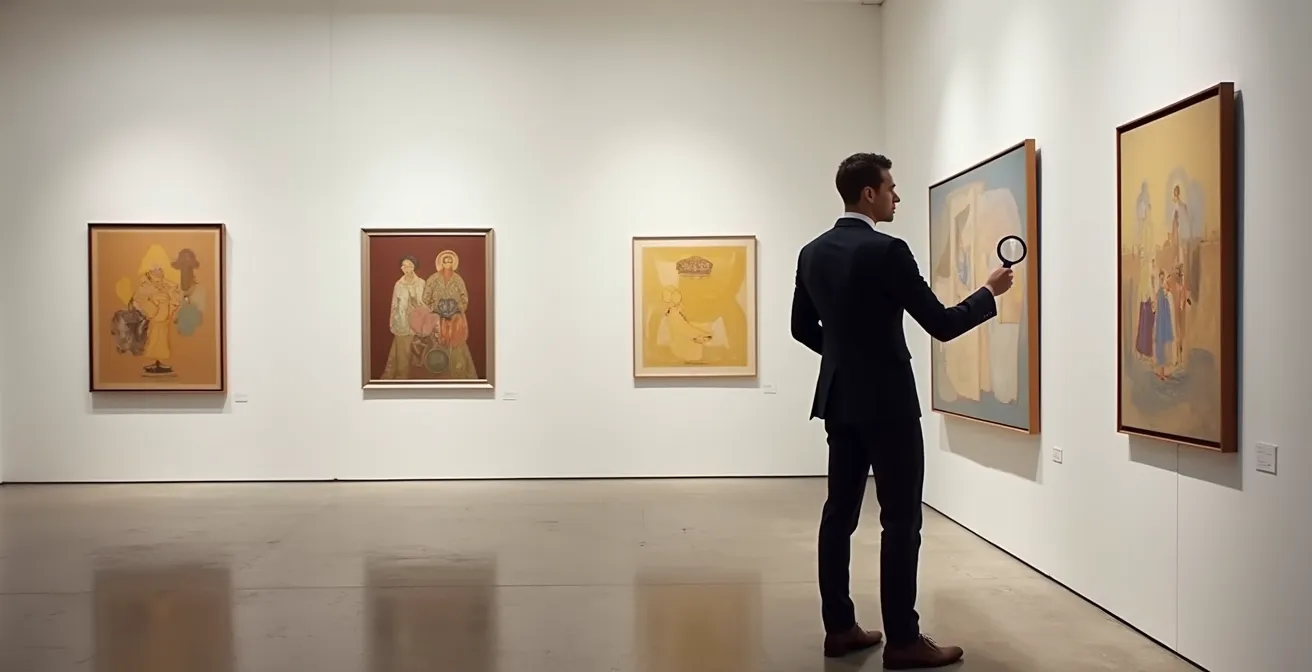
Success in art investing under $10,000 hinges on a disciplined, signal-driven strategy, not on luck or chasing transient trends.
- Focus on risk-adjusted ROI by balancing high-potential emerging artist originals with lower-risk, high-liquidity prints from blue-chip artists.
- Implement a rigorous, technology-assisted provenance verification system as the cornerstone of your due diligence before any acquisition.
Recommendation: Define your specific ‘exit triggers’—quantifiable market signals like a museum acquisition or gallery representation—before you purchase a piece to ensure profit is realized systematically, not emotionally.
For the discerning young professional looking beyond traditional stocks and bonds, the contemporary art market presents a compelling, high-yield alternative. It’s an asset class shrouded in an aura of exclusivity and subjective taste, leading many to believe that success is a matter of cultural intuition or sheer luck. The common advice, “buy what you love,” while well-intentioned, is an incomplete strategy for an investor seeking tangible returns. It mistakes a personal collecting philosophy for a disciplined investment methodology.
The reality is that the art market, while opaque, operates on a series of discernible patterns and signals. To build a serious portfolio with a sub-$10,000 budget, one must adopt the mindset of a financial analyst, not just an art enthusiast. This involves de-risking acquisitions, identifying undervalued assets, and planning for liquidity from the outset. It requires a shift from chasing hype to decoding the fundamental indicators of an artist’s career trajectory and an artwork’s long-term value.
This guide will not ask you to simply “do your research.” Instead, it provides a concrete framework for navigating this complex market. We will explore why the entry-level market is uniquely resilient, how to establish a piece’s authenticity with forensic precision, and how to balance your portfolio for optimal risk-adjusted returns. Ultimately, you will learn to define clear, data-driven triggers for both buying and selling, transforming a passion investment into a sophisticated component of your wealth-building strategy.
This article provides a comprehensive framework for applying financial discipline to the art market. The following sections break down each critical stage of the investment process, from market analysis to tax optimization.
Summary: A Financial Advisor’s Framework for Art Investment
- Why Art Markets Often Resist Traditional Economic Recessions?
- How to Verify the Provenance of a Contemporary Piece Independently?
- Blue-Chip Artists or Emerging Talents: Which Offers Better ROI?
- The “Instagram Famous” Trap: Buying Art Based on Hype Alone
- When to Sell a Piece of Art to Maximize Profit Margins?
- ETFs or Stock Picking: Which Strategies Builds Wealth Reliability?
- When to Apply to Art Fairs to Maximize Acceptance Chances?
- How to Accelerate Wealth Growth Using Tax-Advantaged Accounts?
Why Art Markets Often Resist Traditional Economic Recessions?
Unlike equities, which are immediately susceptible to macroeconomic sentiment, the art market exhibits a unique resilience, particularly at the sub-$10,000 level. This is because art as an asset is illiquid, held by a fragmented base of collectors, and driven by non-financial values such as cultural significance and passion. During downturns, high-net-worth individuals often reallocate capital to tangible assets, providing a stable floor for the market. More importantly, the market bifurcates: while the high-end auction sector may cool, the entry-level segment often thrives.
The stability of the broader market is a clear market signal; the 28th Annual Report by Artprice notes that the art market remained robust with 763,000 transactions completed at auction in 2024 despite global economic headwinds. This demonstrates a consistent volume of exchange that is less volatile than public securities markets. For the budget-conscious investor, this data is particularly reassuring.
Research from The Art Basel and UBS Global Art Market Report provides further evidence. In a recent downturn, the aggregate market decline was driven by a 39% fall in sales over $10 million. Conversely, the market for works under $5,000 grew significantly in both value and volume. This inversion demonstrates that the accessible segment of the market, where a $10,000 budget is most effective, is not only insulated from top-end corrections but can actually accelerate during them. It is a classic flight to tangible, affordable quality.
How to Verify the Provenance of a Contemporary Piece Independently?
In the art market, provenance—the documented history of an artwork’s ownership—is the ultimate foundation of value. An unverified piece is functionally worthless from an investment standpoint, regardless of its aesthetic appeal. With some estimates suggesting that up to 50% of art in circulation may be forgeries or misattributed, independent verification is not a recommendation; it is an absolute necessity. Relying solely on a gallery’s word is insufficient for a serious investor.
Fortunately, technology has democratized the tools for due diligence. The process is no longer confined to dusty archives but has evolved into a multi-layered forensic investigation. This involves a synthesis of direct artist communication, blockchain verification, and physical analysis, creating a robust, tamper-proof data layer for the artwork.
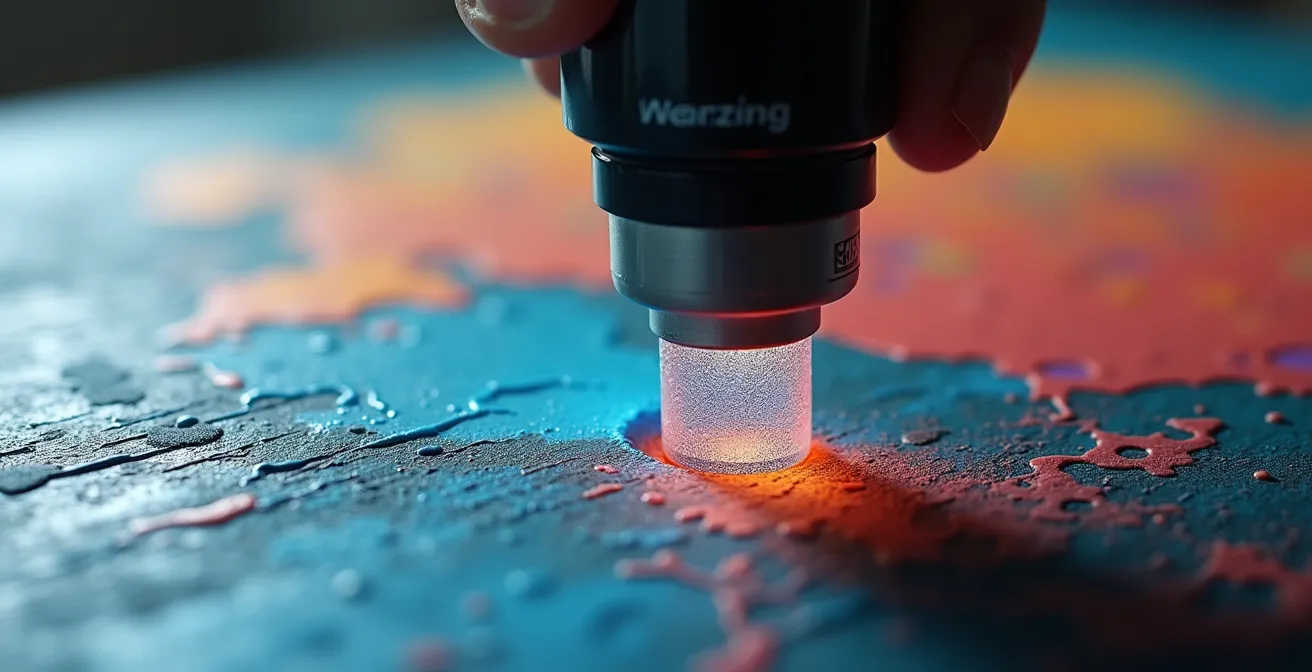
As this visualization suggests, modern authentication combines physical inspection with digital security. Technologies like blockchain-based certificates and microscopic fingerprinting now offer a degree of certainty previously unimaginable. This transforms provenance from a collection of papers into a secure, verifiable digital asset that travels with the physical work, safeguarding its value for future transactions.
Your Provenance Audit Framework: A 5-Step Verification Process
- Direct Artist Contact: Reach out to the artist or their estate via their official website (not just social media) to confirm the work’s creation and sale history.
- Blockchain Ledger Check: Utilize platforms like Verisart or Artory to search for a digital Certificate of Authenticity (COA) or an NFT tokenization record tied to the artwork.
- Physical Fingerprinting: For high-value emerging works, inquire if the piece has been scanned with a service like Artclear, which creates a unique, non-invasive “fingerprint” of the surface.
- Exhibition History Cross-Reference: Verify any listed gallery shows or fair participations by checking the institution’s online archives or catalogues. Discrepancies are a major red flag.
- Document Package Assembly: Compile a secure digital and physical package containing the original invoice, any gallery certificates, correspondence with the artist, and digital verification records.
Blue-Chip Artists or Emerging Talents: Which Offers Better ROI?
With a $10,000 budget, the primary strategic decision is how to allocate capital between the perceived safety of established “blue-chip” artists and the high-growth potential of emerging talent. This is not an “either/or” choice but a question of portfolio construction and risk management. Each offers a distinct risk-adjusted return profile. Investing in an original painting by an unproven artist carries immense risk but offers the potential for exponential returns—the “alpha generation” every investor seeks. Conversely, acquiring a limited-edition print by a globally recognized artist like Banksy or a mid-career star offers more predictable, steady appreciation with significantly higher liquidity.
As Galloire Art Market Analysis notes in its “Reasons To Invest in Contemporary Art” report, this is a key strategic consideration for new investors:
Many are surprised that limited edition prints and editions yield high multiples of return in the shorter term. In the longer term, if an artist continues on their path to success, then original works have more substantial potential while prints and multiples can reach a ceiling or slow.
– Galloire Art Market Analysis, Reasons To Invest in Contemporary Art
This insight is critical: prints provide near-term velocity and liquidity, while a carefully selected original is a long-term venture. The optimal strategy within a $10,000 budget is often a hybrid approach: dedicating 60-70% of capital to high-quality prints from mid-career or blue-chip artists and the remaining 30-40% to one or two original works from emerging artists who exhibit strong “market signals.”
This table breaks down the investment characteristics, helping to quantify the trade-offs between different segments accessible with a sub-$10,000 budget.
| Investment Type | Entry Cost | Risk Level | Potential Return | Liquidity |
|---|---|---|---|---|
| Blue-Chip Limited Edition Prints | $5,000-$10,000 | Low-Medium | 2-3x over 5-10 years | High |
| Emerging Artist Originals | $2,000-$8,000 | High | 5-100x if artist succeeds | Low initially |
| Mid-Career Artist Works | $8,000-$10,000 | Medium | 3-5x over 7-10 years | Medium |
The “Instagram Famous” Trap: Buying Art Based on Hype Alone
In the digital age, social media has become a powerful discovery engine for emerging artists. However, it has also created a dangerous trap for undisciplined investors: confusing online popularity with genuine artistic merit and long-term market viability. An artist with 100,000 Instagram followers may generate significant hype, but this is often a fleeting phenomenon driven by aesthetic trends rather than institutional validation. Buying into this hype without further due diligence is akin to investing in a meme stock—a high-risk gamble on sustained public attention.
The discerning investor must look beyond the follower count and seek a “three-layer verification” of an artist’s potential. The first layer is the work itself: does it demonstrate technical skill, a unique conceptual vision, and a consistent practice? The second layer is early institutional validation: has the artist been included in group shows at reputable galleries, graduated from a prestigious art school, or been shortlisted for a recognized prize? The third layer is peer validation: is the artist’s work being acquired by other respected artists or established collectors?

Ultimately, the most effective hedge against the “Instagram Famous” trap is to align your acquisitions with your own aesthetic conviction, but only after the work has passed rigorous analytical checks. As a long-term investment principle, a work that personally resonates and meets key market signals is a far safer bet than one that is merely fashionable. The emotional connection provides a “value floor” if the market for that artist’s work were to soften, ensuring the piece retains personal worth even if its financial value fluctuates.
When to Sell a Piece of Art to Maximize Profit Margins?
Acquiring the right artwork is only half the battle. Realizing a profit depends entirely on a disciplined and well-timed exit. The most common mistake novice investors make is selling based on emotion or short-term cash needs. A professional approach requires establishing clear, pre-defined “exit triggers” at the moment of purchase. These are specific, observable market signals that indicate an artist’s career has reached a new tier of valuation, making it an opportune moment to liquidate the asset and realize gains.
These triggers are not subjective; they are data points indicating a structural shift in the artist’s market. For an emerging artist, a key trigger could be their first solo exhibition at a major museum or signing with a “blue-chip” gallery like Gagosian or David Zwirner. These events can cause an artist’s primary and secondary market prices to increase exponentially overnight. Waiting for these signals removes guesswork and imposes a logical framework on the selling decision. The following are critical triggers to monitor:
- The artist signs with a top-tier, ‘blue-chip’ gallery (e.g., Gagosian, Hauser & Wirth, David Zwirner).
- The artist is featured in a solo exhibition at a major museum or prestigious biennial (e.g., Whitney Biennial, Venice Biennale).
- Auction prices for the artist’s comparable works consistently achieve 5-10 times your initial entry price.
- The artist’s work is acquired for the permanent collection of a major international museum (e.g., MoMA, Tate Modern, Centre Pompidou).
It is also critical to calculate the true profit margin by factoring in all associated costs. Transaction fees can be substantial. As detailed calculations show, seller’s commission (10-25%), auction house fees, insurance, and shipping can significantly erode the final return. A $10,000 sale might only yield $7,000-$8,000 in net profit after these expenses are deducted, a crucial factor in determining the right time to sell.
ETFs or Stock Picking: Which Strategies Builds Wealth Reliability?
For an investor accustomed to the world of equities, contemporary art can seem dauntingly subjective. However, parallels can be drawn to make strategic decisions more intuitive. Comparing art investment strategies to stock market equivalents like ETFs vs. individual stock picking provides a useful mental model for portfolio construction and risk assessment. No single strategy is inherently superior; the choice depends entirely on your risk tolerance, time horizon, and desired level of involvement.
As Dr. Clare McAndrew of Arts Economics stated in The Art Basel and UBS Survey of Global Collecting, art is a serious component of diversified portfolios for sophisticated investors. The report found that High-Net-Worth collectors allocated an average of 20% of their wealth to art, demonstrating its recognized role as a wealth preservation and growth vehicle. This validates its place alongside more traditional assets.
The following table directly compares different art investment vehicles with their closest stock market equivalents. This allows a financially literate investor to understand the trade-offs in terms of liquidity, risk, and potential returns in a familiar language.
| Investment Type | Minimum Investment | Liquidity | Average Annual Return | Risk Level |
|---|---|---|---|---|
| Masterworks (Fractional Art) | $1,000 | Low (Secondary market) | 9-16% historical | High |
| S&P 500 ETF | $50 | Very High (Daily trading) | 10% long-term average | Medium |
| Individual Artwork | $5,000+ | Very Low (Months to sell) | Variable (0-100%+) | Very High |
| Art Fund | $10,000+ | Low (Lock-up periods) | 6-8% average | Medium-High |
How to Navigate Art Fairs to Maximize Investment Opportunities
Art fairs are the nexus of the contemporary art world—a concentrated marketplace where galleries, collectors, and artists converge. For the sub-$10,000 investor, they are an unparalleled opportunity for discovery and acquisition, provided one navigates them with a clear strategy. The sheer volume can be overwhelming, but a tiered approach allows for efficient use of time and capital. Recent market data reveals that art fair sales increased to 31% of total dealer sales, underscoring their central role in the primary market.
Rather than wandering aimlessly, segment the fairs into tiers based on your objective. Top-tier fairs like Art Basel and Frieze are best used for education and trend-spotting; the price points are generally too high for a starting budget, but observing which emerging artists are being shown by major galleries provides invaluable market intelligence. The “sweet spot” for acquisition lies in mid-tier fairs like NADA (New Art Dealers Alliance) or Untitled, which are specifically focused on emerging and mid-career artists with more accessible price points.
Timing your visit is also a key tactical advantage. A “First Hour Strategy” during the VIP preview is essential for securing high-demand works from rising stars before they are sold. Conversely, a “Last Day Strategy” can be effective for negotiation; galleries may offer discounts of 15-30% on remaining works to avoid the cost and hassle of shipping them back. This tiered and timed approach transforms the fair from a chaotic spectacle into a strategic hunting ground.
Key Takeaways
- Market Resilience: The entry-level art market (sub-$10k) is uniquely insulated from top-end corrections and can even grow during economic downturns, making it a stable alternative asset.
- Provenance is Paramount: Independent, technology-assisted verification of an artwork’s history is non-negotiable to de-risk your investment and protect its fundamental value.
- Systematic Exits: Profit is realized through discipline. Define your specific, data-driven ‘exit triggers’ at the time of purchase to remove emotion from the decision to sell.
How to Accelerate Wealth Growth Using Tax-Advantaged Accounts?
For a U.S.-based investor, understanding the tax implications of art investment is crucial for maximizing net returns. Unlike stocks and bonds, art is classified as a “collectible,” which comes with a specific and often less favorable tax structure. Integrating art into your broader financial plan requires a clear-eyed view of these regulations to avoid costly errors and leverage any available efficiencies. The goal is to ensure that taxes diminish your hard-won gains as little as possible.
A common misconception involves the use of like-kind exchanges. It is critical to note that under the Tax Cuts and Jobs Act, the Section 1031 exchange now applies only to real property. You can no longer defer capital gains by “trading up” from one artwork to another, a strategy that was once popular among collectors. This makes tax planning on each individual sale more important than ever.
The most effective approach is a sequence of tax-efficient actions. This strategy prioritizes the use of traditional tax-advantaged accounts for eligible assets first, while structuring art investments to qualify for the most favorable capital gains treatment possible. The following sequence provides a clear roadmap:
- Step 1: Max Out Traditional Accounts First. Before allocating a single dollar to art, ensure you are fully funding your 401(k), IRA, and other tax-advantaged retirement accounts with eligible assets like stocks and bonds. This is the most powerful tax shield available.
- Step 2: Fund Art Investments with a Taxable Account. Use a standard brokerage or bank account to purchase art. This segregates your non-eligible alternative assets from your tax-sheltered ones.
- Step 3: Hold for Long-Term Capital Gains. To avoid being taxed at higher ordinary income rates, you must hold an artwork for more than one year before selling. The long-term capital gains rate for collectibles is 28%, which is higher than for stocks (15-20%) but still preferable to ordinary income rates (up to 37%).
- Step 4: Consider Tax-Loss Harvesting. If you realize gains on an art sale, you can potentially offset that income by selling stocks or other securities in your taxable portfolio at a loss, a strategy known as tax-loss harvesting.
By applying this rigorous, financially-grounded framework, you can transform your interest in contemporary art into a powerful and sophisticated engine for wealth creation. The next logical step is to begin identifying emerging artists who align with this data-driven methodology.