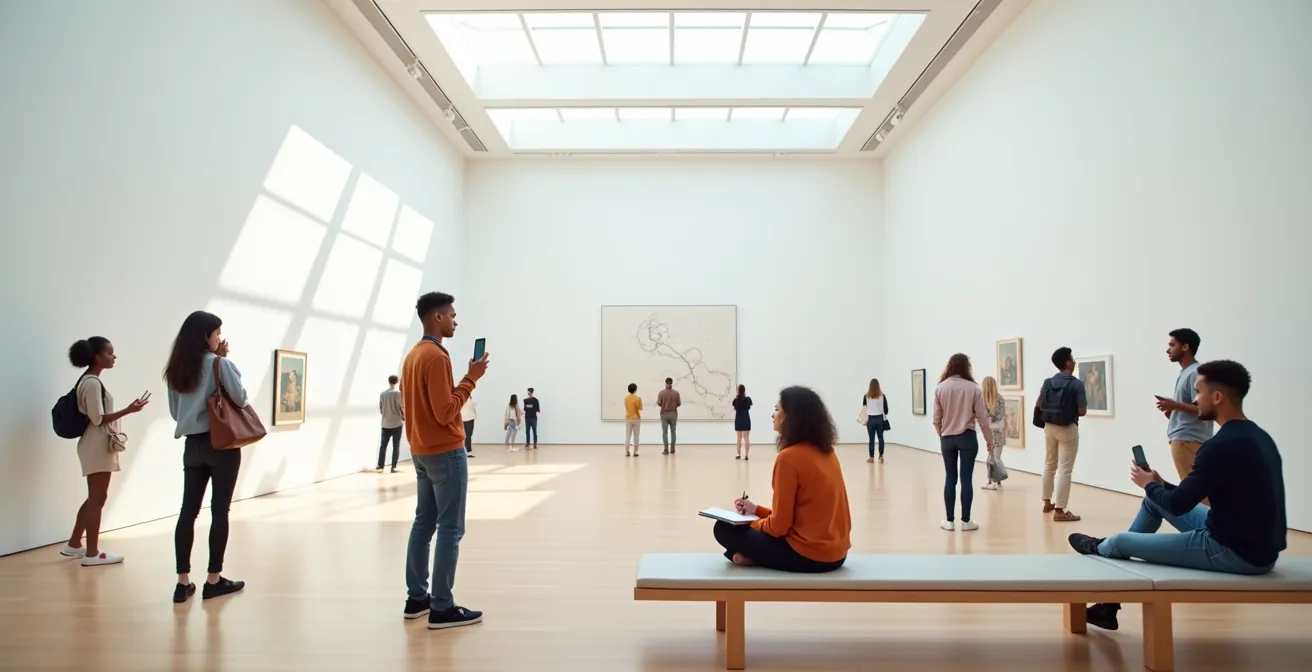
Engaging Gen Z is not about adding more tech, but about designing better stories. The key is to shift from static displays to creating immersive, controllable “narrative flows” that channel their fragmented attention.
- Instead of fighting short attention spans, create “micro-narratives” and thematic paths that empower visitors to choose their own journey.
- Use technology like AR not as a gimmick, but as a tool to deepen the story and reveal unseen layers of an artifact.
Recommendation: Audit your current visitor experience for “flow-breakers”—moments of cognitive overload or forced linearity—and replace them with opportunities for user-controlled discovery.
As curators and exhibition designers, we’ve all felt it: the quiet dread of watching a group of young visitors drift through a gallery, their faces illuminated not by a masterpiece, but by the glow of their phones. The prevailing wisdom tells us to fight fire with fire: add QR codes, launch a TikTok account, and create an “Instagrammable” photo wall. We’re told Gen Z has an impossibly short attention span and that we must cater to it with bite-sized, easily digestible content.
These tactics, while sometimes useful, often miss the point. They treat the symptoms—distraction and disengagement—without addressing the root cause. The challenge isn’t that Gen Z is incapable of deep focus; it’s that their attention is fragmented, accustomed to a digital world where they are the editors of their own experience. They don’t just want to consume a story; they want to inhabit it, control it, and see it from multiple angles.
But what if the real solution isn’t to add more digital distractions, but to fundamentally rethink our approach to storytelling? What if, instead of just presenting information, we could design a true narrative flow? This guide moves beyond the platitudes of “making it interactive.” We will explore the cognitive and emotional mechanics of engagement, focusing on how to channel fragmented attention into a state of focused immersion. We will deconstruct why traditional methods fail and build a new framework for creating experiences that Gen Z will not only visit but remember and share.
This article provides a strategic roadmap for this transformation. We will explore the science behind visitor fatigue, compare narrative structures, and offer practical solutions for implementing immersive experiences, even on a tight budget. Explore the sections below to start building your next-generation exhibition.
Summary: Designing Museum Narratives for a New Generation
- Why Visitors Stop Reading Labels After 30 Minutes?
- How to Implement AR Guides Without Distracting from the Artifacts?
- Thematic vs. Chronological: Which Layout Improves Learning Retention?
- The Security Gap That Most Small Museums Overlook
- When to Schedule Workshops to Maximize Family Attendance?
- Why Audiences Prefer 360-Degree Projections Over Static Paintings?
- The Multitasking Mistake: Trying to Order Coffee While Merging
- How to Create Profitable Immersive Digital Exhibitions in Small Venues?
Why Visitors Stop Reading Labels After 30 Minutes?
The phenomenon is so common we have a name for it: “museum fatigue.” It’s that familiar slump when a visitor’s initial enthusiasm wanes, their eyes glaze over, and they start bypassing entire sections. This isn’t a sign of intellectual laziness; it’s a symptom of cognitive overload. In fact, studies on visitor behavior show a consistent pattern where high interest is maintained for about 30 minutes before a sharp decrease. The traditional museum model, with its dense text panels and linear progression, simply asks too much of our brains.
For a generation fluent in the non-linear language of the internet, a forced chronological march from one glass case to the next is a recipe for disengagement. Their attention isn’t shorter; it’s differently wired. They seek agency and control. The solution, therefore, is not to write shorter labels but to design shorter, more focused narrative arcs. Instead of one monolithic story, we must create a constellation of micro-narratives.
To combat this narrative burnout, consider a more modular approach. These strategies break the overwhelming whole into manageable, engaging parts:
- Create micro-galleries: Design small, focused exhibitions that can be fully explored in under 15 minutes. This caters to visitors with limited time and provides a sense of completion.
- Emphasize storytelling over quantity: Shift to highly curated displays featuring a handful of key objects. Use these objects as anchors for compelling stories rather than trying to showcase the entire collection at once.
- Design for rest and reflection: Reimagine the physical layout to include comfortable seating, quiet zones, and changes in lighting. These “palate cleansers” allow visitors to reset their cognitive load before diving into the next narrative.
By designing for “attention channeling” rather than just information delivery, we respect the visitor’s cognitive limits and empower them to engage on their own terms, turning fatigue into fascination.
How to Implement AR Guides Without Distracting from the Artifacts?
Augmented Reality (AR) is often presented as a silver bullet for engaging Gen Z, but poor implementation can create the very problem it aims to solve. Holding up a phone or tablet that simply overlays text onto an object forces the visitor to split their attention between the screen and the artifact. This doesn’t deepen engagement; it fractures it. The goal is to use AR not as a digital label, but as a magic lens that reveals what is otherwise invisible, making the artifact itself the hero of the experience.

As this visualization shows, the most effective AR enhances, rather than competes with, the physical object. It can peel back layers of a painting to show the artist’s original sketches, reconstruct a shattered pot, or populate a historical diorama with animated figures. The technology becomes a conduit for storytelling, weaving a narrative flow directly onto the world of the exhibit.
Case Study: The National Gallery’s Keeper Council
A powerful example of integrated AR is the National Gallery’s “Keeper Council,” a multiplayer game developed on the Roblox platform. Created through a co-creative process with children and families, the experience blends gaming with AR elements. It doesn’t just provide information; it transforms the museum into a game world, where interacting with the collection is essential to progressing the story. This turns passive viewing into an active quest, a form of controlled immersion that is native to Gen Z.
Ultimately, successful AR integration is less about the technology itself and more about the narrative purpose it serves. It should spark curiosity and wonder, making the visitor lean in closer to the artifact, not pull away to look at their screen.
Thematic vs. Chronological: Which Layout Improves Learning Retention?
The chronological walk-through is a museum staple. Birth, life, death. Stone Age, Bronze Age, Iron Age. While logical for the curator, this rigid, predetermined path often strips visitors of their agency. For Gen Z, a generation that customizes everything from their news feeds to their avatars, being forced down a single path can feel restrictive and disengaging. The alternative? Thematic layouts that function like a well-designed website, with clear navigation and multiple points of entry.
A thematic approach—organizing an exhibition around concepts like “Rebellion,” “Love,” or “Innovation”—allows visitors to follow their own curiosity. This self-directed exploration is not just more enjoyable; it’s more effective. Research has found that visitors who follow a self-regulated path report greater satisfaction and reach a point of satiation later than those on a fixed route. Giving visitors control over their journey transforms them from passive recipients into active participants in their own learning.
This shift from linear to modular storytelling is proving highly effective, both in physical and digital spaces. As a comparative analysis shows, allowing non-linear exploration dramatically boosts engagement.
| Strategy Type | Implementation | Impact on Gen Z |
|---|---|---|
| Digital Overlay | V&A’s Mused platform uses quizzes, listicles and how-to videos for 10-14 year olds to interact with 5,000 years of human creativity | High engagement through familiar formats |
| Modular Architecture | Carnegie Hall’s Timeline saw engagement jump from 66k to over 250k users annually – nearly fourfold increase | Allows non-linear exploration |
| Micro-Content | Brooklyn Public Library’s Jay-Z exhibition used audio integration for digital storytelling, resulting in membership surge | Matches short attention patterns |
Choosing a thematic layout is a declaration of trust in your audience. It says, “We’ve created a rich world for you to explore. Go where your interests take you.” This freedom is precisely what makes an experience memorable and meaningful for a Gen Z visitor.
The Security Gap That Most Small Museums Overlook
When we think of museum security, our minds often jump to velvet ropes, display cases, and surveillance cameras. We are trained to protect the artifacts from the public. But as we invite Gen Z to become co-creators of our narratives—asking them to share stories, submit photos, or interact in apps—a new, often-overlooked vulnerability emerges: digital and psychological safety. This isn’t about protecting objects; it’s about protecting the very people we’re trying to engage.
For small museums especially, which may lack dedicated IT or legal teams, navigating the complexities of user-generated content, data privacy, and online moderation can be daunting. Yet, failing to address these issues can lead to brand damage, legal trouble, and a breach of trust with your community. Creating a safe space for interaction is as critical as creating a physically secure one. It requires a proactive framework that anticipates risks and protects both the institution and its participants.
Implementing a clear policy isn’t just a defensive measure; it’s a way to build trust. When visitors see that you have thoughtfully considered their safety, they are more likely to participate openly and authentically. This checklist provides a starting point for auditing and strengthening your digital security framework.
Your Action Plan: A Digital Security Framework for Co-Creation
- Establish Guidelines: Create and clearly communicate submission guidelines for any user-generated content, including stories, videos, and images, to set clear expectations.
- Implement Moderation: Plan for content moderation. This could range from real-time systems, like the Brooklyn Museum’s app for visitor-staff chats, to post-submission reviews.
- Ensure Data Transparency: Develop a transparent and easy-to-understand data collection policy for all interactive displays, apps, and Wi-Fi services. Let visitors know what you collect and why.
- Prioritize Psychological Safety: Create content warning systems for sensitive topics within both curated and user-generated exhibits to ensure visitors can make informed choices.
- Plan for De-escalation: Train staff on how to handle inappropriate digital submissions or online interactions, just as you would for in-person incidents.
In the end, the most engaging experiences are built on a foundation of trust. By addressing this modern security gap, you show Gen Z that you value not just their engagement, but their well-being.
When to Schedule Workshops to Maximize Family Attendance?
The default answer to this question has long been “Saturday morning.” But for Gen Z and young millennial families, weekends are often packed, and the traditional family structure has evolved. To truly maximize attendance, we must stop thinking about what time is convenient for the museum and start thinking about what is valuable and desirable for our target audience. This means looking beyond the “family” monolith and targeting specific demographic needs with tailored event programming.
The key is to create events that are not just educational, but social and experiential. Gen Z, in particular, seeks unique experiences they can share. They are not just looking for a craft workshop; they are looking for a cool place to hang out, de-stress, and connect with peers. This opens up a whole new realm of scheduling possibilities, particularly in the after-hours slots typically reserved for donors or members.

Case Study: Boston Museum of Science’s College Nights
In 2016, the Boston Museum of Science brilliantly tapped into this by offering free-admission “College Night” events. These evenings featured music, food, and science shows, transforming the museum into a vibrant social hub. Attendees reported coming “for fun,” to “destress,” or simply because it was a “free and intriguing” thing to do. The museum didn’t just schedule an event; it created a destination, successfully drawing in a demographic that might not otherwise have visited.
By scheduling for desirability rather than just availability, we can transform workshops and events from a box to be checked into a core pillar of our engagement strategy, attracting new audiences who come for the experience and stay for the content.
Why Audiences Prefer 360-Degree Projections Over Static Paintings?
The blockbuster success of immersive experiences like “Van Gogh Alive” can be tempting to dismiss as a fleeting trend. However, their immense popularity reveals a profound truth about modern audiences: they are craving not just to see art, but to be enveloped by it. A 360-degree projection doesn’t just show you a painting; it places you inside the artist’s world, creating a powerful emotional and sensory narrative flow that a static object, no matter how beautiful, can rarely match.
This preference isn’t a rejection of traditional art. Instead, it’s a response to a world of constant digital stimulus. As one cognitive psychologist noted, the issue isn’t a lack of attention, but its division.
People’s attention isn’t disappearing—it’s being fragmented. Museums can become the antidote by offering focused, immersive experiences.
– Dr. Megan Thomas, Cognitive psychologist quoted in Museum Observer
This is the crucial insight. A truly immersive environment acts as an “antidote” to fragmentation. By engaging multiple senses and filling the visitor’s entire field of vision, it effectively hijacks their attention, making outside distractions fade away. It creates a temporary, focused world where the story is everything. The global success of the Van Gogh Alive experience, with its multisensory approach, is proof that this format can extend attention and deepen engagement far beyond what traditional displays can achieve.
While not every museum can mount a massive projection show, the principle remains the same: the more an experience can command a visitor’s sensory focus, the more effective it will be at channeling their fragmented attention into a state of deep, memorable engagement.
The Multitasking Mistake: Trying to Order Coffee While Merging
The title seems out of place, but the metaphor is surprisingly apt for exhibition design. Trying to merge into highway traffic while ordering a coffee is a recipe for disaster because it demands conflicting types of attention. You need broad spatial awareness for the road and narrow, focused attention for the transaction. The brain struggles to do both well simultaneously. We inadvertently create this exact “multitasking mistake” in our galleries all the time.
Consider a typical display: we ask a visitor to appreciate the aesthetic beauty of an artifact (a right-brain, emotional task), read a dense label about its historical context (a left-brain, analytical task), and perhaps listen to an audio guide (another analytical task). This is the museum equivalent of ordering coffee while merging. It creates cognitive dissonance and fractures the visitor’s attention, preventing them from ever fully entering a state of narrative flow.
The most common culprit is the over-reliance on text. A visitor who is reading is, by definition, not looking at the artifact. They are toggling back and forth, losing the emotional connection with the object each time their eyes drop to the label. This constant task-switching is mentally exhausting and a primary driver of museum fatigue.
Effective design minimizes this cognitive multitasking. It separates the “feeling” from the “thinking.” It might allow a visitor to first be enveloped by the emotional impact of a space, and only then offer context in a separate, dedicated area or through a subtle, non-intrusive audio layer. By designing for singular focus, we create a smoother, more engaging, and less fatiguing journey.
Key Takeaways
- Gen Z engagement is about narrative design, not tech gimmicks. Focus on creating controllable, immersive “narrative flows.”
- Combat museum fatigue by replacing long, linear exhibits with “micro-narratives” and thematic layouts that grant visitors agency.
- Use technology like AR and projection mapping to deepen the story and create focused, sensory experiences that act as an antidote to fragmented attention.
How to Create Profitable Immersive Digital Exhibitions in Small Venues?
The idea of “immersive digital exhibitions” can conjure images of massive budgets and cavernous warehouses, seemingly out of reach for smaller museums. But profitability and immersion are not solely the domain of large-scale productions. The key is to think surgically and creatively, leveraging low-cost, high-impact strategies that deliver a powerful sensory experience without requiring a complete overhaul of your venue.
First, it’s crucial to understand that for many young visitors, the discovery process begins long before they walk through your doors. In fact, research shows that over 60% of Gen Z now use TikTok as a search engine, bypassing Google for recommendations on where to go and what to see. This means your exhibition’s “shareability”—its potential to be captured and shared in a visually compelling way—is a direct driver of attendance and, therefore, profitability.
Fortunately, creating these shareable, immersive moments can be done on a budget. The focus should be on creating concentrated points of “wow” rather than attempting to cover every surface. Here are several low-cost, high-impact strategies:
- Use Spatial Audio: Immersion is not just visual. A well-designed soundscape using spatial or binaural audio can transform a room with minimal physical change, creating a deep sense of place and emotion.
- Implement Targeted Projection Mapping: Instead of a full 360-degree room, focus projection mapping on a single key object or architectural feature. This creates a stunning centerpiece and a perfect photo opportunity.
- Leverage Live Storytelling: A skilled performer or demonstrator can be more immersive than any technology. As shown by Science Museum London’s live shows, combining performance with education creates a captivating and memorable experience.
- Measure and Refine with Data: Use simple tools like heat mapping and visitor tracking to understand what your audience is actually engaging with. This data is invaluable for refining your offerings and maximizing the impact of future investments.
By focusing on scalable, impactful moments and understanding modern discovery habits, even the smallest venue can create profitable immersive exhibitions that resonate deeply with Gen Z and drive a new generation of visitors through the door.