The key to a profitable immersive exhibition isn’t a massive budget; it’s a smarter business model built on strategic trade-offs across technology, content, and marketing.
- Technology choices should prioritize long-term value and targeted impact over raw power, especially in smaller spaces.
- Content strategy is a clear choice: leverage the draw of famous art or build a unique, cult-following brand with original work.
Recommendation: Shift focus from simply creating an ‘experience’ to engineering a ‘profitability stack’ where every component—from projector choice to your LinkedIn profile—is designed to generate revenue.
The ‘Van Gogh Immersive’ phenomenon has every venue owner and digital artist seeing dollar signs. The allure is undeniable: transforming empty walls into dynamic, ticket-selling worlds. But for those of us without a nine-figure budget or a globally recognized name, the dream often crashes into a wall of financial reality. The common advice—”use great projectors” or “make amazing content”—feels hollow when you’re staring at a spreadsheet. You’re led to believe it’s a game only the giants can play, forcing you to choose between artistic ambition and financial ruin.
But what if that’s the wrong way to look at it? What if profitability isn’t about matching their spend, but outsmarting their model? The secret doesn’t lie in having the most expensive equipment, but in building a cohesive Profitability Stack. This is a system where your technology, content, operational flow, and business development are all interconnected and optimized for a smaller scale. It’s about making deliberate, informed trade-offs that maximize ROI at every turn, turning your constraints into a competitive advantage.
This guide breaks down that system. We’ll move beyond the generic advice and dive into the critical business and technical decisions that make or break a small-venue immersive venture. We’ll explore how to select budget-conscious tech without sacrificing quality, weigh the pros and cons of licensing famous art versus commissioning new work, and even show how your personal brand on LinkedIn can become a powerful engine for filling your venue. It’s time to stop dreaming of being the next Van Gogh exhibit and start building a sustainable, profitable business on your own terms.
This article provides a comprehensive roadmap for launching a successful immersive exhibition. Below is a summary of the key strategic areas we will explore to turn your creative vision into a profitable reality.
Summary: Your Guide to a Profitable Immersive Exhibition
- Why Audiences Prefer 360-Degree Projections Over Static Paintings?
- How to Choose Projectors for Mapping Without Blowing the Budget?
- Licensing Famous Art or Commissioning New Work: Which Draws More Crowds?
- The Software Mistake That Freezes Exhibitions Mid-Show
- In What Order Should You Perform Audio-Visual Loops Play to Manage Flow?
- How to Implement AR Guides Without Distracting from the Artifacts?
- Alexa or Google Home: Which Understands Natural Language Better?
- How to Build a Personal Brand That Generates Leads on LinkedIn?
Why Audiences Prefer 360-Degree Projections Over Static Paintings?
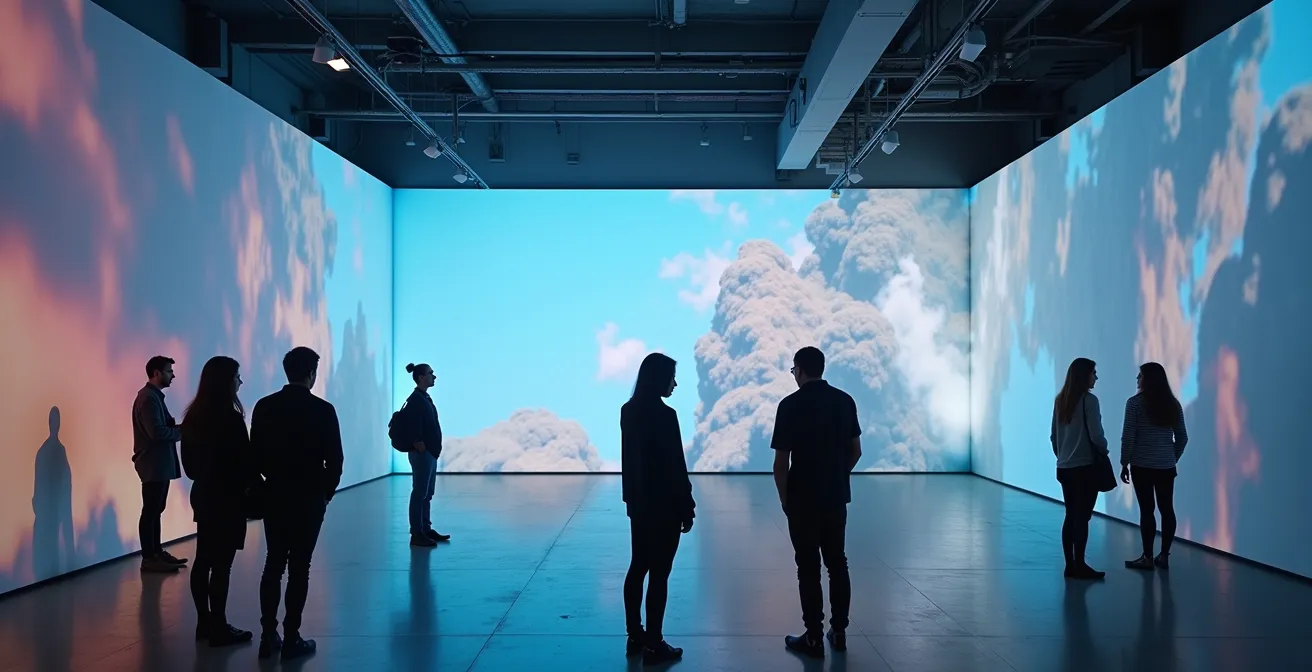
The shift from traditional galleries to immersive experiences isn’t just a fleeting trend; it’s a fundamental change in audience expectations. Viewers today, raised on interactive digital media, crave more than passive observation. They want to be enveloped, to feel a part of the art itself. A static painting is an object to be looked at; a 360-degree projection is an environment to be experienced. This appeal to emotion and sensory engagement is the core driver of the experience economy, where the memory of the event becomes the product. The market reflects this hunger for immersion, as a recent market analysis reveals that stand-alone immersive venues are experiencing a staggering 24.23% compound annual growth rate.
This desire for participation creates a more profound emotional connection. Instead of just appreciating an artist’s technique from a distance, visitors walk through their brushstrokes, surrounded by the colors and sounds that form the world. As Bruno Monnier, the visionary behind the ‘des Lumières’ art centers, states, this technology is a powerful tool for connection:
The role of an art centre is to decompartmentalise, and that is why digital technology is so important in twenty-first-century exhibitions. Used for creative purposes, this technology has become a formidable vector for dissemination, and is capable of creating links between eras, adding dynamism to artistic practices, amplifying emotions, and reaching the largest possible audience.
– Bruno Monnier, President of Culturespaces
This approach transforms a visit from an intellectual exercise into a memorable, shareable event. The success of exhibitions like TeamLab Planets in Tokyo, which set a Guinness World Record by welcoming over 2.5 million visitors in its first year, proves that audiences vote with their feet for experiences that let them step inside the frame. For a small venue, this means you’re not just selling art; you’re selling a powerful, emotional journey.
How to Choose Projectors for Mapping Without Blowing the Budget?
The projector is the heart of your immersive exhibition, but it’s also where budgets can quickly spiral out of control. The good news is you don’t need a cinema-grade, $50,000 unit to create a stunning experience. The strategy for a small venue is about smart trade-offs and targeted impact. Instead of aiming for wall-to-wall coverage with ultra-high-resolution gear, focus on creating high-impact zones. A few well-placed, bright projections in an entryway or on a central feature can deliver 80% of the “wow” factor for 20% of the cost. Look for consumer-oriented home theater projectors, which often provide excellent brightness and color for a fraction of the price of commercial units.
When evaluating budget-friendly options, consider the total cost of ownership, not just the upfront price. For instance, a laser-based projector like the Optoma ZW350e might cost around $650 but offers 30,000 hours of lamp life, eliminating costly bulb replacements and maintenance downtime—a crucial factor for a permanent or long-running show. Furthermore, short-throw projectors are a small venue’s best friend, allowing you to create massive images from just a few feet away, which is perfect for tight spaces. Combining these hardware choices with optimized projection surfaces—smooth, matte, light-colored walls—ensures you get the most brightness for your buck, as suggested by an analysis of budget-friendly setups.
Finally, you need to decide whether to rent, buy, or seek sponsorship for your equipment. Each path has distinct financial implications for a small-scale operation. Renting is ideal for one-off events or testing a concept, while buying builds a long-term asset for regular programming. Sponsorship, where an AV company provides gear for brand exposure, can be a game-changer for venues with good marketing reach. This comparative analysis from Skift breaks down the decision-making process:
| Option | Initial Cost | Long-term Value | Best For |
|---|---|---|---|
| Rent | Low (pay per event) | No asset building | One-time events, testing concepts |
| Buy | High upfront | Hardware can be used repeatedly while creating new digital content for each event | Regular programming venues |
| Sponsor | Zero to minimal | AV companies provide equipment in exchange for brand exposure | Venues with marketing reach |
Licensing Famous Art or Commissioning New Work: Which Draws More Crowds?
Once your tech is sorted, the next million-dollar question is content. Here, you face a fundamental strategic choice: license the work of a world-famous artist or commission original art from contemporary creators. The first path leverages built-in brand recognition. An exhibition titled “Van Gogh” or “Monet” has an immediate, powerful marketing advantage. It’s a proven concept that taps into a massive, existing audience. The success of The Van Gogh Exhibit: The Immersive Experience demonstrates this power, having sold over 5 million tickets in the US alone. For a new venue, this approach de-risks the launch and provides a clear, easy-to-market value proposition.
However, this path comes with significant licensing fees and creative constraints. The alternative is to commission new work, a strategy boldly championed by collectives like Meow Wolf. Instead of borrowing a brand, they built their own. By creating a unique, bizarre, and interactive world, they turned their exhibition into a destination. This approach requires more upfront marketing effort to educate the audience, but the payoff can be immense: you own the IP, foster a dedicated community, and create something truly original.

The Meow Wolf case study is a powerful testament to this model’s profitability. In Santa Fe, a city with a population of just 70,000, their first venue attracted 400,000 visitors and generated $6.8 million in revenue in its first year—more than double the attendance of the local, world-renowned Georgia O’Keeffe Museum. According to an analysis of their success, their break-even attendance target was just 100,000, proving that original, compelling content can be highly profitable without a famous name attached. The choice depends on your long-term vision: do you want to be a host for famous art, or do you want to become a famous destination for art?
The Software Mistake That Freezes Exhibitions Mid-Show
You have brilliant content and the perfect projectors. The show opens, the room is packed, and then it happens: a frozen screen, a stuttering loop, a total system crash. The most common—and costly—mistake in immersive exhibitions isn’t a lack of creativity, but a lack of technical stability. A single show-stopping glitch can lead to a wave of refund requests, negative social media buzz, and irreparable damage to your reputation. Profitability hinges on reliability, and that reliability is built into your software and media workflow long before the first ticket is sold.
The root cause of these failures is often a single point of failure in the system or poorly optimized media files. Running a complex visual show from a single laptop is a recipe for disaster. Professional setups always build in redundancy, using a primary and backup media server connected via a video switcher. If one fails, the other takes over seamlessly. Equally important is media optimization. Using the right video codec (like HAP or NotchLC), which is designed for high-performance, multi-screen playback, is non-negotiable. These codecs reduce the processing load on your hardware, preventing the overheating and memory leaks that cause systems to crash mid-show.
Before opening to the public, your entire system must undergo rigorous “soak testing.” This involves running the complete show on a continuous loop for 24 to 48 hours straight. This stress test is the only way to identify hidden stability issues that might not appear in a short-term trial. It’s the beta testing phase for your experience, and skipping it is a gamble you can’t afford to lose. Having a solid technical foundation ensures your audience remembers the art, not the error message.
Your Pre-Launch Software Stability Checklist
- System Redundancy: Implement a primary and backup media server with an automatic video switcher to eliminate any single point of failure.
- Media File Optimization: Convert all video content to a performance-oriented codec (e.g., HAP, NotchLC) and ensure the resolution and bitrate match your hardware’s capabilities.
- Conduct ‘Soak Testing’: Run the full audio-visual loop continuously for at least 24-48 hours before opening day to detect memory leaks, overheating, or other stability issues.
- Develop a Restart Protocol: Create a simple, one-page ‘Show Restart’ guide for non-technical staff to quickly and correctly reboot the system in case of an unexpected shutdown.
- Allocate Sufficient Content Time: Acknowledge that content creation is a multi-stage process (storyboard, drafts, rendering, testing) that requires weeks or months, and buffer your timeline accordingly.
In What Order Should You Perform Audio-Visual Loops Play to Manage Flow?
Managing visitor flow in an immersive exhibition is more than just crowd control; it’s a critical component of your business model, or what can be termed “flow monetization.” The duration and sequence of your audio-visual loops directly dictate your venue’s maximum capacity and, therefore, your potential ticket revenue. A 30-minute loop allows you to cycle through two groups per hour, while a 15-minute loop doubles that capacity. With ticket sales representing the lion’s share of revenue for most immersive attractions, optimizing this flow is paramount.
The most effective strategy is a variable-timing model that guides visitors through distinct zones, each with a different purpose and loop structure. This prevents bottlenecks and creates a more dynamic journey. A typical flow might be:
- Zone 1: The Introduction (Short, continuous loop). The entry area features a short, visually engaging loop (2-3 minutes) that sets the tone and can be entered at any time. This acts as a holding area, absorbing arriving guests and preventing queues at the entrance.
- Zone 2: The Main Experience (Fixed-length, scheduled loop). This is the core 360-degree projection room. The loop has a defined start and end (e.g., 20 minutes), with staff guiding groups in and out between cycles. This ensures everyone gets the full, intended experience.
- Zone 3: The Interactive Zone (Self-paced). After the main show, visitors enter a space with smaller, interactive displays or photo opportunities. There are no fixed loops here, allowing guests to linger, decompress, and, crucially, share their experience on social media.
- Zone 4: The Exit & Gift Shop (Contemplative loop). A final, calmer ambient loop plays as visitors exit through the retail space, encouraging a last moment of reflection and a final opportunity for ancillary revenue.

This segmented approach gives you precise control over your venue’s throughput. By managing the timing of the main experience, you can accurately predict daily attendance capacity and optimize staffing. It turns the visitor journey from a random walk into a carefully choreographed and profitable performance, ensuring a steady stream of guests and maximizing your revenue potential per square foot.
How to Implement AR Guides Without Distracting from the Artifacts?
As you build your experience, adding technological layers like Augmented Reality (AR) can deepen engagement. However, the risk is pulling visitors out of the immersion by forcing them to constantly stare at their phone screens. The key to successful AR implementation is subtlety and integration. It should feel like a magic lens that enhances the world, not a clunky app that distracts from it. The goal is to use AR to provide context or a new perspective without becoming the main event itself.
One of the most effective and non-distracting methods is using audio-first AR. Instead of displaying text or complex visuals on the screen, visitors can point their phone at a scene to trigger location-specific audio, such as an artist’s commentary or a musical score, delivered through their headphones. This keeps their eyes on the art, using their phone as a simple “key” to unlock hidden layers of content. Another subtle approach is to use unobtrusive triggers like Bluetooth beacons or floor markers instead of visually jarring QR codes, which can break the carefully crafted aesthetic of the exhibition.
AR can also be positioned as a post-experience takeaway. Allow visitors to “capture” a digital version of an artwork or scene, which they can then manipulate or place in their own environment at home. This extends the life of the experience and encourages social sharing without interrupting the on-site flow. As technology evolves, Mixed Reality (MR), which overlays interactive virtual objects onto the real world, will become more accessible. The mixed reality technology in immersive experiences is projected to expand at a CAGR of 23.94% through 2030, offering even more seamless ways to blend the physical and digital. For now, the winning strategy is to use AR as a scalpel, not a sledgehammer, making targeted enhancements that add depth without sacrificing immersion.
Alexa or Google Home: Which Understands Natural Language Better?
Integrating voice control into an immersive exhibition can be a powerful way to add a layer of interactivity, allowing visitors to feel a sense of agency within the digital world. The question of whether to use an established platform like Amazon Alexa or Google Home versus a custom solution is a classic “build vs. buy” trade-off. While both Alexa and Google Assistant have made enormous strides in natural language understanding, their effectiveness in a public exhibition setting presents unique challenges that differ from a quiet living room.
In a noisy environment with ambient music and multiple conversations, the voice recognition accuracy of any cloud-based assistant can degrade significantly. While both platforms are highly capable, their performance will heavily depend on the acoustic design of your space. The primary advantage of using these consumer platforms is the low cost of entry and rapid development. However, they require a stable internet connection and offer limited customization over the “wake word” and command structure. Their primary use case in an exhibition is for simple, robust commands in designated “interaction zones” equipped with highly directional microphones to isolate the user’s voice from background noise.
For more control and offline reliability, many venues opt for custom, offline voice recognition systems. Platforms using Raspberry Pi with libraries like Picovoice can be fully tailored to your exhibition’s specific vocabulary and function without any internet dependency. This avoids latency and potential service outages. Therefore, the choice isn’t really about which platform “understands” language better in a vacuum, but which system offers the right balance of cost, reliability, and customizability for your specific operational environment. For most small venues starting out, a well-implemented system using a consumer assistant in a controlled zone is the most pragmatic and cost-effective entry point into voice interactivity.
Key Takeaways
- Profitability in immersive art is driven by a smart business system, not just a big budget.
- Strategic trade-offs in technology (budget projectors), content (licensing vs. original), and operations (visitor flow) are essential for small venues.
- Technical stability is non-negotiable; rigorous testing and redundancy prevent show-stopping failures that kill revenue and reputation.
How to Build a Personal Brand That Generates Leads on LinkedIn?
Your immersive exhibition can be a masterpiece, but it’s not a profitable business if no one knows it exists. For the digital artist or venue owner, LinkedIn is not just a resume site; it’s a powerful B2B lead generation machine. Your personal brand on the platform is the final, critical layer of your Profitability Stack. It’s how you move from just selling tickets to individuals to securing lucrative private hires, corporate events, and brand partnerships that can dramatically increase your revenue. The key is to position yourself not just as an artist, but as a thought leader at the intersection of art, technology, and business.
Start by clearly defining your target audience on the platform. These aren’t just art lovers; they are corporate event planners, HR managers looking for unique team-building activities, and brand marketing managers seeking novel ways to launch a product. Your content should speak directly to their needs. Share behind-the-scenes posts about your creative and technical process. Write about the challenges you overcame, the software you chose, and why. This demonstrates expertise and transparency, building trust and authority. Go beyond posts and publish long-form LinkedIn Articles about the future of entertainment, the role of art in corporate culture, or the technical aspects of projection mapping.
Collaborate and engage. When you feature an artist’s work, tag them and their company to cross-pollinate audiences. Engage in comments on posts by industry leaders like Blooloop or AV technology companies. This visibility establishes you as an active and knowledgeable member of the community. As demonstrated by Meow Wolf, which generated 10% of its revenue from events in its first year, diversifying into B2B opportunities is a proven path to profitability. Your LinkedIn brand is the engine that drives those opportunities, turning your artistic passion into a steady stream of high-value clients.
By systematically addressing each layer of this stack—from audience psychology and budget technology to operational flow and B2B branding—you transform your exhibition from a creative project into a resilient, profitable enterprise. The path is clear: start building your stack today.
Frequently Asked Questions About How to Create Profitable Immersive Digital Exhibitions in Small Venues?
How can voice assistants enhance immersive exhibitions?
Voice commands can allow visitors limited control over the environment, such as changing scenes or requesting information, creating deep engagement at a fraction of the cost of physical interactives.
What are the technical challenges of voice recognition in exhibitions?
The main challenge is voice recognition in noisy rooms with loud music. Solutions include using highly directional microphones in designated ‘interaction zones’ or implementing simple, robust command sets.
Are there offline alternatives to cloud-based voice assistants?
Yes, offline voice recognition systems using Raspberry Pi with libraries like Picovoice offer independence from internet connections and can be fully customized for exhibition needs.