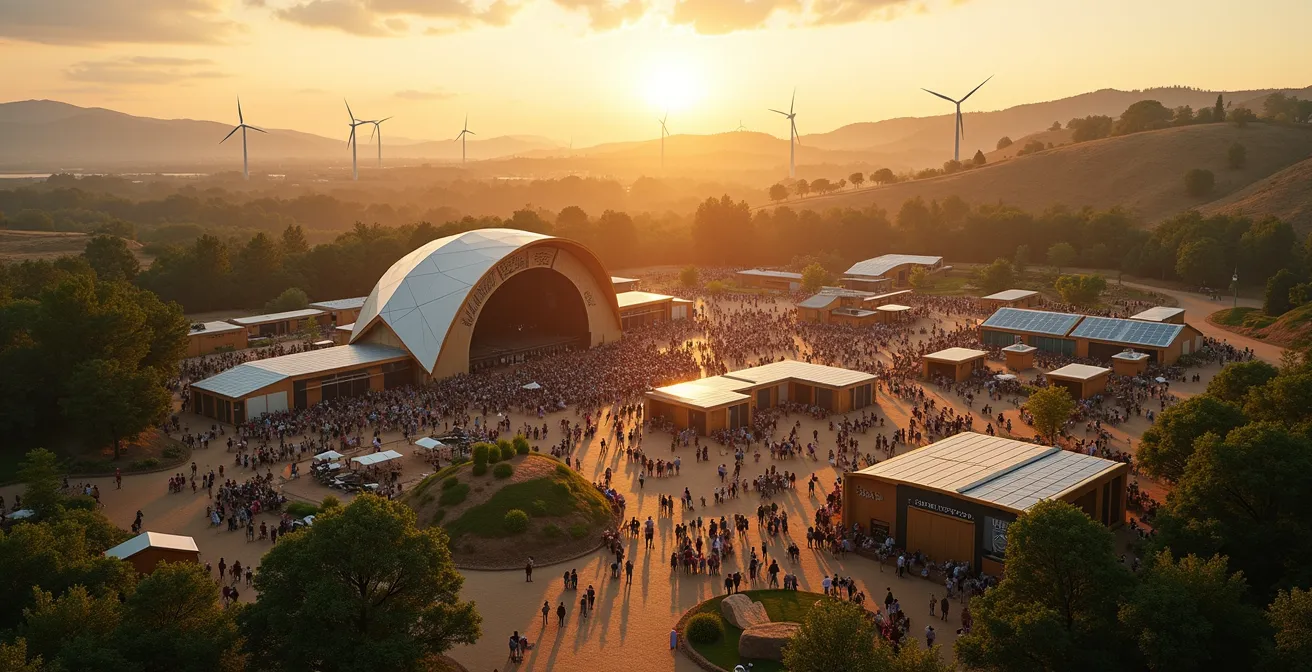
The key to a profitable carbon-neutral festival isn’t spending more on green initiatives; it’s building a circular economic system where sustainability drives revenue and efficiency.
- Integrate sustainability directly into core operations like ticketing, supply chains, and crowd management to unlock new income streams.
- Transform cost centers like waste management and energy into assets through closed-loop systems and decentralized infrastructure.
Recommendation: Shift your mindset from ‘offsetting costs’ to ‘building a regenerative economic engine’ from the ground up.
For festival producers, the pressure is immense. You’re expected to create a magical, unforgettable experience while simultaneously navigating rising operational costs and intense public scrutiny over your environmental impact. The conventional wisdom suggests a painful trade-off: go green and watch your profit margins shrink, or prioritize profitability and face accusations of greenwashing. Most attempts to square this circle revolve around familiar, but often ineffective, tactics like buying carbon offsets as a last-minute fix or simply asking attendees to “be more green.”
These approaches treat sustainability as an add-on, a line item expense that sits uncomfortably on the balance sheet. They miss the fundamental opportunity. What if the entire framework is flawed? What if, instead of being a cost to be minimized, sustainability could be the very engine of your festival’s profitability, operational efficiency, and long-term resilience? The secret isn’t about tacking on eco-friendly features; it’s about fundamentally redesigning your festival’s operational DNA.
This guide moves beyond the platitudes. We will deconstruct the logistics of a truly sustainable festival, showing you how to transform every aspect—from local supply chains and volunteer engagement to ticketing systems and crowd flow—into a component of a self-reinforcing, profitable, and carbon-neutral ecosystem. We will explore how to create year-round local income, build a passionate volunteer force, eliminate waste at a profit, and design safer, more engaging experiences for your audience, all driven by a commitment to circular principles.
This article provides a detailed roadmap for festival organizers. Below, the table of contents outlines the key operational systems we will dissect to build your profitable, carbon-neutral event model.
Table of Contents: The Producer’s Playbook for a Profitable Green Festival
- Why a 3-Day Festival Generates Year-Round Income for Locals?
- How to Recruit and Retain Reliable Volunteers for Mega-Events?
- Flat Fee or Commission: Which Ticketing Platform Fits Your Cash Flow?
- The Crowd Density Error That Leads to Stampedes and Injuries
- Problem and Solution: Eliminating Single-Use Plastics in Food Courts
- Problem and Solution: Managing Crowds During Blockbuster Exhibitions
- When to Visit Sensitive Ecosystems: A Guide to Low-Impact Seasons
- How to Transition Supply Chains to Circular Bioeconomies Without Disrupting Output?
Why a 3-Day Festival Generates Year-Round Income for Locals?
The traditional festival model is extractive: a massive temporary city appears, consumes resources, and vanishes, leaving little behind but compacted soil and a short-term cash injection for a few businesses. A truly sustainable festival inverts this. It acts as a supplier incubator, using its massive purchasing power to build permanent, local, and green supply chains. The goal is to transform a seasonal demand into a year-round economic driver for the community, creating a positive legacy that extends far beyond the event itself.
This isn’t philanthropy; it’s a strategic investment in your own operational resilience. By creating year-round contracts with local organic farms, renewable energy providers, and sustainable material suppliers, you secure your supply chain against volatile global markets and build powerful community goodwill. This model turns your festival into an anchor institution that people want to see succeed and support. It’s a fundamental shift from being a temporary guest to a long-term partner in the local economy.
The legendary Glastonbury Festival serves as a powerful blueprint. Its commitment to sustainability has evolved into a year-round economic engine for the region. A core part of their strategy is deep investment in permanent infrastructure, a model detailed in analyses of their green transition. For example, by developing their own renewable energy sources, they not only power the festival but also create permanent jobs and assets.
Case Study: Glastonbury Festival’s Year-Round Economic Impact Model
Drawing 210,000 attendees, Glastonbury has moved far beyond simple green initiatives. The festival now runs entirely on renewable energy, with production areas using fossil-free electricity or solar battery hybrids. Even its iconic Arcadia spider structure is powered by recycled biofuels made from waste cooking oil. As detailed in a report on major festivals going green, this commitment began in 1984 and has transformed the event into a permanent economic and employment driver for Somerset through its investment in sustainable, year-round infrastructure.
To implement this, you must actively identify and nurture local talent. This means sourcing food locally, providing grants or favorable contracts to vendors using compostable materials (only if you have commercial composting), and implementing strict energy policies. Adding a small, dedicated donation from each ticket to a local climate non-profit or carbon offset program further solidifies this community partnership, making every attendee an investor in the region’s sustainable future.
How to Recruit and Retain Reliable Volunteers for Mega-Events?
For a mega-event, volunteers are the lifeblood, but the old model of “work for a free ticket” is broken. It often attracts unreliable participants and leads to high turnover and low engagement. The key to building a dedicated and effective volunteer corps is to transform the role from simple labor into a meaningful, rewarding experience. This means treating your volunteers as an elite “eco-squad” and making their sustainability tasks engaging, visible, and fun.
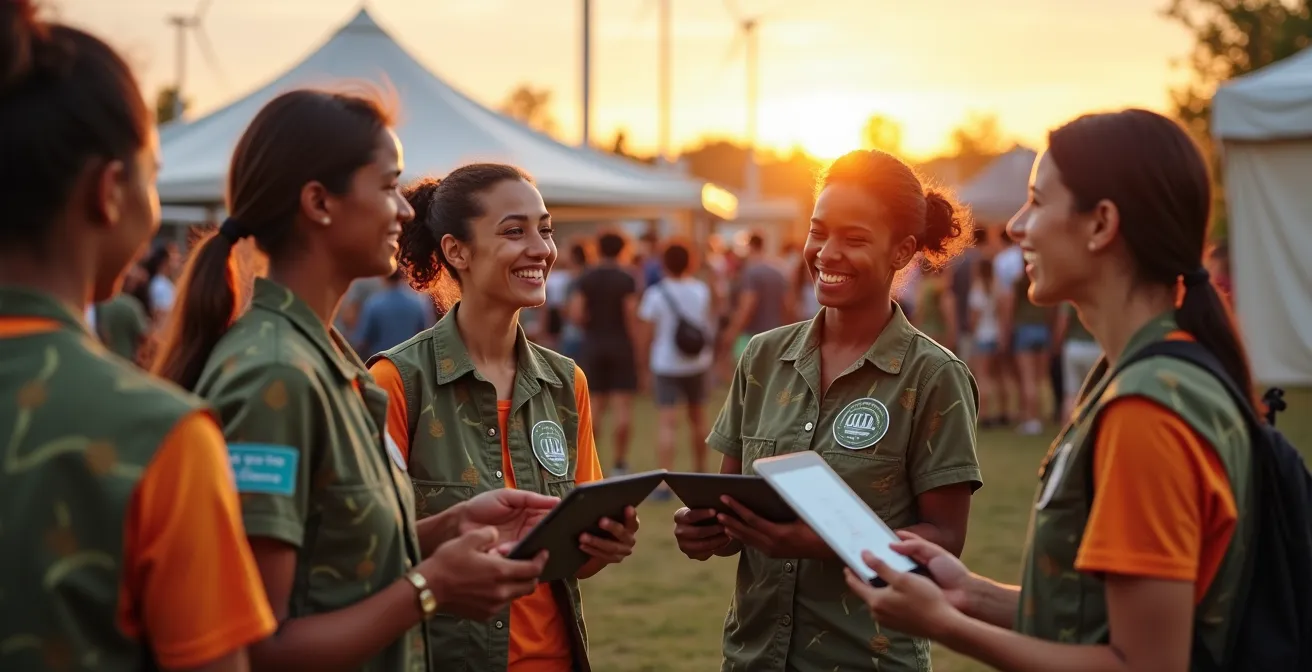
Instead of just pointing to recycling bins, you empower them. This is where gamified engagement becomes a game-changer. Equip your teams with tablets showing real-time data: kilograms of waste diverted, liters of water saved, or single-use plastics avoided. Create friendly competitions between teams or zones with rewards for hitting sustainability targets. This approach taps into a powerful desire for purpose and achievement, making volunteers feel like they are active participants in a critical mission, not just free labor.
The PrintPlast Sustainability Report highlights this exact strategy as a top trend, emphasizing that it transforms green habits from a chore into a compelling activity.
Gamification is a powerful tool for engaging attendees in sustainability by transforming sustainable practices into a game, making the process of adopting green habits more fun and engaging.
– PrintPlast Sustainability Report, 15 Top Trends for Planning Sustainable Events in 2024
This strategy also has a powerful retention effect. When volunteers see the tangible impact of their work and feel valued as part of an expert team, their loyalty skyrockets. You’re no longer just filling shifts; you’re building a community of passionate advocates who will return year after year, bringing their experience and enthusiasm with them. This creates a stable, knowledgeable volunteer base that reduces training costs and dramatically improves operational execution.
Flat Fee or Commission: Which Ticketing Platform Fits Your Cash Flow?
Choosing a ticketing platform is often seen as a simple financial decision: which model takes the smallest cut? This is a dangerously narrow perspective. For a sustainable festival, your ticketing platform is not just a payment processor; it’s a strategic tool for carbon tracking and regenerative funding. The right platform becomes the central nervous system for understanding and mitigating your event’s largest source of emissions: audience travel.
Therefore, the “flat fee vs. commission” debate must be reframed. The critical question is: Which platform provides the best tools to collect travel data, integrate carbon pricing, and channel funds into sustainability projects? Some platforms now offer dynamic carbon pricing, which automatically calculates an offset fee based on an attendee’s stated travel plans. Others facilitate the creation of a “regenerative ticketing fund,” where a small percentage of every sale is funneled directly into certified offset projects or local environmental initiatives.
Coldplay’s “Music of the Spheres” tour provides a masterclass in this approach. By using an app to track how fans get to the show, they can reward sustainable choices with real-world perks. This turns the ticketing process into the first point of engagement in the festival’s green mission.
Case Study: Coldplay’s Innovative Ticketing and Carbon Tracking
In a move to radically reduce their tour’s footprint, Coldplay leverages app technology that logs fans’ modes of transportation to concerts. Those who opt for carpooling, electric vehicles, or public transit are rewarded with discounts on merchandise. This system not only incentivizes greener travel but also provides the band with invaluable data to assess their total carbon footprint post-tour and plan more effective offsetting strategies, proving how ticketing can be a powerful sustainability tool.
The following table breaks down how different features align with the two main pricing models, helping you decide based on strategic value, not just cost.
As detailed in a playbook for green production, the right features can transform your ticketing from a simple transaction into a core part of your sustainability strategy.
| Platform Feature | Flat Fee Model | Commission Model | Sustainability Impact |
|---|---|---|---|
| Dynamic Carbon Pricing | Fixed integration cost | % of carbon offset fees | Automatically calculates attendee travel emissions |
| Regenerative Ticketing Fund | One-time setup fee | Small % of each sale | Helps events achieve carbon-neutral status when paired with genuine reductions |
| Travel Data Collection | Included in base fee | Per-transaction cost | Captures transport intentions for carbon forecasting |
The Crowd Density Error That Leads to Stampedes and Injuries
Every festival producer’s nightmare is a crowd crush. While we often focus on stage barriers and security numbers, a critical and overlooked factor is the layout of your sustainability infrastructure. A single, centralized water station, a poorly placed bank of generators, or a consolidated waste sorting center can create dangerous bottlenecks. People need resources, and if those resources are all in one place, you are unintentionally designing choke points that can lead to dangerous surges in crowd density.
The solution is a radical shift towards decentralized infrastructure. Instead of one massive generator farm, think multiple smaller, solar-powered energy hubs. Instead of one main water source, install dozens of strategically positioned refill stations. The same applies to waste management; multiple smaller sorting centers distribute the crowd load and make recycling more convenient for attendees. This approach breaks up large, moving masses of people into smaller, more manageable flows, dramatically reducing the risk of dangerous density levels.
This isn’t just a safety protocol; it’s an engagement opportunity. Displaying “energy dashboards” at each solar hub showing real-time power generation turns a piece of infrastructure into an interactive exhibit. This philosophy of decentralization directly links your sustainability goals with a safer, more pleasant attendee experience. By breaking up critical services, you eliminate dangerous bottlenecks and create a more resilient, efficient, and engaging festival environment.
Your Action Plan: The Decentralized Infrastructure Safety Protocol
- Map Critical Services: Identify all essential attendee touchpoints (power, water, waste, first aid) and their potential to create bottlenecks.
- Install Distributed Hubs: Replace large, centralized facilities with multiple smaller, strategically placed hubs. Prioritize solar-powered energy hubs and numerous water refill stations.
- Integrate Real-Time Data: Use live energy dashboards and waste-sorting counters to turn infrastructure into engaging, educational exhibits that naturally distribute crowds.
- Design for Flow: Position these hubs along pathways with low congestion and away from main stage sightlines to prevent blockages.
- Develop Contingency Plans: Create backup plans specifically for failures in your green infrastructure to ensure service continuity and prevent sudden crowd shifts.
By rethinking infrastructure from a flow-management perspective, you turn a logistical necessity into a powerful tool for enhancing both safety and sustainability.
Problem and Solution: Eliminating Single-Use Plastics in Food Courts
The sea of single-use plastic cups, plates, and cutlery left after a festival is a visual and environmental disaster. The common “solution”—asking vendors to use compostable or recyclable materials—often fails. Recyclables get contaminated, and commercial composting facilities are rarely available or utilized correctly. The only real solution is to eliminate “disposable” from your vocabulary and build a closed-loop system for reusable tableware. This turns a massive waste problem into a streamlined, and potentially profitable, operation.

The model is simple: attendees pay a small deposit for a durable, reusable cup or plate with their first purchase. They can exchange it for a clean one with each subsequent purchase. At the end of the event, they return it to a designated point to get their deposit back. This system creates a powerful incentive for return and dramatically reduces waste. The logistical backbone is a centralized or containerized washing facility on-site or nearby, which cleans and sanitizes the tableware for reuse.
This is not a theoretical concept. Major promoters are already proving its success at scale. The company r.Cup, for example, has created a robust system that delivers quantifiable results, demonstrating that a zero-waste food court is achievable.
Case Study: r.Cup’s Festival Waste Diversion Success
Companies like r.Cup are partnering with major promoters like Goldenvoice to replace single-use items with washable, reusable cups. As reported by Billboard, the cups are collected nightly and processed at a local cleaning center. In 2023, this program successfully diverted an impressive 1.1 tons of waste from landfills, which equates to roughly 30,000 cups per day, proving the viability of reusable systems at large-scale events.
This principle extends beyond food courts. As sustainability organization REVERB has shown, providing accessible water refill stations paired with the sale of reusable bottles can eliminate millions of single-use plastic bottles, further cutting down on your waste footprint.
REVERB has eliminated over four million single-use plastic water bottles through their refillable water bottle program.
– Adam Gardner, REVERB Co-Founder, Rolling Stone
Problem and Solution: Managing Crowds During Blockbuster Exhibitions
Every festival has its “blockbuster” moments—the headline act that draws a massive, dense crowd to the main stage. This peak moment creates two problems: a high-risk crowd density situation at one location and a “ghost town” effect everywhere else. The strategic solution is sustainability-driven counter-programming. This involves creating unique, can’t-miss attractions in other areas of the festival that are timed to coincide with peak main stage performances, effectively pulling people away and distributing the crowd.
Crucially, these counter-attractions should not be B-list artists. They should be innovative, interactive experiences rooted in your sustainability mission. Imagine a mesmerizing, bio-luminescent art installation that only activates after dark. Or a kinetic dance floor in a smaller tent that generates electricity from the crowd’s movement, with live visuals showing the power being created. These aren’t just distractions; they are compelling destinations in their own right.
This strategy is especially vital when considering the overall carbon footprint. While on-site waste is visible, it’s a minor contributor compared to travel. In fact, sustainability research confirms that audience festival travel emits 11 times more climate pollution than waste does. Since you have limited control over how people get to your event, you have a massive responsibility—and opportunity—to make their on-site experience as impactful and engaging as possible. Using sustainability as a tool for creative counter-programming allows you to better manage crowds for safety while simultaneously deepening your audience’s connection to your green mission.
Other effective strategies include creating “regenerative rest zones” with living walls that act as quiet pressure valves, or using IoT sensors to monitor air quality and comfort levels, guiding people toward less crowded, more comfortable areas. Live counters tracking plastic bottles saved or carbon offset also serve as powerful, data-driven engagement points that capture attention and help redistribute attendees across the festival grounds.
When to Visit Sensitive Ecosystems: A Guide to Low-Impact Seasons
One of the first and most critical decisions a festival producer makes is “when.” This choice is usually driven by weather and competing events. However, for a sustainable festival, the timing must be viewed through an ecological and resource lens. Scheduling your event during a region’s low-impact season can dramatically reduce your environmental footprint, lower operational risks, and create unique opportunities for local sourcing.
Each season presents a different set of ecological risks and opportunities. Holding a festival in the spring might interfere with sensitive wildlife breeding seasons. A summer date in a dry region brings high fire risk and strains local water resources. Conversely, a fall festival might align perfectly with the local harvest, allowing for an incredible farm-to-table food program that supports local agriculture and drastically cuts food miles. A winter event might require significant energy for heating, but could be ideal for an indoor venue powered by renewable sources.
This strategic scheduling requires a deep understanding of the local ecosystem. It involves consulting with local environmental groups, agricultural associations, and authorities to identify the period of least impact. This proactive approach demonstrates a profound respect for the host environment and can unlock significant operational benefits. For example, avoiding the peak of fire season can lower insurance premiums and reduce the need for extensive fire mitigation measures.
The following table provides a framework for assessing seasonal impacts, helping you make a more informed and responsible scheduling decision.
This type of analysis, as highlighted in guides to eco-friendly music festivals, is fundamental to minimizing negative impacts before a single ticket is sold.
| Season | Ecological Risk | Carbon Impact | Recommended Actions |
|---|---|---|---|
| Spring | Wildlife breeding season | Moderate | Schedule after nesting periods |
| Summer | Fire risk, water scarcity | High – livestock produces 14.5% of greenhouse gases | Implement water conservation, local food sourcing |
| Fall | Migration patterns | Lower | Ideal for harvest-aligned local sourcing |
| Winter | Soil compaction | Highest (heating needs) | Indoor venues, renewable heating |
Ultimately, choosing the right season is the first step in designing an event that works in harmony with its environment, rather than in opposition to it.
Key Takeaways
- Profitability and sustainability are not mutually exclusive; a circular system turns green initiatives into revenue drivers.
- Focus on systemic change in core operations—ticketing, supply chains, infrastructure—rather than superficial add-ons.
- Engage your audience and volunteers in the sustainability mission through gamification and interactive experiences to improve outcomes and retention.
How to Transition Supply Chains to Circular Bioeconomies Without Disrupting Output?
The ultimate goal for a sustainable festival is to move beyond “less bad” and towards a truly regenerative model. This means transitioning your entire supply chain to a circular bioeconomy. In this system, there is no “waste.” Every output from one process becomes a valuable input for another. Staging materials are made from compostable bamboo or mycelium, food scraps are turned into biofuel to power generators, and all assets are designed for disassembly, repair, and reuse.

This transition can seem daunting, with fears of disrupting established processes and increasing costs. The key is a phased, strategic approach. Start with high-impact areas: switch from standard construction materials to “materials-as-a-service” providers who lease and retrieve reusable or recyclable assets. Partner with local bio-energy companies to create closed-loop systems for organic waste. The ambition should be high, aiming for a “climate positive” status where you eliminate more emissions than you create.
REVERB works to make concerts and tours climate positive by offsetting a show’s entire carbon footprint including fan, band, crew travel, accommodations, and energy use, supporting vetted projects that eliminate significantly more greenhouse gas emissions than the concert created.
– REVERB Organization, Rolling Stone Magazine
This is not a fringe movement; it’s the future of the industry. The “Festival Vision: 2025” initiative is a clear indicator of this shift, as it shows a significant commitment from the industry itself. The report that over 40 UK festivals pledged to halve emissions and achieve 50% recycling rates by 2025 demonstrates a powerful collective will. Adopting a circular model now is not just an ethical choice, but a competitive advantage that builds brand reputation, attracts a conscious audience, and creates a more resilient, efficient, and ultimately more profitable event.
Building this circular system is the final piece of the puzzle, integrating all the strategies discussed—from local supplier incubation and reusable systems to decentralized energy—into one cohesive, regenerative operational model. It transforms your festival from a temporary event into a living laboratory for a sustainable future.
Start implementing these systemic changes today to build a festival that is not only a cultural landmark but also a beacon of profitable, carbon-neutral innovation.