
Your top operators fail at strategy not from a lack of talent, but from the absence of a system designed to cultivate it.
- Strategic thinking is an organizational capability, not just a personal skill; it must be engineered into your company’s DNA.
- Transforming operators into strategists requires fundamentally shifting their environment, incentives, and decision-making frameworks, not just their mindset.
Recommendation: Begin by auditing your current decision-making processes to identify and dismantle the hidden operational biases that stifle long-term vision.
You’ve seen it happen. You promote your sharpest operational manager—a master of efficiency, execution, and hitting quarterly targets—into a role that demands strategic vision. Twelve months later, they are struggling, mired in the daily grind, and producing tactical plans disguised as strategy. The temptation is to blame the individual, to lament a gap in their skillset. We tell them to “think bigger,” “see the forest for the trees,” or send them to a leadership seminar. This is a fundamental misdiagnosis of the problem.
The transition from operational excellence to strategic leadership is one of the most significant challenges in talent development. The issue isn’t a lack of intelligence or drive in your managers. The issue is the ecosystem they operate in—an environment that has relentlessly trained and rewarded them for short-term, predictable, and linear thinking. The skills that made them brilliant operators are the very cognitive shackles that now hold them back from becoming true strategists.
But what if the solution wasn’t to “fix” the manager, but to re-architect the system around them? This guide is not a list of tips for your aspiring leaders. It is a blueprint for you, the executive, to build a decision-making ecosystem that systematically dismantles operational biases and forces your managers to engage in the uncomfortable, ambiguous, and non-linear work of strategy. We will deconstruct the common failure points and provide a framework to cultivate a pipeline of leaders who don’t just manage the present, but actively create the future.
This article will guide you through the essential shifts required to build this capability within your organization. We will explore the core distinctions between operational and strategic mindsets, provide tools to translate analysis into action, and address the cognitive biases that sabotage long-term vision.
Summary: Forging Strategic Thinkers from Your Best Operators
- Why Being Busy Is Not the Same as Being Strategic?
- How to Turn SWOT Insights into Actionable Business Moves?
- Expansion or Consolidation: Which Strategy Suits a Recession?
- The Persistence Error: Continuing Projects Just Because You Started
- Problem and Solution: Reducing Decision Fatigue in Executive Teams
- Why Relying on “Gut Feeling” Fails in High-Stakes Markets?
- Excluding Bad Companies or Selecting Good Ones: Which Strategy Changes the World?
- How to Overcome the Fear of Failure in the First Year of Entrepreneurship?
Why Being Busy Is Not the Same as Being Strategic?
The most pervasive myth in modern management is that activity equals progress. Operational managers are masters of activity. Their world is governed by key performance indicators (KPIs), process optimization, and immediate problem-solving. They are rewarded for clearing their inbox, resolving today’s crisis, and ensuring the machine runs smoothly. This creates a state of “productive busyness” that feels effective but is often the primary obstacle to strategic thought. As a recent analysis reveals, many executives report feeling busier than ever, with less time for the deep thinking that drives innovation.
Strategic thinking, by contrast, is not about doing more; it’s about seeing differently. It involves stepping away from the immediate flurry of tasks to question underlying assumptions, identify emerging patterns, and connect seemingly unrelated dots. It is a long-term, vision-oriented discipline focused on transformative outcomes, not just operational efficiency. Your first task as a leader is to make this distinction brutally clear and to create protected space for the latter. An operator’s value is in answering questions; a strategist’s value is in asking the right ones.
To begin cultivating this shift, you must first provide your team with a clear vocabulary to differentiate these two modes of thinking. The following breakdown illustrates the fundamental chasm between the operational comfort zone and the strategic frontier.
| Aspect | Operational Thinking | Strategic Thinking |
|---|---|---|
| Focus | Daily tasks and efficiency | Long-term vision and goals |
| Time Horizon | Short-term (days/weeks) | Long-term (months/years) |
| Decision Type | Routine, process-oriented | Transformative, vision-oriented |
| Metrics | Operational KPIs | Strategic outcomes |
| Example | Optimizing production schedules | Entering new markets |
The goal is not to eliminate operational thinking—it is essential for survival. The goal is to create a decision ecosystem where managers are required to toggle between both modes, understanding that optimizing the present is only valuable if it serves the creation of a deliberate future.
How to Turn SWOT Insights into Actionable Business Moves?
The SWOT analysis (Strengths, Weaknesses, Opportunities, Threats) is the quintessential tool of “strategic planning.” Yet, for most organizations, it’s a sterile academic exercise. Teams spend hours creating lists, file the document away, and return to their operational tasks unchanged. The SWOT analysis fails because it’s a tool for data collection, not decision-making. It tells you *what is*, but offers no framework for deciding *what to do*. This is where you must intervene to prevent strategic-looking activity from masquerading as strategy.
The critical evolution is the shift from SWOT to a TOWS Matrix. As its creator Heinz Weihrich outlined, this framework forces confrontation between internal factors (Strengths, Weaknesses) and external factors (Opportunities, Threats) to generate concrete strategic options. It moves beyond mere listing to active combination, asking a more powerful set of questions:
- SO (Strengths-Opportunities): How can we leverage our core strengths to seize emerging market opportunities?
- ST (Strengths-Threats): How can we use our strengths to neutralize or mitigate external threats?
- WO (Weaknesses-Opportunities): How can we exploit opportunities to overcome our internal weaknesses?
- WT (Weaknesses-Threats): What defensive moves must we make to prevent our weaknesses from being exploited by threats?
This approach, detailed as a tool for situational analysis by Heinz Weihrich in “Long Range Planning”, transforms a passive list into an engine for “actionable insight.” It creates the “strategic friction” necessary to force managers out of their descriptive comfort zone and into a prescriptive, decision-oriented mindset.
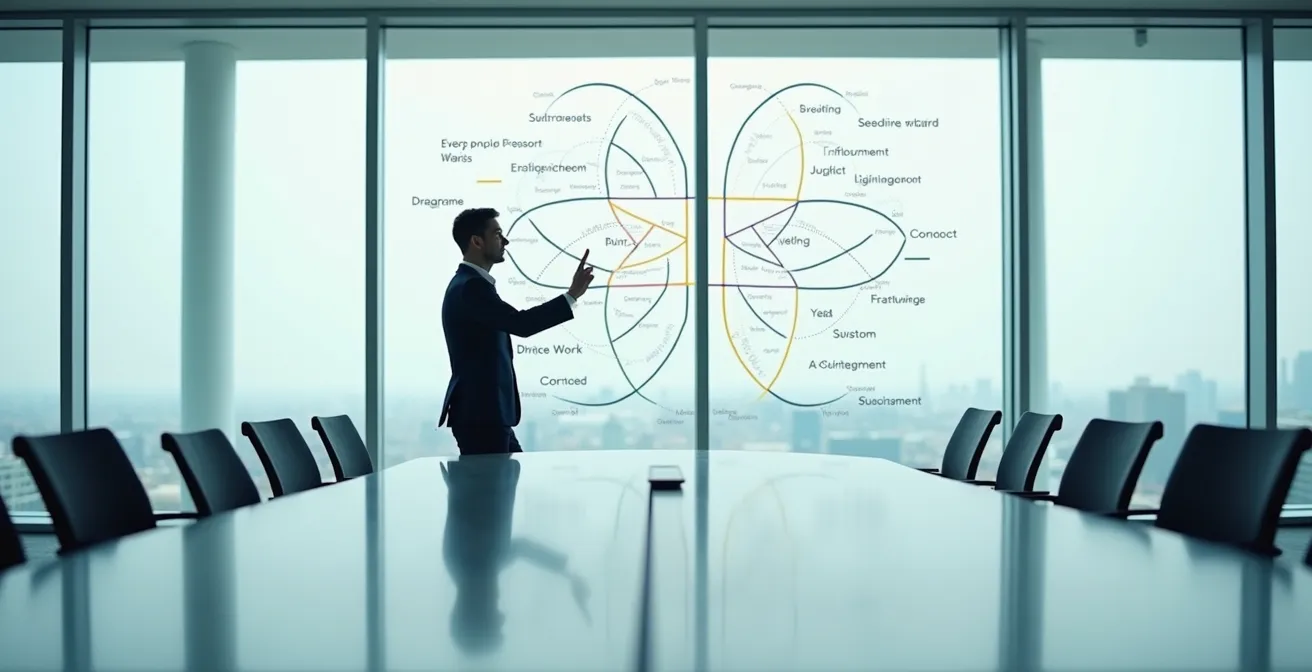
This visualization represents the move from flat data to a dynamic framework. Instead of four isolated lists, the manager is now forced to see the interplay and tension between quadrants, which is the birthplace of genuine strategy. Your role is to demand this level of analysis, rejecting any SWOT that isn’t translated into a TOWS matrix with clear, prioritized strategic options.
Your Action Plan: Auditing Your Strategic Pipeline
- Contact Points: Map every forum where strategic decisions are discussed (e.g., weekly reviews, budget meetings) and assess if they reward operational updates or strategic debate.
- Data Collection: Inventory existing strategic documents like SWOT analyses. Tally how many led to a documented decision versus how many were simply filed away.
- Coherence Check: Confront these documents with your company’s core values and mission. Identify the most significant disconnect between stated strategy and operational reality.
- Emotional Resonance: Pinpoint one major initiative driven by momentum or sunk cost (“zombie project”) versus one driven by a clear, data-backed market opportunity.
- Integration Plan: Formally kill the “zombie project” and publicly reallocate its resources to the high-potential strategic experiment, sending a clear signal about what is now valued.
Expansion or Consolidation: Which Strategy Suits a Recession?
During economic uncertainty, the default operational mindset is defensive: cut costs, reduce risk, and consolidate. The strategic mindset, however, asks a more nuanced question: is this a moment for survival or for seizing a once-in-a-generation opportunity? The expansion-versus-consolidation dilemma is not a simple binary choice; it’s a paradox that must be managed, not solved. Forcing your managers to grapple with this tension is a powerful method of developing their strategic acumen.
This challenge is at the heart of what management theorists call “strategic ambidexterity.” It’s the ability of an organization to simultaneously exploit its current business (optimize, consolidate, improve efficiency) and explore new opportunities (innovate, expand, take risks). An operator excels at exploitation. A strategist must learn to balance exploitation with exploration. A truly visionary leader understands that the two are not mutually exclusive but complementary.
Case Study: The Ambidextrous Leader
Research into what is known as paradox theory highlights this duality. As described in a study on individual-level ambidexterity, the most effective leaders don’t see exploitation and exploration as a trade-off. Instead, they treat them as inherent contradictions to be actively engaged. They learn to apply “both/and” thinking, understanding that they must simultaneously refine existing processes to fund the creative pursuit of new markets. Forcing a manager to create a budget that allocates resources to both “defend the core” and “build the future” is a powerful exercise in strategic thinking.
Rather than asking your team, “Should we expand or consolidate?” reframe the question to force a more sophisticated response: “How will we fund our strategic expansion by becoming radically more efficient in our core business?” This question doesn’t allow for a simple ‘yes’ or ‘no’. It demands a plan that embraces both sides of the paradox, which is the essence of high-level strategic thought and a key part of a robust decision ecosystem.
The Persistence Error: Continuing Projects Just Because You Started
One of the most powerful operational biases is the “sunk cost fallacy”: the irrational commitment to a project based on the resources already invested, rather than on its future prospects. Operators, measured on completion and execution, find it incredibly difficult to abandon a project they have championed. For them, stopping is an admission of failure. For a strategist, however, the ability to recognize a losing bet and cut it loose is a critical skill—an act of calculated abandonment that frees up resources for more promising ventures.
The modern business landscape is littered with colossal examples of this fallacy. A prominent case is the enormous investment in the metaverse, where Meta has lost an estimated $70-77 billion on a vision that has yet to find a significant market. This demonstrates that even at the highest levels, the emotional and financial momentum of a project can override objective strategic assessment. It is your job to build a culture where stopping a project is not seen as a failure, but as a disciplined and celebrated strategic decision.

To combat this bias, you must introduce formal mechanisms for de-escalation. The “pre-mortem” exercise is an invaluable tool. Before a project even begins, the team is asked to imagine it has failed spectacularly and to write down every possible reason for that failure. This creates a list of objective “kill criteria” that can be reviewed at regular intervals.
Here are some pillars of a framework to overcome the sunk cost fallacy:
- Establish Objective ‘Kill Criteria’: Before launching any significant initiative, define specific, measurable thresholds for failure (e.g., “cost overrun exceeds 15%,” “user engagement remains below target X by day 90”).
- Implement Neutral Project Reviews: Use third-party or cross-functional teams to assess project viability. This removes the personal bias of the project’s original champions.
- Focus on Future Utility: As cognitive therapist Robert Leahy advises, frame all decisions around “future utility or future payoff,” explicitly discounting past investments from the discussion.
By creating a formal process for “calculated abandonment,” you change the rules of the game. You give your managers the psychological safety and the procedural cover to make the tough, but strategically correct, call.
Problem and Solution: Reducing Decision Fatigue in Executive Teams
A significant bottleneck in many organizations is the executive team itself, which often suffers from decision fatigue. When every operational hiccup and minor strategic choice is escalated, senior leaders become overwhelmed. They lack the time and mental bandwidth for the deep thinking that strategy requires. A key function of a strategically-minded operational manager is to act as a filter and a clarifier, protecting the executive team’s focus.
You must redefine the role of the operational manager within your decision ecosystem. Their job is not to bring you problems; it is to bring you well-packaged decisions. This requires a fundamental shift in how information flows upward. As one management expert puts it, you should train them to be a “Decision Clarifier.”
Frame the operational manager’s role as a ‘Decision Clarifier’ for the executive team by presenting problems as well-synthesized packages: ‘Here is the issue, here are the 2-3 vetted options, here is our data-backed recommendation’
– Management Strategy Expert, Strategic Decision-Making Framework
This approach achieves two critical goals. First, it forces the manager to perform the strategic legwork of analyzing the issue, researching alternatives, weighing trade-offs, and forming a hypothesis. This is an invaluable training ground for strategic thinking. Second, it presents the executive with a clear choice, dramatically reducing their cognitive load. Instead of untangling a complex problem from scratch, they can focus their energy on validating or challenging the recommended course of action.
Case Study: Google’s Pre-Mortem Process
Tech giant Google famously utilizes “pre-mortem” exercises not just to kill bad projects, but to refine good ones. Before a product launch, teams are tasked with anticipating every possible operational hurdle and strategic threat. This process forces operational managers to think strategically about downstream consequences and present plans that have already been pressure-tested. It ensures that by the time a decision reaches senior leadership, much of the strategic analysis has already been done, clarifying the path forward.
By demanding that problems arrive with solutions, you transform your managers from simple reporters into genuine strategic partners, strengthening your entire leadership pipeline in the process.
Why Relying on “Gut Feeling” Fails in High-Stakes Markets?
Experienced operators often develop a powerful “gut feeling” or intuition about their domain. This intuition is invaluable for making quick, effective decisions within a familiar, stable system. However, when the context shifts to high-stakes, volatile, or unfamiliar markets, this same gut feeling can become a catastrophic liability. Operational intuition is pattern-matching based on past experience. In a new or rapidly changing environment, the old patterns no longer apply, and relying on them leads to predictable errors.
Genuine strategic thinking is an exceedingly rare skill. In fact, comprehensive research indicates that only 4-7% of leaders are considered skilled at strategic thinking. The vast majority rely on operational heuristics and cognitive shortcuts that break down under strategic pressure. Your role is to teach your rising leaders that strategic intuition is not a mystical gift; it is a “calibrated intuition” built on a foundation of critical thinking, diverse data synthesis, and the ruthless questioning of one’s own biases.
You must build a culture that values evidence over confidence and structured questioning over instinct. The goal is not to eliminate intuition, but to discipline it. A good strategic leader holds their gut feeling as a hypothesis to be tested, not a truth to be acted upon. They synthesize information from multiple, often conflicting, sources before developing a viewpoint. This process of cognitive de-tunneling is essential for seeing the bigger picture.
To cultivate this calibrated intuition, you should embed the following principles into your team’s decision-making process:
- Question Everything: Challenge all assumptions, especially those that are widely held or “obvious.”
- Reframe Problems: Dig for root causes instead of addressing symptoms. Ask “why” five times.
- Challenge Beliefs: Actively seek out data and opinions that contradict your own initial beliefs and the prevailing company mindset.
- Uncover Bias: Learn to spot hypocrisy, manipulation, and cognitive biases in organizational decisions, including your own.
By making these behaviors the standard for how decisions are made, you shift the cultural norm from rewarding quick, intuitive answers to rewarding deep, validated insights.
Excluding Bad Companies or Selecting Good Ones: Which Strategy Changes the World?
This question, often posed in the context of socially responsible investing, is a powerful metaphor for a fundamental strategic choice every leader faces: is our strategy primarily defensive or proactive? A defensive strategy focuses on risk mitigation—avoiding threats and minimizing weaknesses (the “WT” quadrant of a TOWS matrix). A proactive strategy focuses on opportunity capture—using strengths to seize possibilities (the “SO” quadrant). Many organizations default to a defensive posture, a remnant of the operational mindset focused on preventing problems.
A truly strategic organization, however, understands that you cannot “risk-manage” your way to market leadership. While defensive moves are necessary for survival, growth and transformation are born from proactive, offensive plays. Your task is to shift your organization’s center of gravity from a defensive crouch to a proactive stance. This requires building a decision ecosystem that disproportionately rewards the creation of opportunities over the mere management of risks.
The TOWS matrix provides a clear language for this distinction. As TSW Training highlights, strategies can be categorized by their intent: ” SO strategies: Use strengths to seize opportunities. ST strategies: Use strengths to mitigate identified threats. WO strategies: Use opportunities to overcome your weaknesses.” You must demand that your leaders’ strategic plans are heavily weighted towards SO and WO strategies.
| Approach | Focus | Strategy Type | Example |
|---|---|---|---|
| Excluding Bad (Defensive) | Risk Mitigation | WT Strategies | Minimize weaknesses to avoid threats |
| Selecting Good (Proactive) | Opportunity Capture | SO Strategies | Use strengths to seize opportunities |
| Hybrid Approach | Balanced Growth | WO Strategies | Use opportunities to overcome weaknesses |
A simple audit can be revealing: review the last five major strategic initiatives. How many were designed to enter a new market, launch a new product, or create a new capability (proactive)? And how many were focused on cost-cutting, restructuring, or responding to a competitor’s move (defensive)? The ratio will tell you the true strategic posture of your organization, regardless of what your mission statement says.
Key Takeaways
- Strategic thinking is not an innate talent but a disciplined process that can be cultivated through a purpose-built organizational system.
- Transforming an operator into a strategist requires shifting their environment from one that rewards short-term execution to one that demands long-term, paradoxical thinking.
- Tools like the TOWS Matrix, pre-mortems, and ambidextrous budgeting are crucial for creating “strategic friction” that breaks down operational biases.
How to Overcome the Fear of Failure in the First Year of Entrepreneurship?
While the title references entrepreneurship, the core challenge—the paralyzing fear of failure—is identical for a manager stepping into their first true strategic role. They are leaving a world of predictable outcomes and entering one of high ambiguity and significant personal risk. If your culture punishes all failures equally, you will extinguish any spark of strategic ambition. You must therefore differentiate between sloppy execution and “intelligent failure.” Intelligent failures are the unavoidable, and even desirable, outcomes of well-planned strategic experiments in uncertain territory.
The ability to lead with a “strategic perspective” is the single greatest differentiator for senior executives. A landmark study from Zenger Folkman on leadership qualities found that a strategic perspective was the attribute that most powerfully separated top managers from senior management. It’s not just about having good ideas; it’s about having the courage to pursue them in the face of uncertainty and the resilience to learn from the inevitable setbacks. This is why a culture that embraces intelligent failure is a prerequisite for developing strategic leaders.
The difficulty of this mindset shift cannot be overstated. It runs counter to basic human wiring and typical corporate incentive structures. As a point of comparison, consider how difficult it is for individuals to stick to personal goals. Research from Duke University shows that fewer than 8% of people stick to their New Year’s resolutions each year. Now imagine the difficulty of sticking to a bold strategic path when financial results, peer approval, and career progression are on the line. It’s nearly impossible without an ecosystem that provides psychological safety.
Your ultimate role is to be the chief architect of this ecosystem. You must celebrate the learning that comes from a failed pilot program as much as the revenue from a successful product launch. You must reward the manager who killed a failing project based on data more than the one who drove it into the ground through sheer force of will. When you change what you celebrate, you change what your people will dare to do.
The journey from an operational expert to a strategic visionary is a profound transformation. It is not achieved through memos or weekend seminars. It is forged in an environment that intentionally demands strategic thought, provides the tools to structure it, and offers the psychological safety to pursue it boldly. Your legacy as a leader will be defined not by the operators you manage, but by the strategists you create. Begin architecting that future today.