Auto & Motorcycle
The automotive landscape has undergone a profound transformation in recent years, evolving far beyond simple mechanical transportation. Whether you’re considering your first electric vehicle, trying to decode the technology behind your car’s safety alerts, or weighing whether vehicle ownership still makes sense in an era of ride-sharing and subscriptions, understanding the fundamentals has never been more crucial. Today’s vehicles represent a convergence of mechanical engineering, software systems, aerodynamic science, and energy management—each element playing a vital role in performance, cost, and environmental impact.
This comprehensive resource connects the essential concepts every modern driver and enthusiast should grasp. From the physics governing fuel consumption to the practical realities of charging infrastructure, from the subtle art of regenerative braking to the limitations of automated safety systems, we’ll explore what actually matters when making decisions about vehicles. The goal isn’t to turn you into an engineer, but to provide the foundational knowledge that empowers confident choices and deeper appreciation for the machines we rely on daily.
The Evolution of Vehicle Ownership and Mobility Services
The traditional model of vehicle ownership—purchase, insure, maintain, eventually sell—no longer represents the only viable path. Mobility as a Service (MaaS) has emerged as a compelling alternative, bundling various transportation modes into subscription packages that promise convenience without the burdens of ownership. Think of it like shifting from buying music albums to streaming services: access replaces possession.
However, the economics require careful analysis. When evaluating total cost of ownership, most people focus solely on the purchase price, overlooking insurance premiums, maintenance schedules, depreciation curves, and opportunity cost of capital. A vehicle that costs $30,000 might actually represent $45,000 in real expenses over five years. Subscription models, conversely, offer predictable monthly fees but may cost significantly more for high-mileage users.
The concept of multi-modal transit integration addresses a persistent challenge: no single transportation method serves every need efficiently. Combining personal vehicles with public transit, bike-sharing, and ride-hailing requires smart planning. The infamous “last mile problem”—getting from transit hubs to final destinations—often determines whether car-free living remains practical or merely aspirational. Urban density, climate, and local infrastructure all factor into this equation.
Engineering Fundamentals: Balancing Performance and Longevity
Modern vehicles face an inherent tension between complexity and durability. Advanced features require intricate systems—multiple computers, sensors, actuators—each representing a potential failure point. A turbocharged engine delivers impressive power from a small displacement, but introduces components (intercoolers, wastegates, variable geometry systems) that naturally aspirated engines avoid entirely. The trade-off isn’t inherently good or bad; it’s about matching engineering choices to your priorities.
Understanding planned obsolescence doesn’t require conspiracy theories. Components are engineered for specific lifespans based on cost-benefit calculations. A water pump designed to last 150,000 miles uses different materials and manufacturing tolerances than one designed for 80,000 miles—and costs accordingly. The question becomes: does the vehicle’s overall value proposition justify the replacement intervals?
Electronic systems have become the most common source of diagnostic challenges. When a dashboard warning appears, the underlying cause might be a failed sensor, corroded connector, software glitch, or genuine mechanical problem. Proper diagnosis requires methodical troubleshooting—checking fault codes is just the starting point. This complexity also introduces warranty considerations: aftermarket modifications, even seemingly benign ones, can void coverage if they affect related systems.
Making the Electric Transition: What Every Driver Should Know
The shift to electric driving represents more than swapping one power source for another—it fundamentally changes the relationship between driver, vehicle, and infrastructure. The most common anxiety centers on battery degradation: unlike a gas tank that holds the same amount indefinitely, lithium-ion batteries gradually lose capacity. Modern packs typically retain 80-90% capacity after eight years, but extreme temperatures, frequent fast charging, and consistently full or empty states accelerate decline.
Choosing between Battery Electric Vehicles (BEV) and Plug-in Hybrid Electric Vehicles (PHEV) depends largely on daily driving patterns and charging access. A BEV excels when daily mileage stays within battery range and home charging exists—eliminating most gas station visits entirely. PHEVs offer combustion-engine backup but add complexity, weight, and the need to maintain two powertrains. There’s no universal answer; the right choice aligns with your specific usage profile.
Home charging installation varies from simple (existing 240V outlet in garage) to complex (panel upgrade, trenching, permits). The investment—typically $500 to $2,000—pays dividends in convenience and lower electricity rates versus public charging. Speaking of which, public charging infrastructure presents its own learning curve: different networks, varying payment systems, occasional broken stations, and the reality that advertised charging speeds require specific conditions rarely met in practice.
Cold weather performance deserves special attention in northern climates. Battery chemistry slows in freezing temperatures, reducing both available range and charging speed. Preconditioning the cabin while still plugged in, using heated seats instead of cabin heat, and parking in sheltered locations all help mitigate these effects.
Aerodynamics and Efficiency: The Science of Going Further
Air resistance increases exponentially with speed, making aerodynamics crucial for efficiency at highway velocities. The drag coefficient (Cd) quantifies how cleanly air flows around a vehicle’s shape—a lower number means less resistance. A typical SUV might have a Cd of 0.35, while a streamlined sedan achieves 0.25. That difference doesn’t sound dramatic, but at 70 mph, it translates to significantly different energy requirements.
Aerodynamic modifications promise efficiency gains, but effectiveness varies enormously. Smooth underbody panels and properly designed rear spoilers can reduce drag; poorly chosen accessories (roof racks, bug deflectors, oversized mirrors) reliably increase it. The fundamental principle: disrupted airflow creates turbulence, turbulence requires energy to push through, and that energy comes from your fuel tank or battery.
Active aerodynamic elements—adjustable grille shutters, deployable spoilers, adaptive air suspension—optimize for different conditions automatically. Passive designs represent fixed compromises. The windows-versus-air-conditioning debate illustrates these principles perfectly: below approximately 45 mph, open windows typically consume less energy; above that speed, the aerodynamic penalty exceeds the compressor’s electrical draw.
Maximizing Fuel Economy in Traditional Engines
Combustion engines operate most efficiently within specific engine load ranges—typically 60-80% of maximum output at moderate RPMs. City driving, with constant acceleration and deceleration, forces the engine into inefficient operating zones repeatedly. Highway cruising allows sustained operation in the efficiency sweet spot, explaining why highway fuel economy often exceeds city ratings despite higher speeds.
Simple maintenance practices deliver measurable efficiency improvements. Tire pressure represents the easiest win: underinflated tires increase rolling resistance, forcing the engine to work harder. A 10 PSI deficit can reduce fuel economy by 3-5%. Similarly, using the manufacturer-specified fuel octane matters—premium fuel in an engine designed for regular provides zero benefit, while regular fuel in an engine requiring premium triggers knock sensors that retard timing, reducing both power and efficiency.
Idling waste is straightforward: a running engine consumes fuel producing zero miles of motion. Modern engines consume minimal fuel during restarts, making the old “idling uses less fuel than restarting” advice obsolete. The break-even point sits around 10 seconds—anything longer and you’re better off shutting down. Weight reduction, while beneficial, offers diminishing returns unless removing hundreds of pounds; focus first on aerodynamics and proper maintenance.
Energy Recovery Systems: Turning Motion Into Range
Regenerative braking fundamentally changes the driving experience in electric and hybrid vehicles. Instead of converting kinetic energy into waste heat through friction brakes, the electric motor runs in reverse, acting as a generator that converts motion back into stored electricity. Think of it like a wind turbine: the vehicle’s momentum spins the motor, which produces electrical current that refills the battery.
Most systems offer adjustable regeneration levels, from minimal (coast freely, like a traditional vehicle) to aggressive (significant deceleration when lifting the accelerator, enabling “one-pedal driving”). The optimal setting depends on driving conditions—aggressive regen suits stop-and-go traffic; minimal regen feels more natural on highways. The coasting-versus-regenerating debate centers on efficiency: coasting maximizes distance from existing momentum, while regenerating captures energy that would otherwise be lost when you eventually brake.
An unexpected benefit: regenerative systems reduce friction brake wear dramatically, since most deceleration occurs through motor resistance. Some drivers report original brake pads lasting over 100,000 miles. However, infrequent friction brake use can allow rust formation on rotors, requiring occasional deliberate brake application to maintain proper function.
Advanced Safety Technology: Benefits and Boundaries
Modern vehicles increasingly incorporate automated safety systems—adaptive cruise control, lane-keeping assistance, automatic emergency braking, blind-spot monitoring. These technologies demonstrably reduce accident rates when functioning within their designed parameters. The critical phrase: “within their designed parameters.” Sensors have inherent limitations that drivers must understand to avoid over-reliance.
Cameras struggle with direct sunlight, darkness, and obscured lenses. Radar systems occasionally misinterpret metal objects or overhead signs as obstacles. Ultrasonic parking sensors miss thin posts and low barriers. None of this negates their value, but it demands appropriate vigilance. Automation complacency—the tendency to reduce attention as systems handle routine tasks—represents a genuine risk. The technology assists; it doesn’t replace human judgment.
After any collision repair, windshield replacement, or suspension work, safety systems often require recalibration. Cameras and sensors must be precisely aimed; millimeter-level misalignment causes malfunctions. Alert settings deserve customization, too—overly sensitive warnings create annoyance and eventual disregard, while insufficient warnings defeat the purpose.
Mastering Modern Vehicle Interfaces
Voice-activated controls promise safer interaction with vehicle systems, keeping hands on the wheel and eyes on the road. Reality proves more nuanced. Voice recognition lag—the delay between command and execution—frustrates drivers accustomed to instant smartphone responsiveness. Background noise, accents, and ambiguous phrasing all degrade accuracy. The systems work best with specific, pre-learned commands rather than natural conversation.
Setting up custom shortcuts and frequently-used destinations in advance dramatically improves usability. The difference between saying “Navigate to 1234 Main Street, Apartment B, Sometown” while merging onto a highway versus pressing a single preset button labeled “Home” isn’t subtle.
The choice between native vehicle systems and smartphone projection platforms (like Apple CarPlay or Android Auto) involves trade-offs. Projection systems offer familiar interfaces and regular updates but require phone connectivity and may access less vehicle data. Native systems integrate more deeply with vehicle functions but update infrequently and often feature less intuitive designs. Cognitive load—the mental effort required to operate controls—should guide these choices. Simpler, more predictable interfaces reduce distraction regardless of their underlying technology.
Software updates increasingly affect vehicle operation beyond the infotainment screen. Over-the-air updates can modify battery management, safety system sensitivity, motor mapping, and charging behavior. While convenient, they occasionally introduce bugs; understanding the update process and knowing how to defer non-critical updates provides useful control.

Voice vs. Touch in Your Car: A Safety Tester’s Verdict on Distraction
The common belief that hands-free voice control is inherently safer than a touchscreen is a dangerous oversimplification. System unreliability—from accent recognition errors to software bugs—forces drivers to mentally debug the interface, creating a significant cognitive load. A predictable, quick touch…
Read more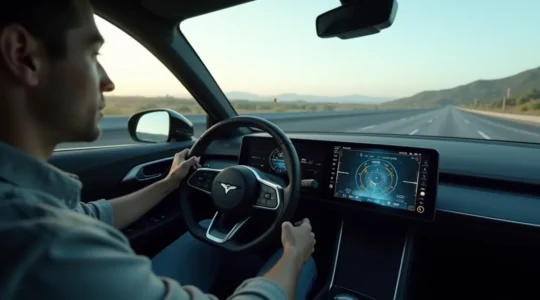
How to Use ADAS Safety Protocols Without Losing Focus on the Road?
Contrary to the belief that ADAS makes driving inherently safer, these systems introduce subtle psychological traps like ‘vigilance decrement’ and ‘alert fatigue’. This guide moves beyond generic advice, focusing instead on the cognitive skills required to manage these systems. The…
Read more
How to Master One-Pedal Driving with Regenerative Braking Systems?
In summary: Regenerative braking isn’t just “slowing down”; it’s actively converting your car’s momentum back into stored electricity. Match your regen settings to your environment: use higher levels for stop-and-go city traffic and lower levels for smooth highway cruising. Mastering…
Read more
How to Achieve 20% Fuel Savings: A Hypermiler’s Guide to Driving Discipline
In summary: Treat fuel efficiency as a technical discipline, not a list of tips, by mastering vehicle energy management. Optimize your vehicle as a system by correcting tire pressure and eliminating unnecessary weight. Use data-driven techniques, like the 10-second idling…
Read more
How Your Car’s Aerodynamic Profile Directly Impacts Your Wallet
Aerodynamic drag is not just for race cars; it’s a measurable tax on every mile you drive, responsible for a significant portion of your fuel consumption at highway speeds. Your vehicle’s shape—its drag coefficient (Cd) combined with its frontal area—is…
Read more
How to Overcome Range Anxiety When Switching to a Zero-Emission Vehicle?
The secret to overcoming range anxiety isn’t a bigger battery or more charging stations; it’s building personal charging resilience by mastering your vehicle and your planning. Modern EVs are more robust against fast-charging damage than most people believe, thanks to…
Read more
Why Are Modern Cars Becoming Impossible to Repair at Home?
The difficulty of repairing modern cars isn’t just about added complexity; it’s the result of deliberate engineering that transforms vehicles into sealed, unserviceable ecosystems. Software locks and digital “tattletale” flags now prevent even basic component resets without dealership tools. Design…
Read more
The End of Car Ownership: How MaaS Is Becoming the New Urban Operating System
The debate over selling your car isn’t about saving a few dollars; it’s about opting out of an inefficient, depreciating system. Your privately owned car is a massively underutilized asset, costing you far more in hidden fees and lost time…
Read more